
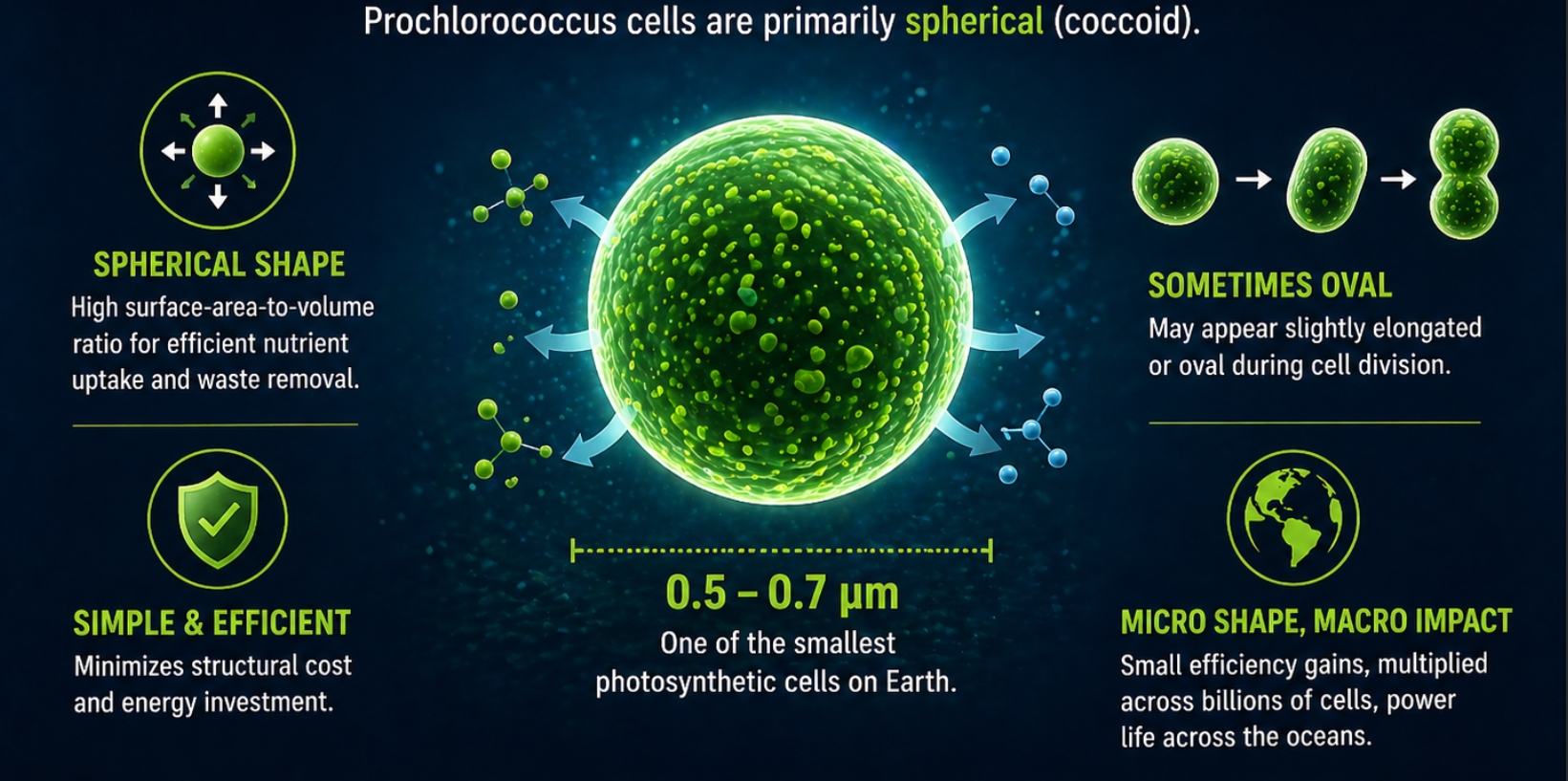
Prochlorococcus cells are primarily coccoid (spherical) in shape. During certain stages of cell division, some cells may appear slightly elongated or oval, but overall the organism maintains a compact and highly symmetrical form. This morphology is closely linked to how Prochlorococcus survives in the open ocean.
At only ~0.5-0.7 µm in diameter, the cell is extremely small, and its spherical structure helps maximize the surface-area-to-volume ratio. In practical terms, this means a relatively large amount of the cell’s surface is exposed to surrounding seawater compared to its internal volume.
That matters because Prochlorococcus lives in oligotrophic waters where nutrients such as nitrogen and phosphorus exist at extremely low concentrations. Efficient exchange across the cell surface becomes essential for survival. The spherical form also reduces structural cost.
Unlike filamentous cyanobacteria such as Oscillatoria or Anabaena, Prochlorococcus does not invest energy into maintaining large multicellular structures, specialized cells, or extended surfaces. Its compact shape requires less material to build and less energy to maintain.
This simplicity aligns with its broader evolutionary strategy of minimizing internal and external complexity wherever possible.
Its morphology may also help optimize light absorption. Because the cell is so small and compact, light can penetrate efficiently through much of the interior with minimal internal shading, supporting photosynthesis even under low-light conditions deeper in the water column.
At the level of a single cell, these advantages appear subtle. But across global populations estimated at around ~10²⁷ cells, even small gains in efficiency become ecologically enormous.
The shape of Prochlorococcus demonstrates an important biological principle: at microscopic scales, form and function are tightly linked. A simple geometry, refined through evolution, can become the foundation for planetary-scale ecological success.
A simple spherical form allows Prochlorococcus to absorb scarce resources efficiently, supporting its success across vast nutrient-poor regions of the ocean.