
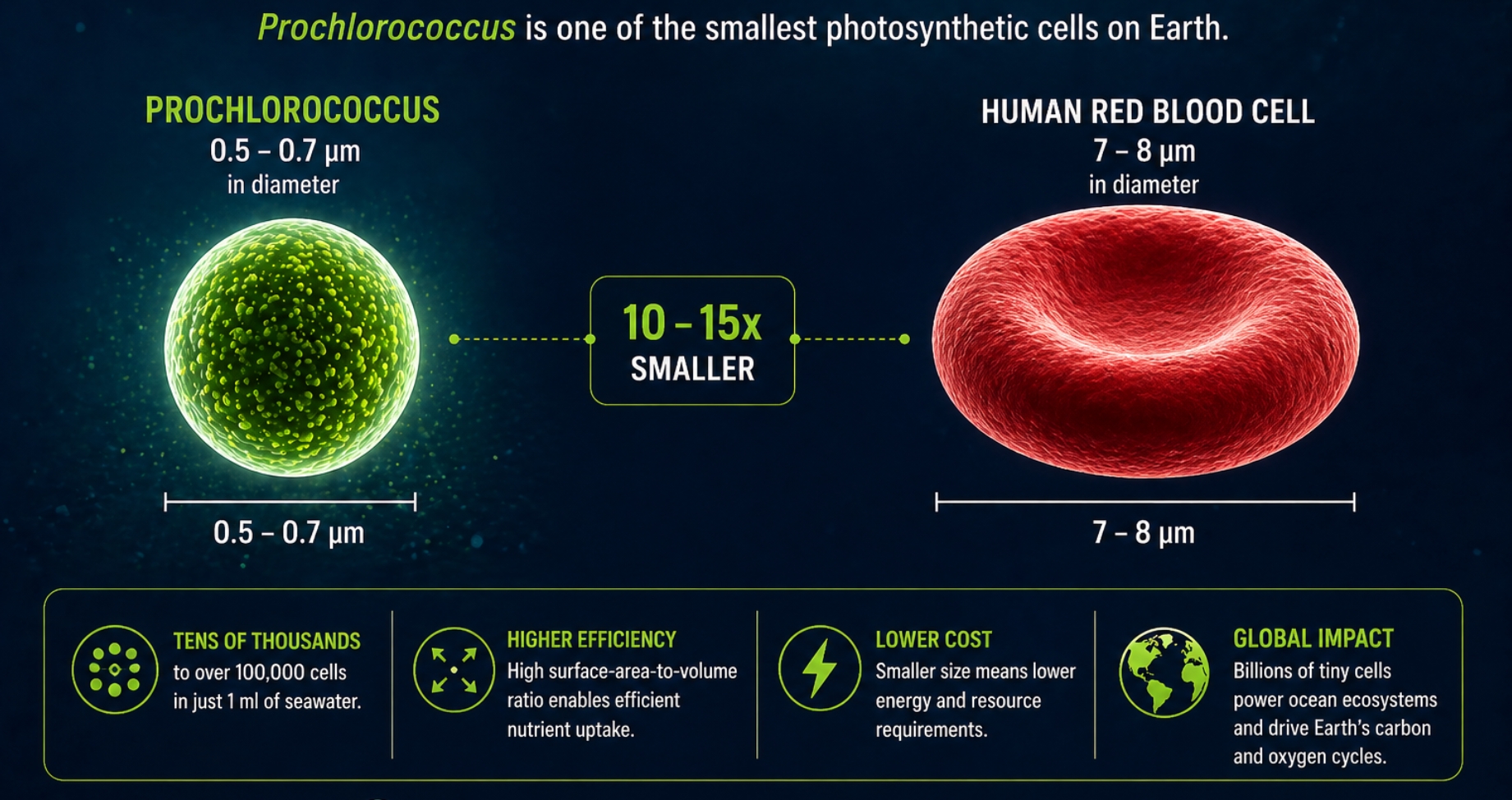
A typical Prochlorococcus cell measures only ~0.5-0.7 micrometres (µm) in diameter, making it the smallest known photosynthetic organism on Earth.
To put that into perspective:
- a human red blood cell is about ~7-8 µm wide
- many common bacteria are around ~1-5 µm
- and some cyanobacteria can exceed ~10 µm in width
This means Prochlorococcus is roughly 10-15 times smaller than a human red blood cell and also smaller than many other photosynthetic microbes.
Its size is not just a physical characteristic, it is central to how the organism functions.
Because the cell is so small, it has a very high surface-area-to-volume ratio. In practical terms, more of the cell’s surface is exposed relative to its internal volume, allowing nutrients dissolved in seawater to diffuse into the cell more efficiently.
This is especially important in oligotrophic oceans, where nutrients such as nitrogen and phosphorus exist at extremely low concentrations. Small size also lowers metabolic demand.
Prochlorococcus contains less cellular material to maintain, repair, and replicate, which reduces energy consumption and nutrient requirements. This allows it to survive and reproduce in environments where larger or more complex organisms struggle to sustain growth.
Its compact structure also minimizes internal shading. Light can penetrate the cell efficiently, improving photosynthetic performance under low-light conditions deeper in the water column.
At the population level, the consequences become enormous. Because each cell occupies so little space, vast numbers can exist within a relatively small volume of seawater. A single millilitre may contain tens of thousands to more than 100,000 Prochlorococcus cells, and globally the population is estimated at around ~10²⁷ cells.
Collectively, these microscopic cells contribute significantly to marine primary production, carbon fixation, oxygen generation and nutrient cycling across the global ocean
Prochlorococcus demonstrates that at the microbial scale, being smaller can become a major ecological advantage. Its size enables efficiency, persistence, and abundance on a planetary scale.
The microscopic size of Prochlorococcus enables efficient resource use and allows billions of cells to occupy even a small volume of seawater.