
Photosynthetic efficiency describes how effectively an organism converts light energy into chemical energy and ultimately into fixed carbon. In practice, this depends not only on the chemistry of photosynthesis itself, but also on how well an organism performs under real environmental conditions.
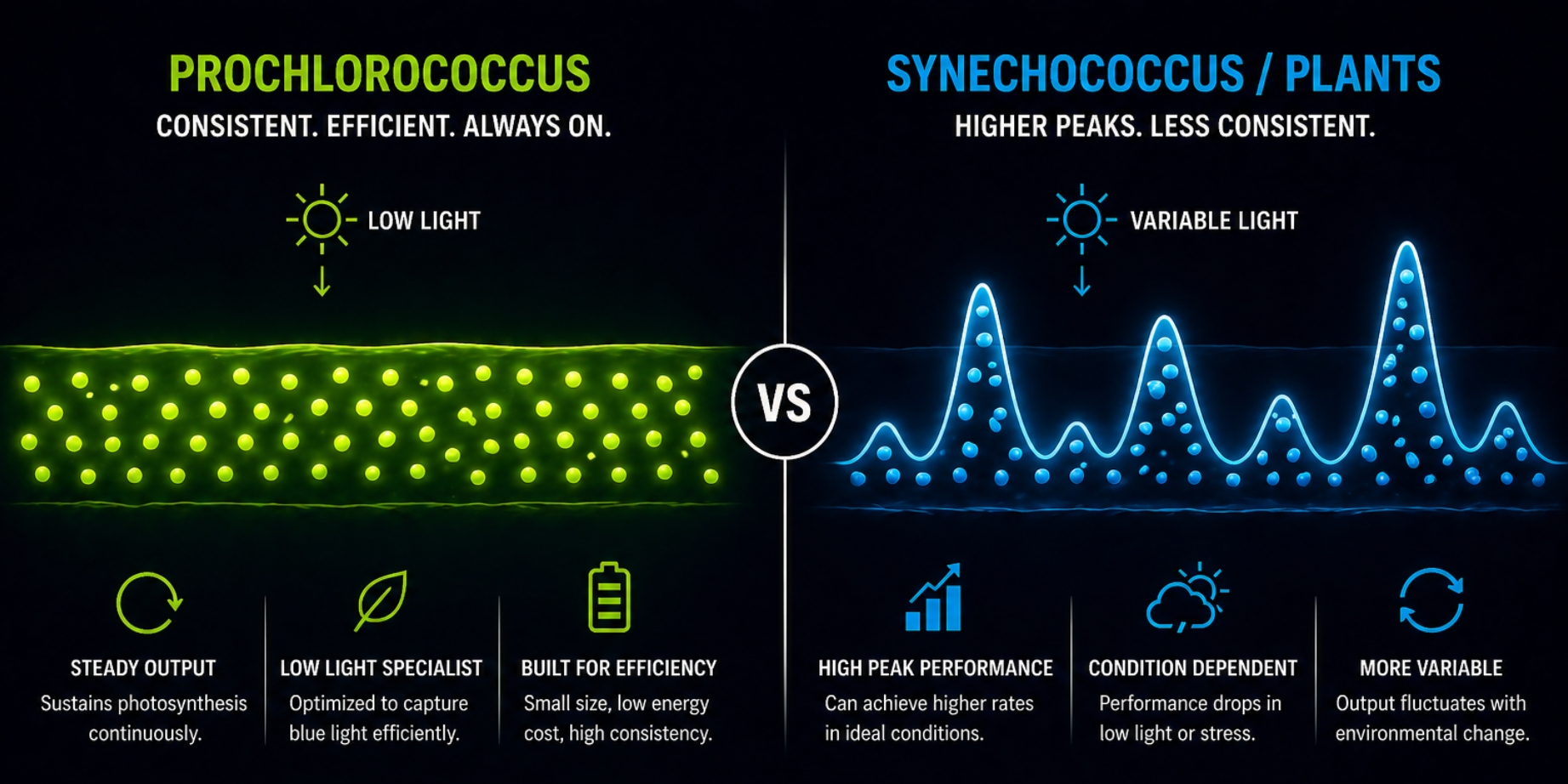
For Prochlorococcus, the defining feature is not maximum output, but sustained efficiency under limitation.
Among marine microbes, cyanobacteria can convert roughly ~5–10% of absorbed light energy into chemical energy under favourable conditions, although actual values vary depending on nutrient availability, temperature, and light intensity. Prochlorococcus operates within this general range, but its ecological advantage emerges in environments where light and nutrients are scarce. Its photosynthetic system is highly specialized for the open ocean.
Prochlorococcus uses pigments adapted for absorbing blue wavelengths, which penetrate deeper into seawater than red light. Its extremely small size also minimizes internal self-shading, allowing light to move efficiently through the cell. These features help maintain photosynthetic activity even under very low irradiance, particularly in deeper regions of the euphotic zone. Its close relative Synechococcus follows a different strategy.
Synechococcus is generally more versatile and often achieves faster growth and higher peak photosynthetic rates in nutrient-rich or fluctuating environments. Prochlorococcus, in contrast, performs more consistently under stable oligotrophic conditions where resource efficiency becomes more important than rapid expansion.
The comparison becomes even more striking when viewed against terrestrial plants.
Land plants can achieve high instantaneous photosynthetic rates under ideal conditions, but their overall ecosystem-level efficiency is often relatively low, typically around ~1-2% of incoming solar energy converted into biomass under natural conditions.
Several factors reduce this efficiency:
- internal shading within leaves and canopies
- energy costs associated with roots, stems, and structural tissues
- water limitation
- and fluctuating environmental conditions
Prochlorococcus operates under a much simpler design. It lacks large structural investments, experiences minimal internal shading, and exists as enormous populations distributed continuously across the ocean surface.
Its strategy is therefore based on persistence and scale rather than peak productivity.
This distinction matters because oligotrophic oceans cover vast regions of Earth. In these environments, Prochlorococcus helps sustain carbon fixation and oxygen production under conditions where many other photosynthetic organisms become far less effective.
Its success demonstrates that in many ecosystems, long-term efficiency comes from maintaining stable performance under persistent environmental constraint.
Prochlorococcus maintains effective photosynthetic performance under low-light and low-nutrient conditions, allowing it to sustain productivity across vast regions where other organisms are constrained.