
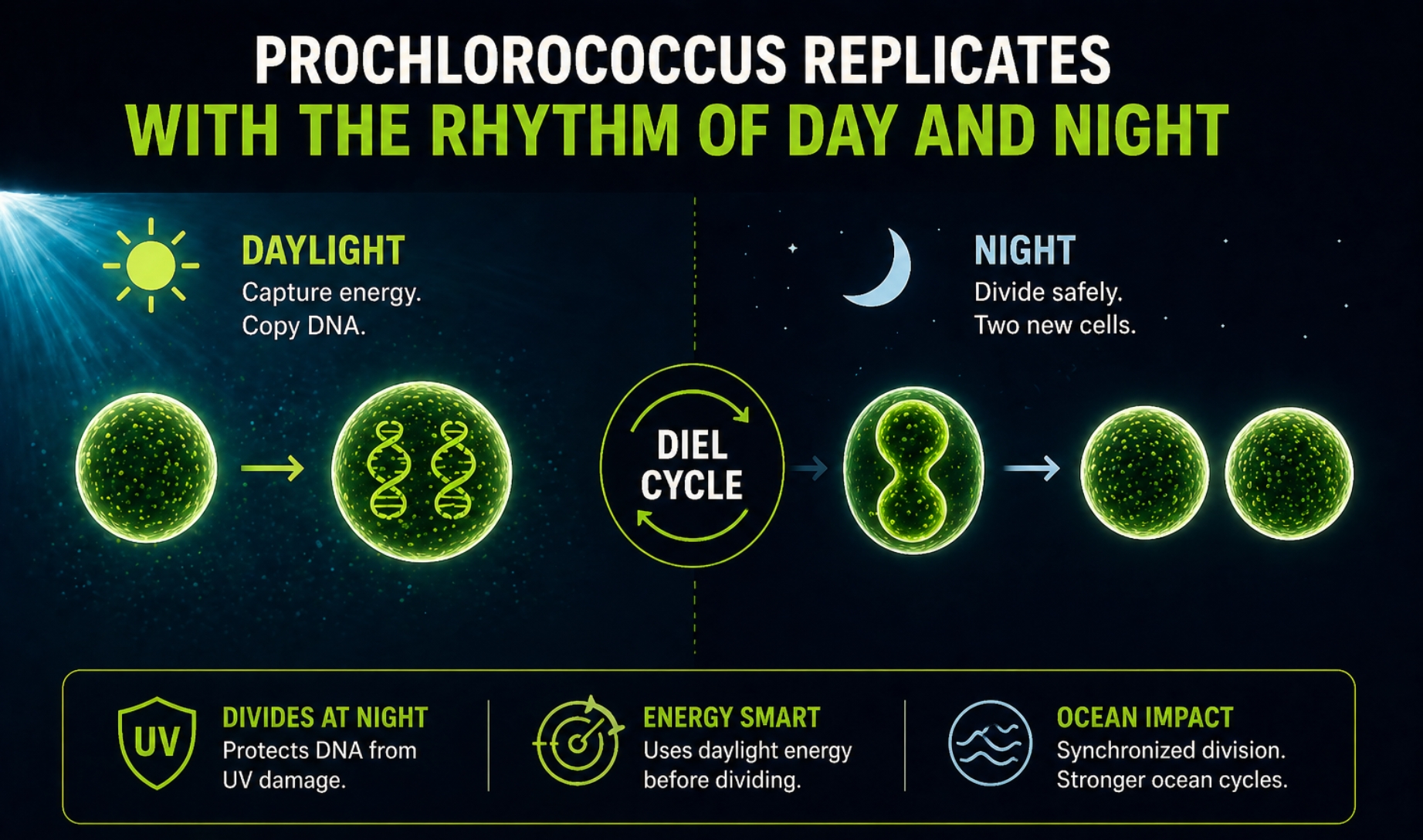
Like most bacteria, Prochlorococcus reproduces through binary fission, a process in which a single cell replicates its DNA and divides into two daughter cells.
The mechanics of division are relatively simple. What makes Prochlorococcus unusual is how precisely this process is synchronized with the daily light cycle of the ocean.
Its growth follows a strongly regulated diel rhythm, meaning cellular activities are coordinated with the transition between day and night.
During daylight hours, Prochlorococcus primarily focuses on:
- harvesting light energy through photosynthesis
- fixing carbon
- and replicating cellular components, including DNA
As sunlight declines, the cells shift toward division. In many populations, cell division occurs predominantly during the evening or nighttime hours.
This timing provides several advantages.
Photosynthesis during the day supplies the energy required for DNA replication and biomass production. Delaying cell division until later also reduces exposure of newly replicated DNA to intense ultraviolet radiation near the ocean surface, lowering the risk of damage.
Environmental conditions help regulate this cycle. Light intensity is the dominant signal, but nutrient availability, temperature, and physiological stress can also influence growth rates and division timing.
Because Prochlorococcus populations are extremely abundant and often synchronized over large ocean regions, these daily cycles become visible at ecosystem scales. Researchers have observed coordinated fluctuations in:
- cell abundance
- photosynthetic activity
- carbon uptake
- and oxygen production
over the course of a single day.
This synchronization reveals an important feature of marine microbial life. Even organisms with relatively simple cellular structures can exhibit highly coordinated behavior when environmental conditions are stable and predictable.
In Prochlorococcus, reproduction is not simply continuous cell division. It is a process tightly integrated with the physical rhythms of the ocean itself.
Prochlorococcus reproduces by binary fission, but its growth is regulated by the diel cycle, aligning DNA replication with daylight and division with night.