
In the open ocean, much of the food web begins with microscopic photosynthetic organisms suspended in the sunlit surface waters. Among the most abundant and influential of these is Prochlorococcus.
Through photosynthesis, it converts sunlight and dissolved carbon dioxide into organic carbon, providing a continuous source of energy for marine ecosystems. In nutrient-poor regions where larger phytoplankton are less dominant, Prochlorococcus becomes one of the primary biological foundations supporting ocean productivity.
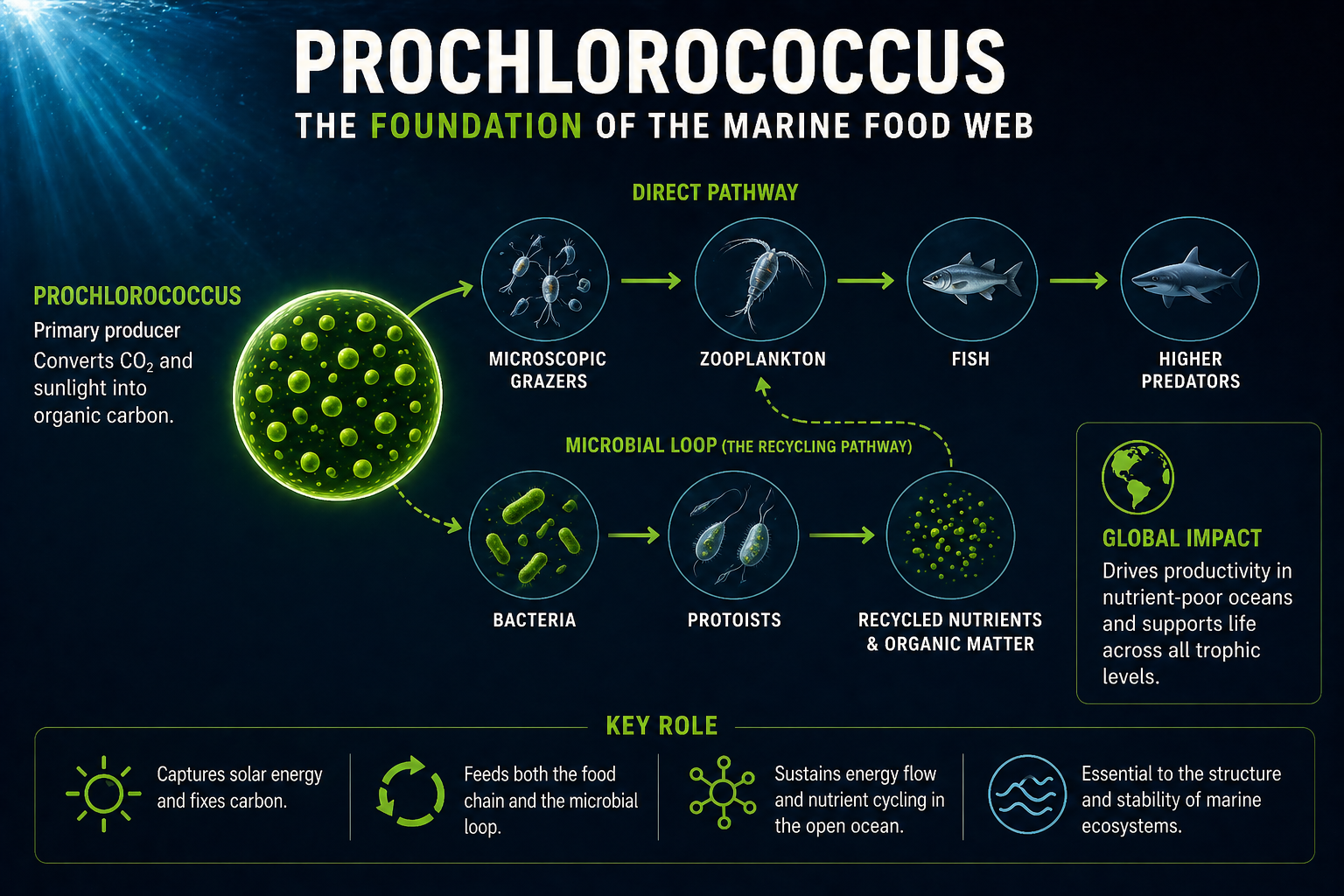
This energy first enters the food web through direct grazing.
Tiny predators such as heterotrophic nanoflagellates and small ciliates consume Prochlorococcus cells directly. These microorganisms are then eaten by larger zooplankton including copepods, which in turn support fish, squid, and larger predators such as tuna and sharks.
Energy therefore moves upward through multiple trophic levels, beginning at the scale of single microbial cells.
At the same time, a large fraction of Prochlorococcus-derived carbon follows a different pathway.
During growth and metabolism, Prochlorococcus releases dissolved organic compounds into surrounding seawater. These compounds are rapidly taken up by bacteria and small protists within the microbial loop, where nutrients and energy are recycled repeatedly through microbial interactions before eventually re-entering larger food webs.
This recycling system is especially important in oligotrophic oceans, where nutrients are scarce and efficient reuse of organic matter becomes critical for sustaining biological activity.
Viruses further influence this process. When cyanophages infect Prochlorococcus cells, cell lysis releases additional organic material back into seawater, reinforcing microbial recycling pathways.
The result is an ecosystem in which energy moves simultaneously through:
- direct grazing food chains
- microbial recycling networks
- and viral redistribution processes
Because Prochlorococcus populations are so vast, these pathways collectively influence nutrient cycling, carbon transport, and ecosystem productivity across enormous areas of the ocean.
Its role at the base of marine food webs therefore extends beyond simple energy production. Prochlorococcus helps determine how efficiently energy is transferred, retained, and recycled throughout the open ocean.
Prochlorococcus sits at the base of marine food webs, but more importantly, it determines how energy enters, moves through, and is recycled within the ocean.