
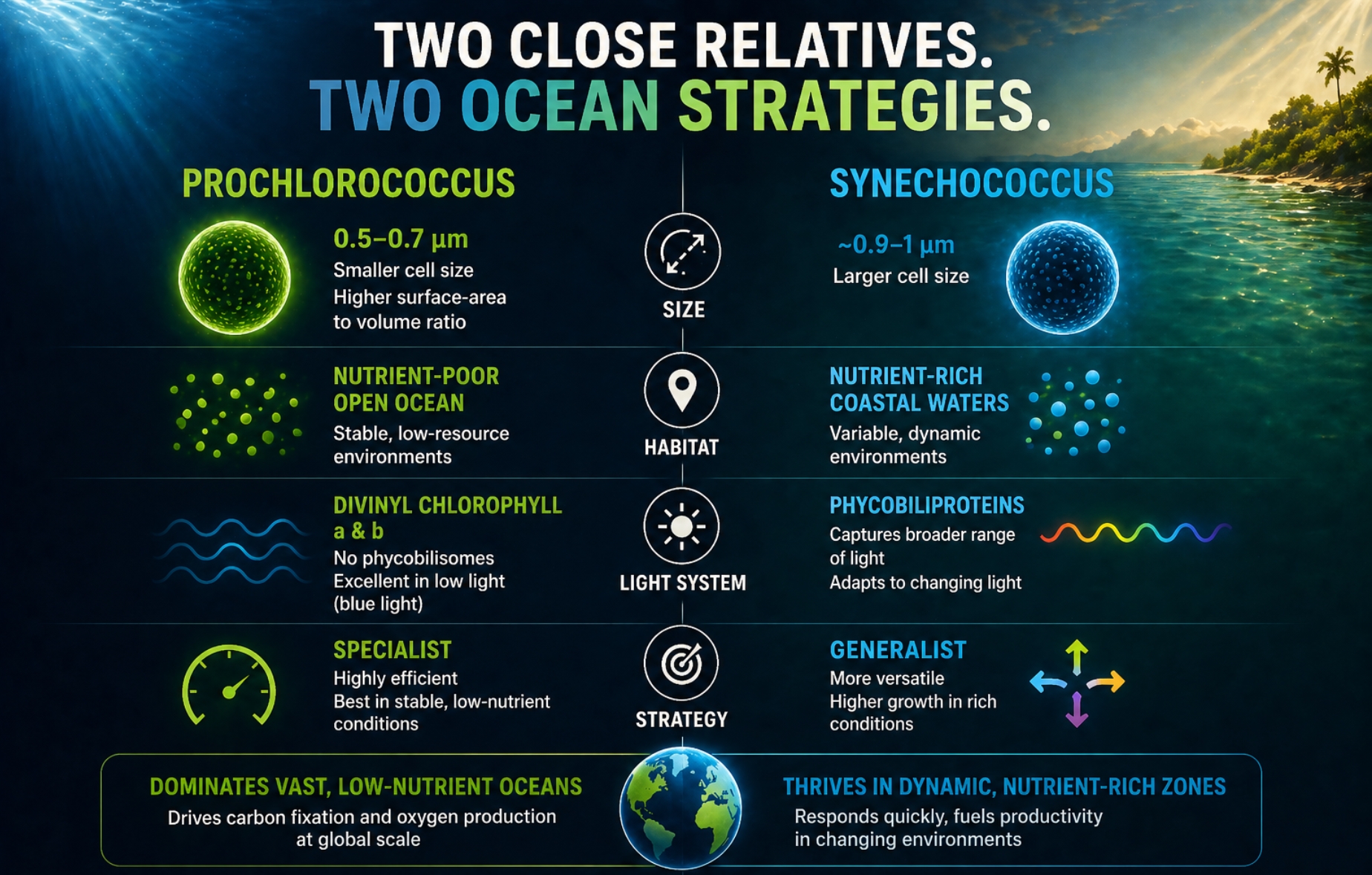
Although closely related, Prochlorococcus and Synechococcus differ in ways that reflect distinct ecological strategies in the ocean.
One of the most immediate differences is size. Prochlorococcus is extremely small, about 0.5-0.7 µm in diameter, while Synechococcus is larger, typically around ~0.9-1 µm. This size difference influences how each organism interacts with its environment, particularly in terms of nutrient uptake and light capture.
Their habitat preferences also diverge. Prochlorococcus is adapted to nutrient-poor (oligotrophic), open-ocean regions, where it maintains stable populations under low-resource conditions. In contrast, Synechococcus is more common in nutrient-rich or variable environments, including coastal waters, where conditions fluctuate more widely.
A key distinction lies in their light-harvesting systems.
Prochlorococcus uses divinyl chlorophyll a and b, modified forms of chlorophyll that are particularly effective at absorbing blue light, which penetrates deeper into the ocean. These pigments are embedded directly in the cell’s internal membranes, creating a compact and efficient light-harvesting system.
What makes this unusual is that Prochlorococcus lacks phycobilisomes, the large light-harvesting antenna complexes found in most cyanobacteria. In organisms like Synechococcus, phycobilisomes contain pigments such as phycocyanin and phycoerythrin, which allow them to absorb a broader range of wavelengths, including green and orange light.
However, phycobilisomes are structurally large and energetically expensive to build and maintain. By lacking them, Prochlorococcus reduces cellular complexity and energy demand, but at the cost of narrower light absorption flexibility.
Instead, it relies on a simpler, more efficient system optimized specifically for low-light, blue-dominated environments, particularly at depth.
These differences reflect a broader trade-off. Prochlorococcus is highly specialized, optimized for consistent performance in stable, resource-limited conditions. Synechococcus is more versatile, capable of adjusting to a wider range of environmental conditions and often achieving higher growth rates when resources are abundant.
The implications of this distinction are ecological. Together, these organisms partition the ocean environment. Prochlorococcus dominates vast, low-nutrient regions, while Synechococcus occupies more dynamic and nutrient-rich zones. This division allows both to coexist while collectively contributing to global processes such as carbon fixation and oxygen production.
Prochlorococcus and Synechococcus illustrate how closely related organisms can follow different evolutionary paths, one toward specialization and efficiency, the other toward flexibility and adaptability.
Prochlorococcus dominates stable, low-nutrient waters, while Synechococcus thrives in more variable, nutrient-rich environments, dividing the ocean between them.