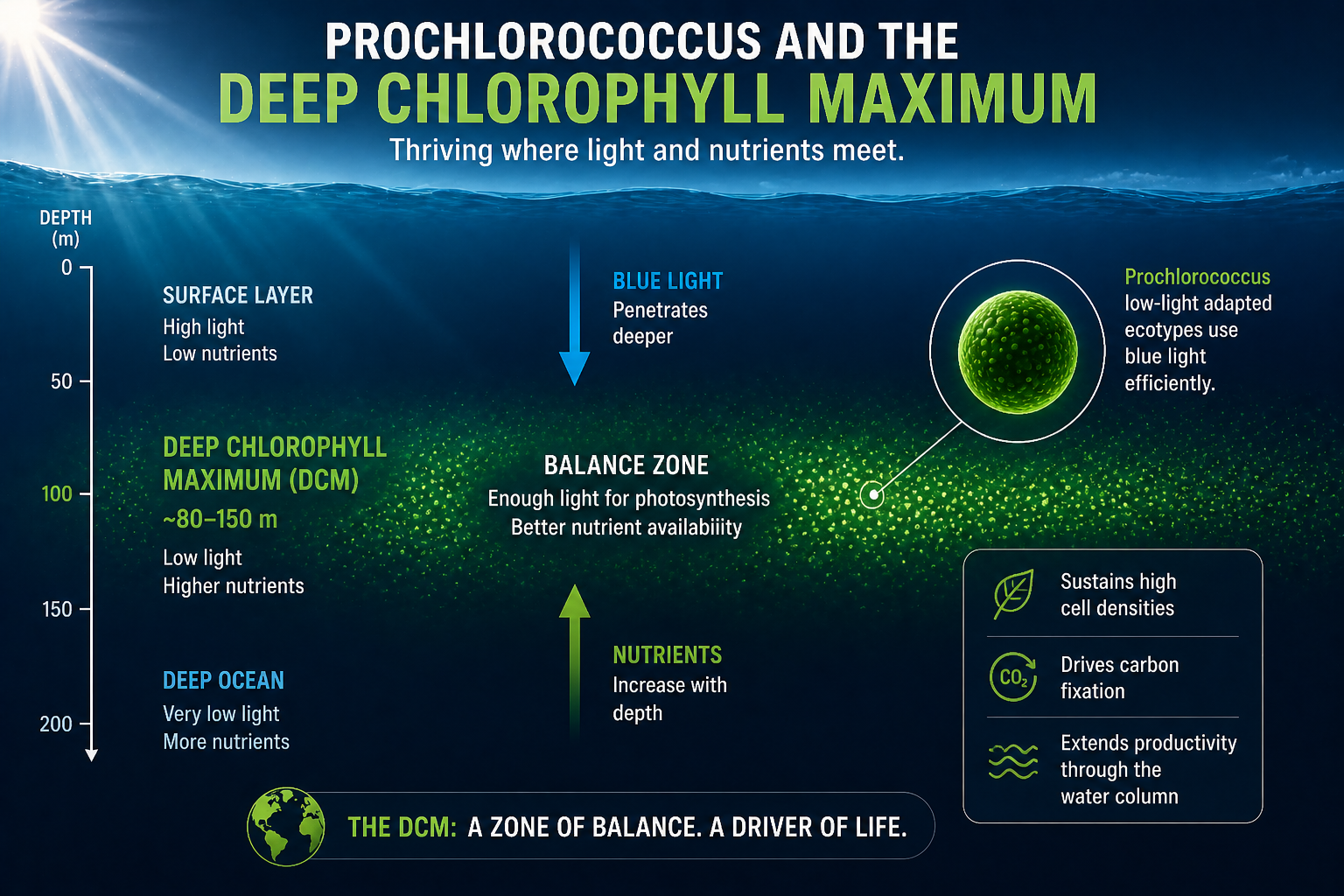
The deep chlorophyll maximum (DCM) is a layer in the ocean, typically found at depths of ~80 to 150 meters, where chlorophyll concentrations peak despite low light levels. Understanding its relationship with Prochlorococcus is important because the DCM represents a key zone of maximum biological activity in the open ocean.
Prochlorococcus is a major contributor to this layer, particularly through its low-light (LL) adapted ecotypes.
At these depths, light intensity is greatly reduced, often to ~1% of surface levels, but remains sufficient for photosynthesis. At the same time, nutrient availability is slightly higher than at the surface, where nutrients are rapidly depleted by biological uptake.
This creates a narrow but favourable balance: limited light, but improved access to nutrients.
LL ecotypes of Prochlorococcus are specifically adapted to these conditions. Their pigment systems are optimized to capture blue wavelengths, which penetrate deeper into the ocean, allowing them to maintain photosynthetic activity where most other organisms cannot.
As a result, Prochlorococcus populations often reach peak abundance within or just above the DCM, making it a central zone for carbon fixation in nutrient-poor oceans.
The DCM is therefore not just a region of high chlorophyll. It represents a balance between light limitation and nutrient availability, where biological efficiency is maximized.
By occupying this layer, Prochlorococcus extends its influence beyond surface waters, contributing to carbon cycling and energy flow across a greater vertical range of the ocean.
Prochlorococcus reaches peak performance in the deep chlorophyll maximum, where light and nutrients are both limited, but optimally balanced.