Much of Earth’s habitability depends on processes that are invisible at human scale. Prochlorococcus is one of the clearest examples of this.
Despite being microscopic, it contributes significantly to two planetary functions that sustain complex life: oxygen production and carbon cycling.
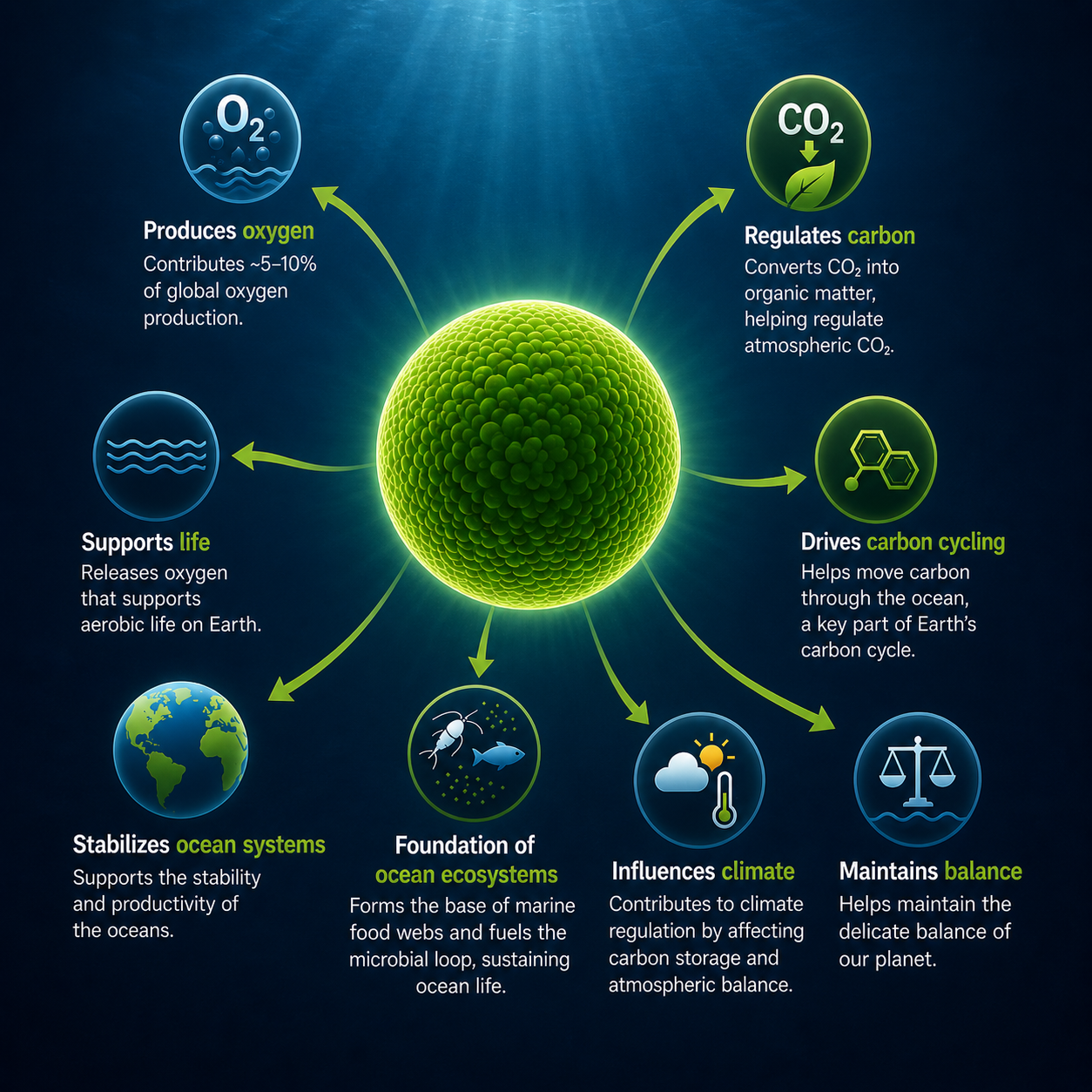
Through photosynthesis, Prochlorococcus absorbs dissolved carbon dioxide from seawater and converts it into organic matter using sunlight. Oxygen is released as a byproduct of this process, contributing an estimated ~5-10% of global oxygen production.
Its influence is magnified by scale. Prochlorococcus populations occupy vast regions of the tropical and subtropical ocean, including nutrient-poor areas once thought to be relatively unproductive. Across these regions, billions upon billions of cells continuously process carbon and release oxygen into the Earth system.
Its role extends beyond atmospheric chemistry.
Prochlorococcus forms a major component of open-ocean food webs, supplying energy to microbial grazers and supporting the flow of carbon through marine ecosystems. It also helps sustain the microbial loop, where dissolved organic compounds are recycled through bacterial communities rather than being lost from surface waters.
These interactions influence:
- ocean productivity
- nutrient recycling
- carbon transport
- and the chemical balance of seawater
Collectively, these processes contribute to the stability of marine ecosystems that help regulate climate and atmospheric composition over long timescales.
The significance of Prochlorococcus lies partly in what it reveals about planetary systems themselves. Earth’s habitability is not maintained only by forests, oceans, or large organisms visible at the surface. It also depends on distributed microbial activity operating continuously across microscopic scales.
Prochlorococcus represents one of those underlying systems: small, persistent, and deeply integrated into the biological and chemical processes that make the planet habitable.
By contributing to oxygen generation, carbon cycling, and ocean productivity, Prochlorococcus helps maintain the conditions required for life on Earth.