A major decline in Prochlorococcus populations would affect far more than a single microbial species. Because of its abundance and role in ocean productivity, the consequences would extend across interconnected biological and chemical systems within the ocean.
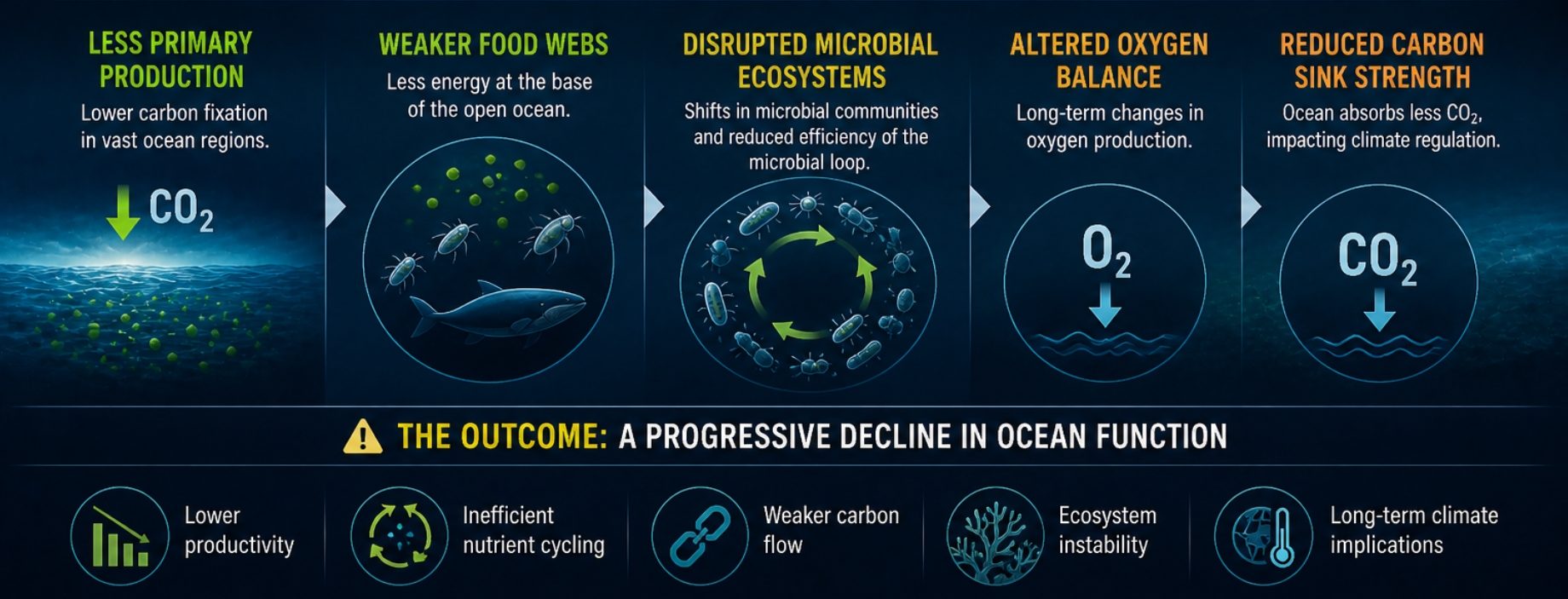
One of the first effects would be a reduction in marine primary production across large oligotrophic regions. Prochlorococcus contributes significantly to carbon fixation in these nutrient-poor waters, converting dissolved CO₂ into organic matter that supports marine food webs.
A sustained decline would therefore reduce the amount of energy entering open-ocean ecosystems.
This impact would likely propagate upward through the food web. Microbial grazers, bacteria, and larger planktonic communities that depend directly or indirectly on Prochlorococcus-derived organic matter would experience shifts in abundance and composition. The structure of microbial communities across vast ocean regions could change as different organisms compete to occupy the altered ecological space.
The efficiency of the microbial loop would also be affected. Prochlorococcus continuously releases dissolved organic compounds that fuel microbial recycling processes. Reduced inputs into this system could alter nutrient regeneration and slow the movement of carbon and energy through surface ocean ecosystems.
The consequences extend into global biogeochemistry.
A decrease in carbon fixation would weaken the ocean’s role as a carbon sink, potentially affecting long-term climate regulation. Oxygen production would also decline, although atmospheric oxygen levels would remain relatively stable in the short term because of the enormous amount already present in the atmosphere.
The larger concern is not immediate atmospheric collapse, but gradual destabilization of ocean function over long timescales.
Changes in productivity, nutrient cycling, microbial interactions, and carbon processing would collectively influence how efficiently the ocean regulates planetary chemical balance.
The significance of Prochlorococcus therefore comes less from the biology of any individual cell and more from the cumulative effect of trillions upon trillions of cells operating continuously across the global ocean.
Prochlorococcus operates quietly at scale. Its loss would be equally systemic, affecting the processes that sustain ocean life and influence the global environment.