
Prochlorococcus performs best in environments that change slowly.
Its physiology is highly optimized for the stable, nutrient-poor conditions that dominate much of the open ocean. Because of this specialization, sudden environmental disturbances often place it at a competitive disadvantage.
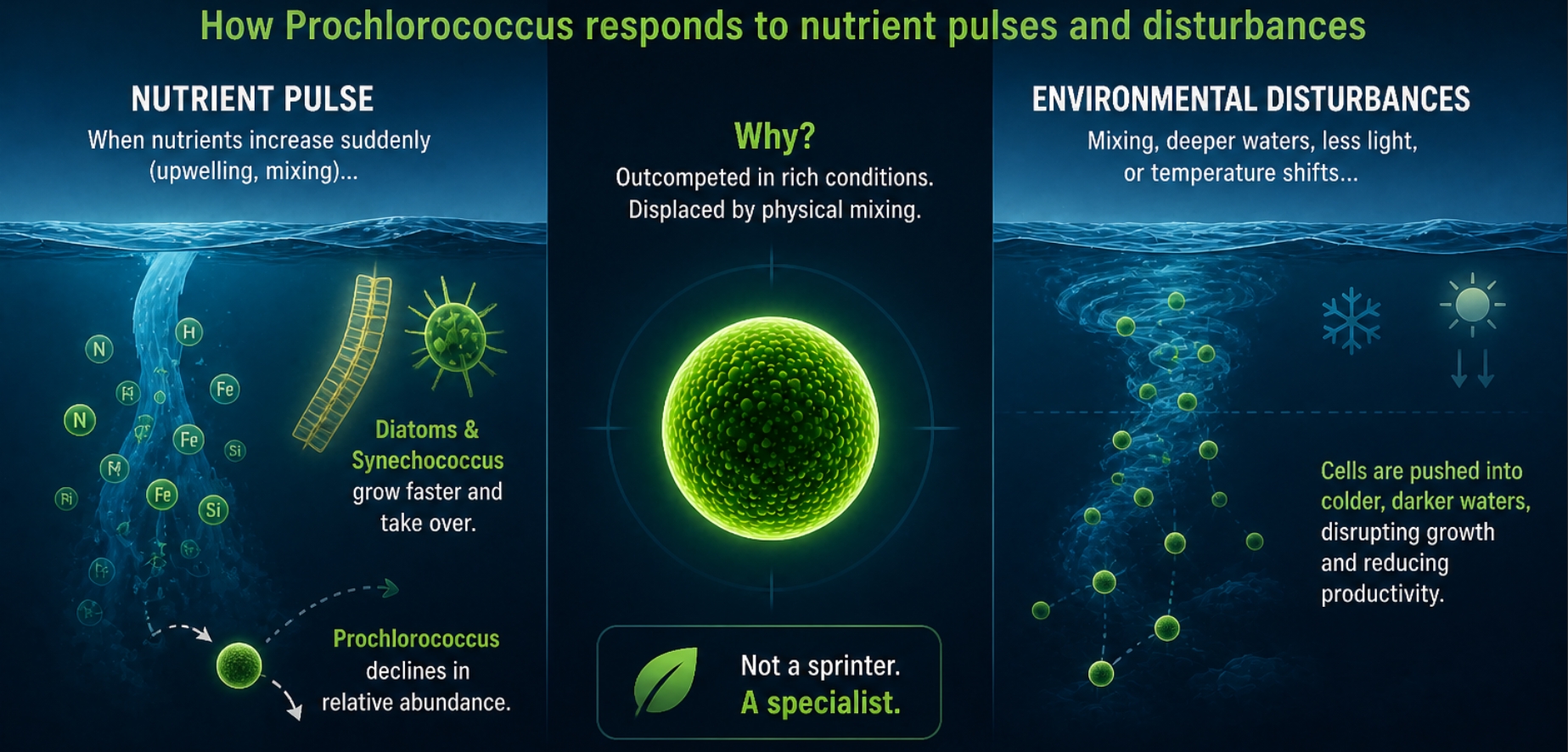
One of the clearest examples occurs during nutrient pulses caused by upwelling or vertical mixing. In these events, deeper nutrient-rich waters rise toward the surface, temporarily increasing the availability of nitrogen and phosphorus.
Under such conditions, faster-growing phytoplankton such as diatoms and Synechococcus typically respond more rapidly. These organisms are adapted to exploit short-term nutrient abundance, allowing them to increase in biomass quickly and outcompete Prochlorococcus.
As a result, Prochlorococcus populations often decline in relative abundance during bloom events, even if the cells themselves are not immediately dying. The surrounding community simply grows faster under enriched conditions.
Physical disturbances can also disrupt its growth directly.
Processes such as strong vertical mixing may transport Prochlorococcus cells into deeper, colder, or lower-light waters where photosynthesis becomes less efficient. Because its growth and cell division are tightly synchronized with stable light conditions, these disturbances can reduce productivity and alter population structure.
These responses reflect the ecological strategy of Prochlorococcus as a whole. It is adapted for long-term efficiency under persistent scarcity, not for rapid expansion during temporary resource surges.
This distinction helps explain the broader structure of ocean ecosystems. Nutrient-rich regions tend to favour larger, fast-growing phytoplankton blooms, while nutrient-poor oligotrophic waters favour smaller and more resource-efficient organisms such as Prochlorococcus.
As ocean conditions shift through warming, stratification, and changing circulation patterns, the balance between these strategies may also change, influencing patterns of productivity and carbon cycling across large regions of the ocean.
Nutrient enrichment and disturbance shift advantage to other phytoplankton, reducing the relative dominance of Prochlorococcus.