A substantial portion of Earth’s oxygen is produced not on land, but in the ocean by microscopic photosynthetic organisms.
Among them, Prochlorococcus is one of the most important.
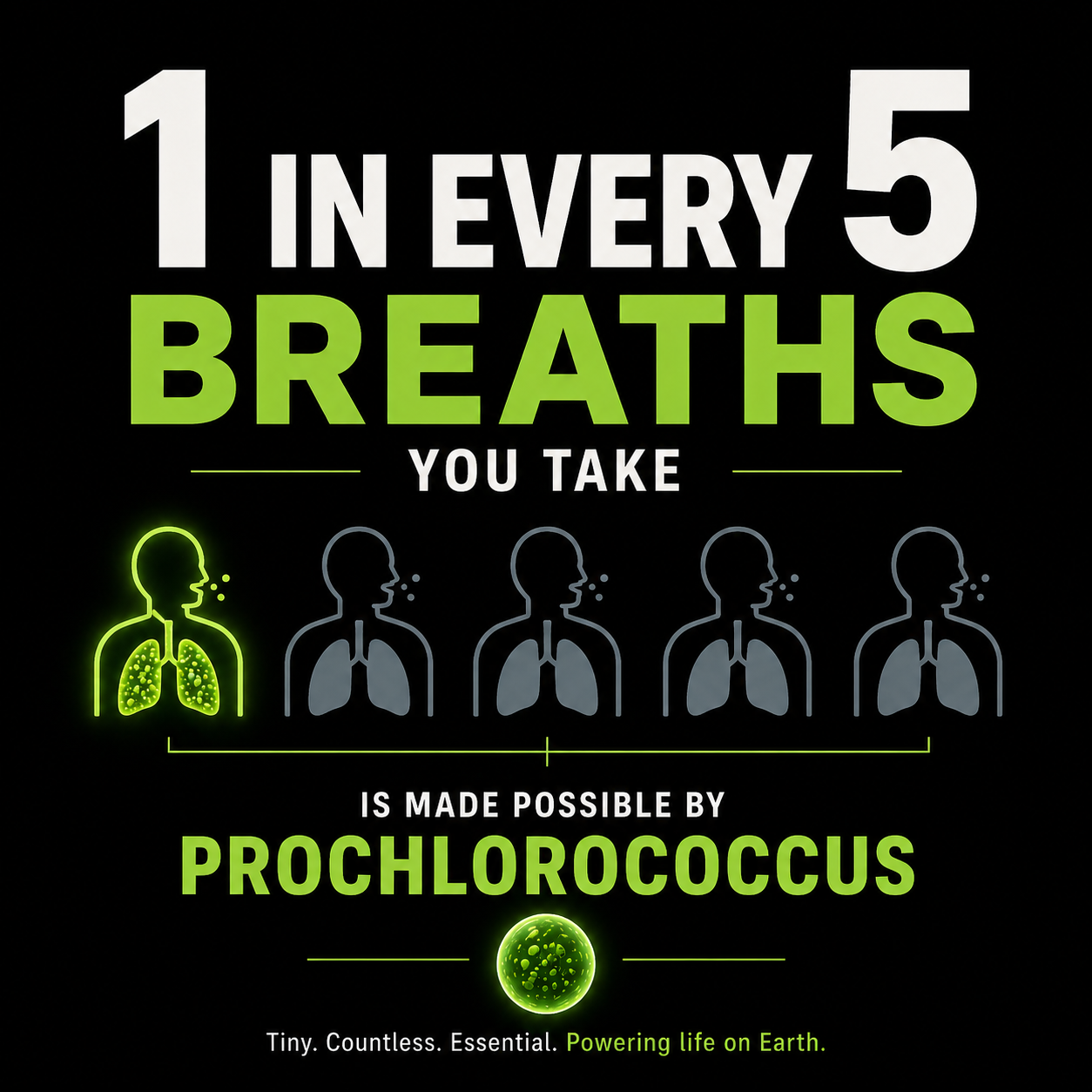
Current estimates suggest that Prochlorococcus contributes roughly ~5-10% of global oxygen production, while marine phytoplankton as a whole account for approximately 50-80% of the oxygen generated on Earth.
Earlier estimates sometimes suggested values closer to ~20%, but these are generally considered upper-range approximations tied to regional productivity assumptions. Most current assessments place its global contribution somewhat lower, though still extraordinarily large for a single microbial group. Its importance comes from scale rather than the productivity of individual cells.
Each Prochlorococcus cell is microscopic and produces only a tiny amount of oxygen through photosynthesis. But with a global population estimated around ~10²⁷ cells, their combined activity becomes immense.
Distributed across tropical and subtropical oceans, Prochlorococcus continuously converts carbon dioxide and water into organic matter and oxygen using sunlight. Unlike forests or seasonal algal blooms, this activity occurs diffusely and persistently across enormous regions of the open ocean.
The process is especially significant in oligotrophic waters, where few larger photosynthetic organisms can maintain high productivity.
Much of the oxygen generated in marine environments is rapidly consumed again through respiration by microbes, animals, and other biological processes. What ultimately matters for atmospheric balance is the fraction that escapes immediate consumption and contributes to the long-term oxygen reservoir of the atmosphere.
Even within this dynamic cycle, Prochlorococcus remains one of the major biological contributors to Earth’s oxygen system.
Its influence extends beyond oxygen itself. By fixing large amounts of carbon in surface waters, Prochlorococcus also helps regulate marine carbon cycling and supports the ocean’s broader role in moderating atmospheric CO₂.
Its ecological power comes from persistence and abundance. Tiny individual cells, operating continuously across vast ocean regions, collectively help sustain some of the most fundamental chemical conditions required for life on Earth.
A significant fraction of the oxygen on Earth begins with Prochlorococcus.