
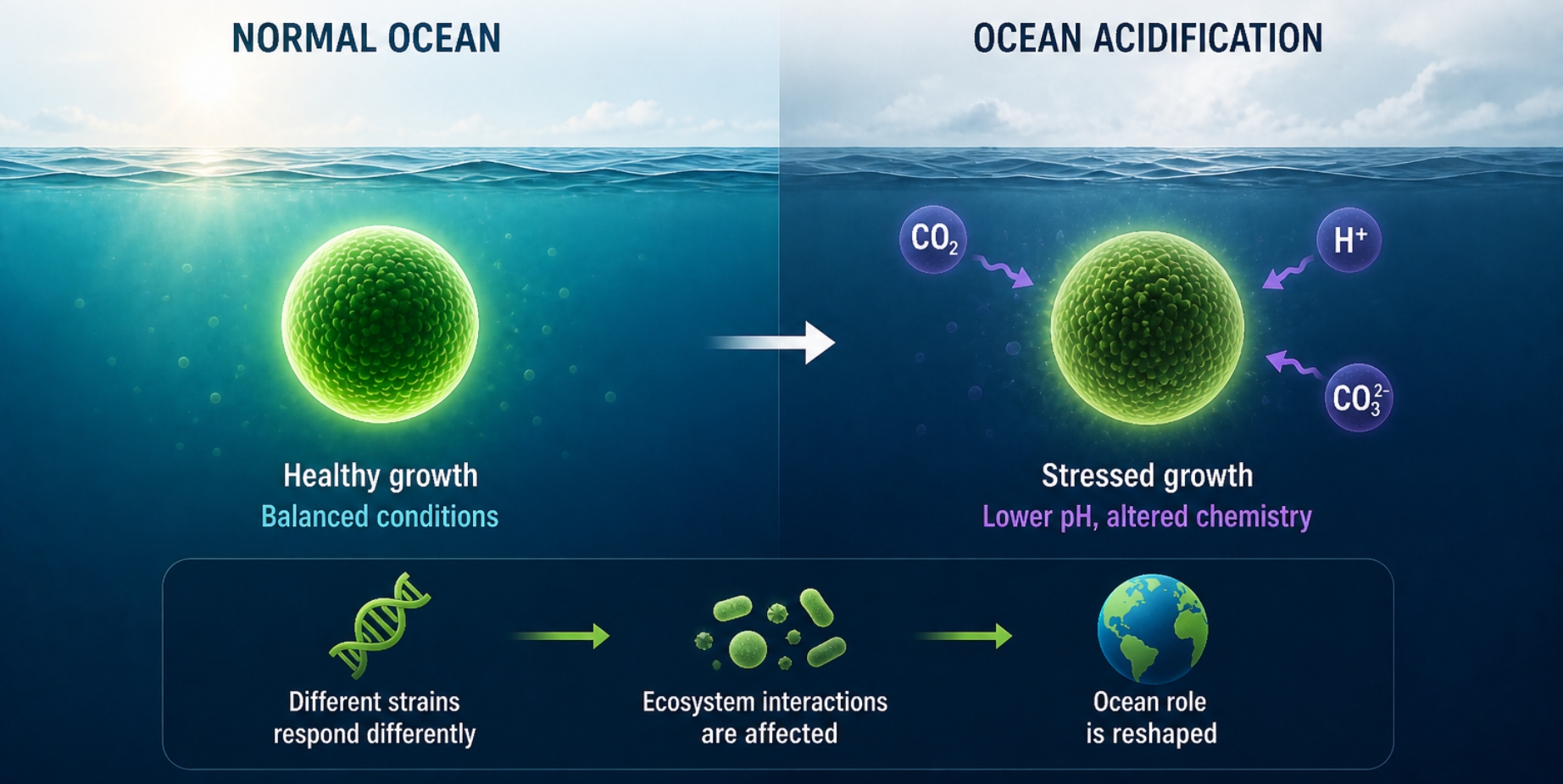
Ocean acidification does not produce a single, predictable response in Prochlorococcus. Instead, it changes the chemical environment in which the organism functions.
As the ocean absorbs more atmospheric CO₂, seawater chemistry shifts. Higher CO₂ levels can increase the availability of inorganic carbon, which may support photosynthetic activity. At the same time, the accompanying drop in pH alters carbonate chemistry, affecting enzyme activity, nutrient uptake, and overall cellular balance.
The response is therefore not uniform.
Experimental studies show that different Prochlorococcus strains react differently under elevated CO₂ conditions. Some maintain stable growth or even show slight improvement, while others experience reduced growth, particularly when acidification occurs alongside additional stressors such as nutrient limitation or rising temperatures.
This variability reflects an important feature of Prochlorococcus biology. It is not a single homogeneous population, but a collection of ecotypes with distinct physiological tolerances and environmental adaptations.
The effects also extend beyond the cell itself. Changes in seawater chemistry influence surrounding microbial communities, including helper bacteria and competing phytoplankton, indirectly affecting how efficiently Prochlorococcus can survive and function.
Taken together, ocean acidification does not simply increase or decrease Prochlorococcus populations. It reshapes the balance between strains, alters microbial interactions, and changes how energy and carbon move through marine ecosystems.
The significance of ocean acidification therefore lies less in whether Prochlorococcus simply increases or declines, and more in how microbial ecosystems are reorganized under changing ocean conditions. Even subtle shifts in these interactions can influence how carbon and energy move through large regions of the ocean.
Ocean acidification affects Prochlorococcus unevenly, shifting strain performance, growth rates, and ecological interactions rather than producing a uniform response.