
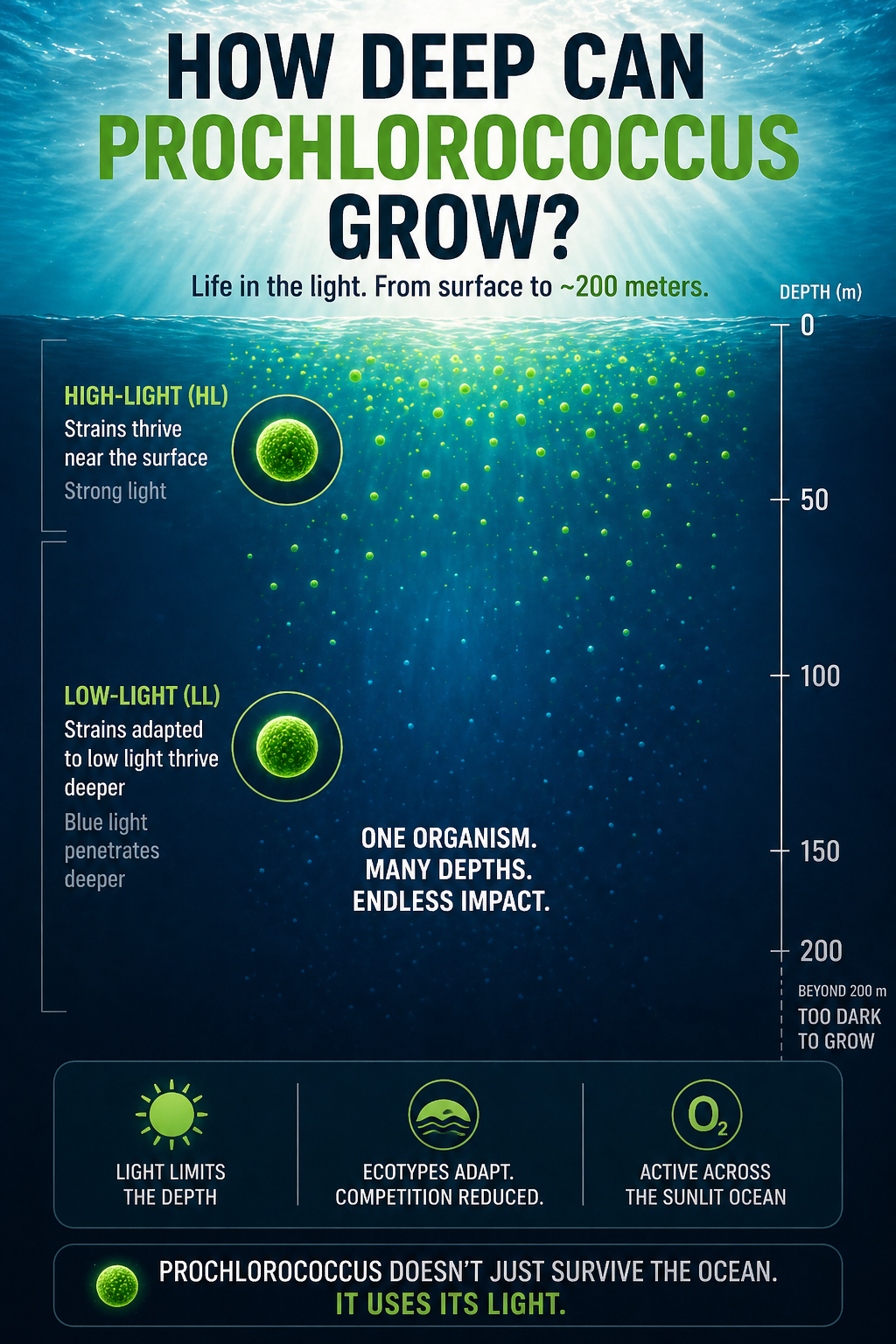
Prochlorococcus occupies much of the ocean’s sunlit upper layer, typically extending from near the surface down to depths of roughly ~150–200 meters in clear open-ocean waters.
Its lower depth limit is determined primarily by light availability.
As sunlight passes through seawater, it decreases rapidly with depth. Red and longer wavelengths are absorbed first, while blue light penetrates the deepest. Eventually, light intensity falls below the minimum level required for photosynthesis, making further growth impossible.
This depth boundary is not fixed. In exceptionally clear oligotrophic waters, light penetrates farther, allowing Prochlorococcus to survive deeper in the water column. In more turbid coastal waters, suspended particles and organic matter absorb and scatter light more strongly, compressing the habitable zone closer to the surface.
The deepest populations are often associated with the deep chlorophyll maximum (DCM), a layer where low but usable light overlaps with slightly improved nutrient availability. This creates conditions where photosynthesis can still be maintained despite reduced irradiance.
Nutrients also influence vertical distribution indirectly. Near the surface, light is abundant but nutrients are often depleted. Deeper waters contain more nutrients, but progressively less light. Prochlorococcus persists within the narrow range where enough of both remain available simultaneously.
Its ability to remain active across such a large vertical range allows it to contribute to carbon fixation and oxygen production throughout much of the upper ocean rather than only at the surface.
The limits of its distribution therefore reflect a balance between physics and biology: how far sunlight penetrates into seawater, and how efficiently a microscopic cell can continue harvesting that energy under increasingly constrained conditions.
Prochlorococcus is limited by light, but its distribution across depth is structured by specialized ecotypes rather than a single optimal zone.