
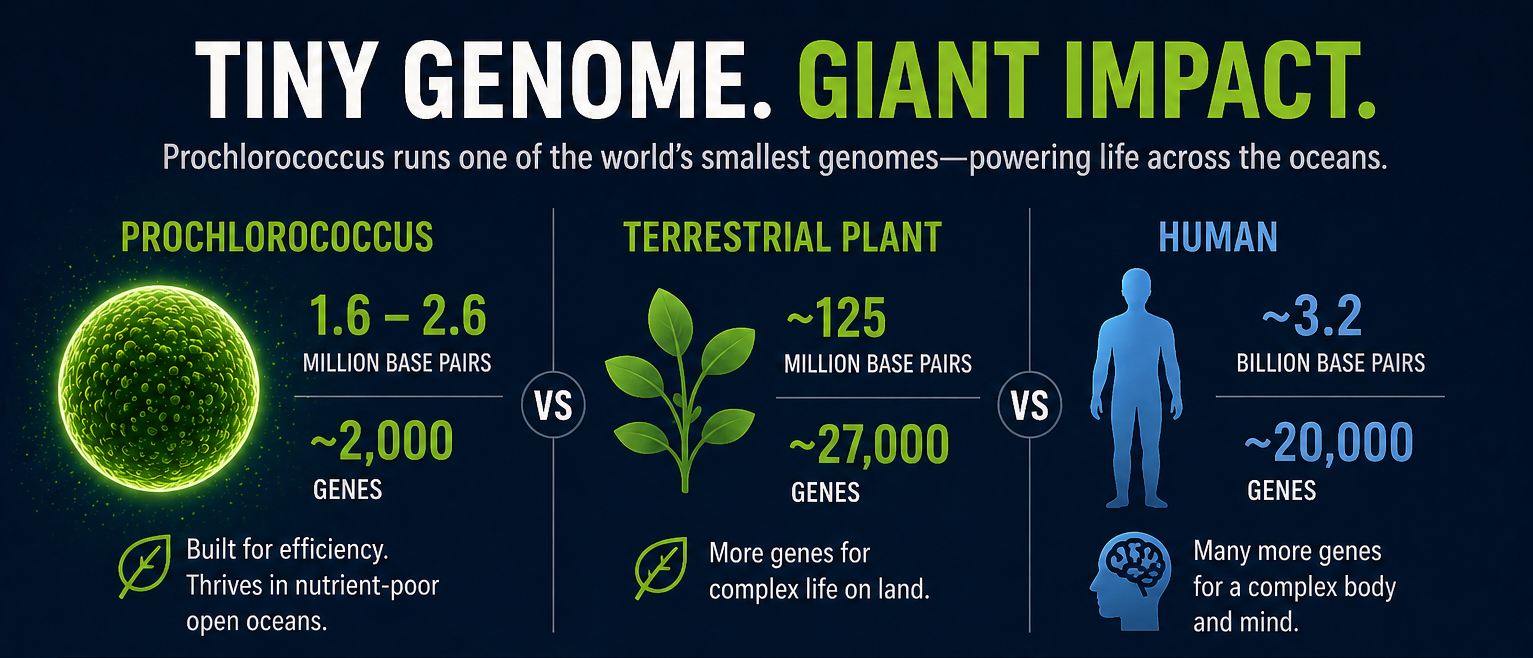
The genome of Prochlorococcus is remarkably small for a free-living photosynthetic organism, and that compactness reveals a great deal about how it survives in the open ocean.
Most Prochlorococcus strains possess genomes ranging from approximately ~1.6 to 2.6 million base pairs (Mbp), containing around ~2,000 genes.
To appreciate how reduced this is:
- the human genome contains about ~3.2 billion base pairs and roughly ~20,000 genes
- many free-living bacteria possess ~3,000-6,000 genes
- some cyanobacteria have genomes exceeding ~5-9 Mbp
Prochlorococcus operates with a far smaller genetic toolkit than many organisms that occupy more variable environments. This reduction reflects a process known as genome streamlining.
Over evolutionary time, genes that were not essential for survival in stable oligotrophic oceans were gradually lost. The result is a genome focused heavily on photosynthesis nutrient uptake, basic cellular maintenance and efficient replication while many costly regulatory, stress-response, and metabolic pathways have been minimized or eliminated.
High-light strains, which inhabit warm surface waters with relatively stable conditions, usually possess the smallest genomes, often around ~1.6-1.8 Mbp. These strains are highly specialized for efficiency under persistent nutrient limitation.
Low-light strains, found deeper in the water column where conditions become dimmer and more variable, tend to carry somewhat larger genomes, approximately ~1.8-2.6 Mbp. The additional genes provide greater metabolic flexibility and allow adaptation to more complex environmental constraints.
This reveals an important biological principle that genome size often reflects environmental demands.
In predictable environments, evolution can favor extreme reduction and specialization. In more variable environments, additional genes become useful because they expand the range of conditions an organism can tolerate. The compactness of the Prochlorococcus genome also explains some of its ecological dependencies.
Because many functions have been reduced or lost, Prochlorococcus often relies on surrounding microbial communities for processes such as detoxification and nutrient recycling. In effect, some biological functions have been outsourced to the ecosystem itself.
Its genome therefore reflects an evolutionary trade-off in which independence is reduced in exchange for extraordinary efficiency.
That efficiency is what allows Prochlorococcus to maintain enormous populations across vast ocean regions and continuously contribute to global carbon cycling and oxygen production.
Prochlorococcus operates with one of the smallest genomes in photosynthetic life, yet this reduction allows it to dominate vast regions of the ocean, showing that precision, not complexity, can scale to a planetary level.