
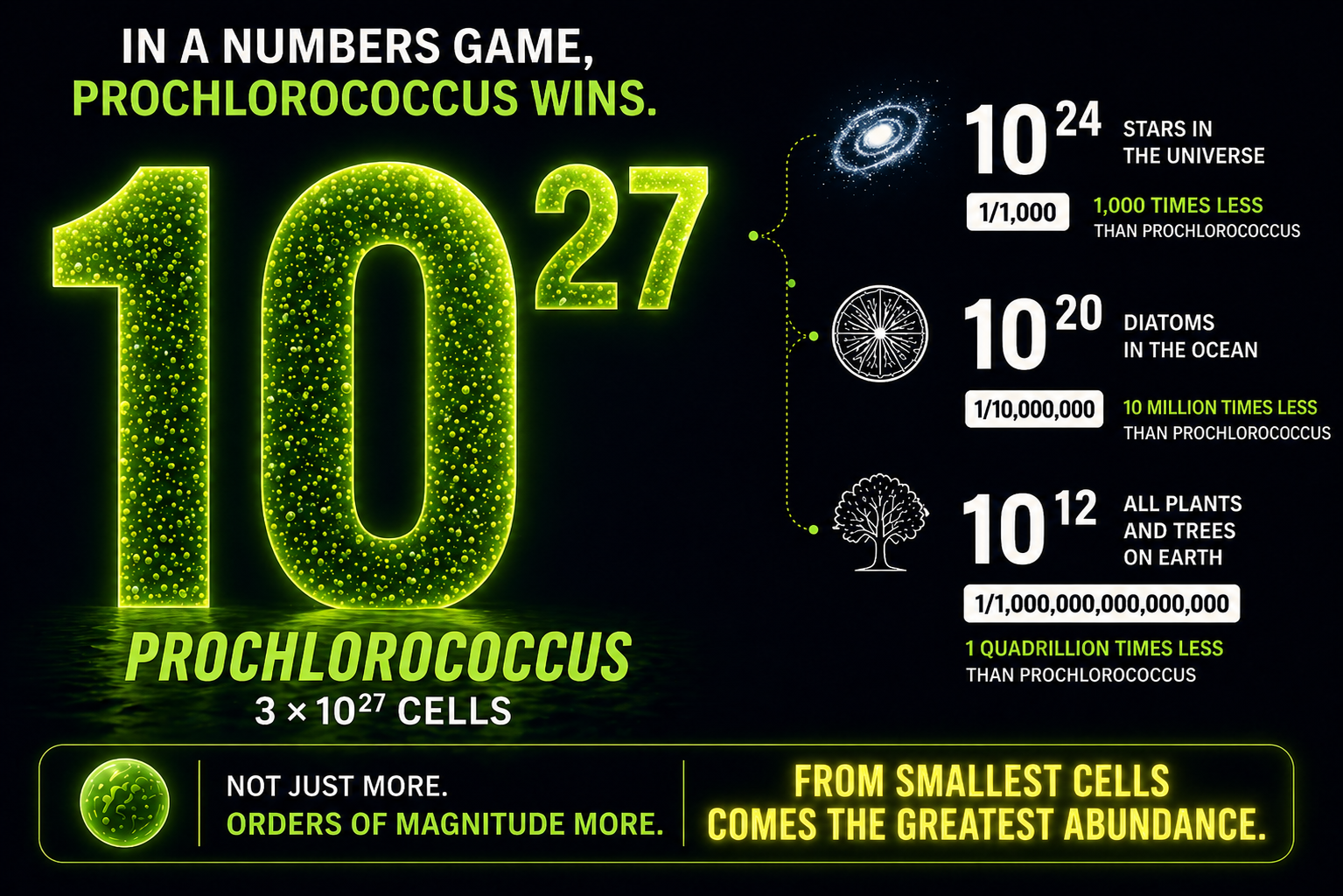
Prochlorococcus is considered the most abundant photosynthetic organism on Earth.
Global estimates place its population at roughly ~3 × 10²⁷ cells, an almost incomprehensible number equivalent to 3 octillion individual cells distributed throughout the world’s oceans.
Even at local scales, its abundance is remarkable. A single millilitre of seawater can contain tens of thousands to more than 100,000 Prochlorococcus cells, especially in warm open-ocean regions.
Its distribution is concentrated mainly within the tropical and subtropical oceans, generally between about 40°N and 40°S latitude. These regions provide the stable sunlight, warm temperatures, and stratified water conditions under which Prochlorococcus performs best.
It inhabits much of the ocean’s euphotic zone, extending from near the surface down to depths of roughly ~100-200 meters, depending on water clarity and local environmental conditions.
Prochlorococcus thrives primarily in oligotrophic waters, ocean regions extremely poor in nutrients such as nitrogen and phosphorus. These areas were once considered relatively unproductive because they lack the dense blooms commonly associated with coastal ecosystems.
Instead of forming dramatic visible blooms, Prochlorococcus maintains stable background populations across enormous areas of the open ocean.
Its success comes from efficiency tiny cell size, low nutrient demand, streamlined cellular organization and highly optimized photosynthesis under resource limitation
Different ecotypes are adapted to different parts of the water column, allowing populations to occupy a broad vertical range without all competing under identical conditions.
Collectively, Prochlorococcus contributes substantially to:
- marine primary production
- carbon fixation
- oxygen generation
- nutrient cycling across the global ocean
Because its populations are so widespread, even relatively small environmental changes can have large cumulative effects. Warming oceans, altered stratification, or shifts in nutrient supply may redistribute Prochlorococcus populations and influence the broader marine systems that depend on them.
Its ecological influence comes from persistent activity sustained across an immense and continuously operating global population.
With trillions upon trillions of cells across the oceans, Prochlorococcus operates at a scale where microscopic activity translates into planetary impact.