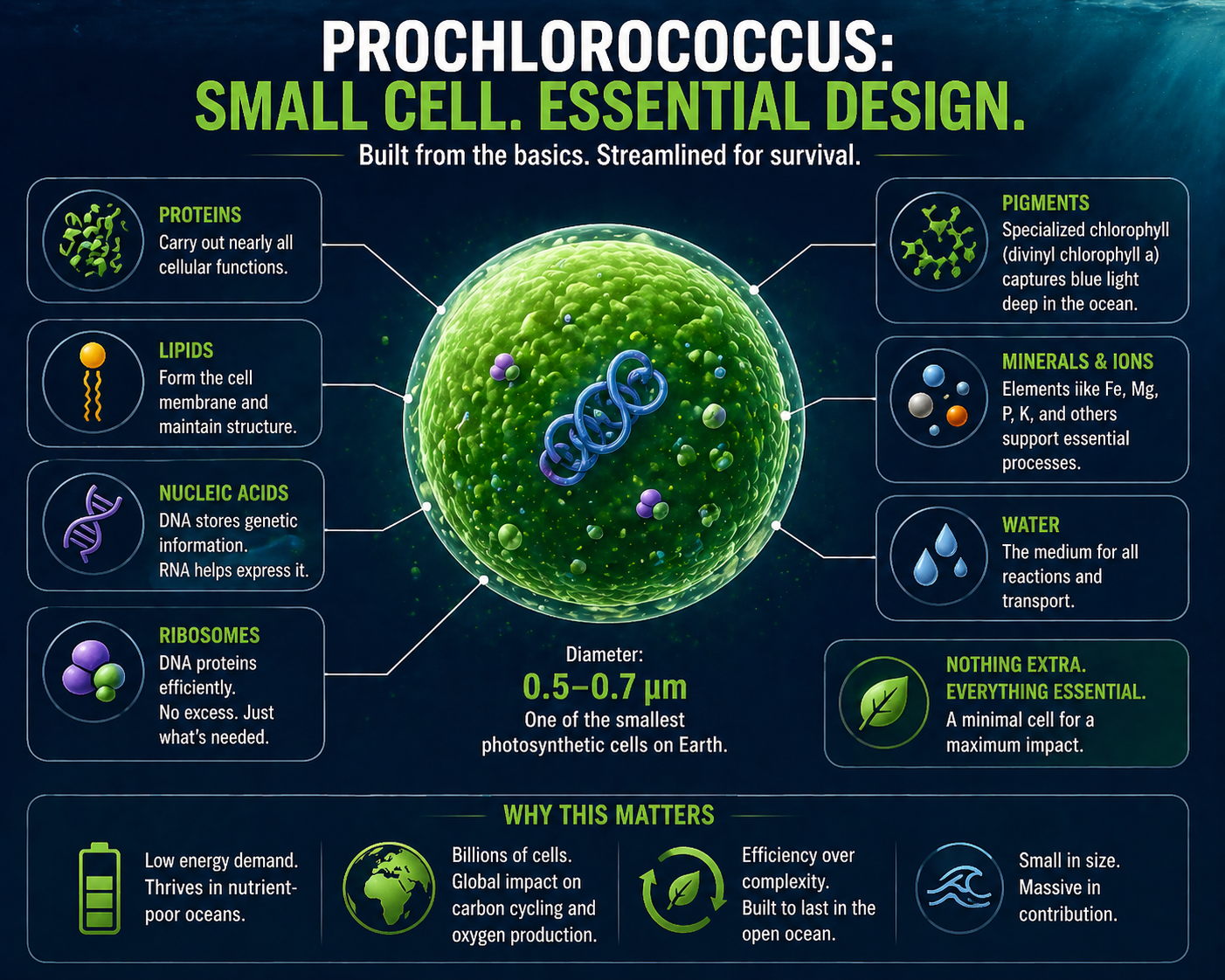
Despite its microscopic size, Prochlorococcus contains the same fundamental components found in all living cells, but in a highly reduced and efficient form.
Its cellular structure includes:
- Proteins, which carry out most biochemical and metabolic functions
- Lipids, which form the cell membrane and maintain cellular integrity
- Nucleic acids (DNA and RNA), which store and process genetic information
- Pigments, including divinyl chlorophyll a and b, which enable efficient light capture in the ocean
As a prokaryote, Prochlorococcus lacks a nucleus and membrane-bound organelles. Its internal structure is relatively simple, with DNA located in a nucleoid region and metabolic processes occurring directly within the cytoplasm.
What distinguishes Prochlorococcus is not the presence of unusual components, but the extreme reduction of non-essential systems. Its genome, approximately 1.6-2.6 million base pairs with ~2,000 genes, is among the smallest for photosynthetic organisms.
This reduction results in the loss of several capabilities found in other bacteria, including limited stress response systems, reduced biosynthetic pathways, and minimal regulatory complexity.
The benefit of this design is efficiency. With fewer components to maintain, Prochlorococcus has lower energy and nutrient requirements, allowing it to survive and grow in nutrient-poor (oligotrophic) environments where many other organisms are constrained.
Its cellular structure reflects a clear trade-off. By minimizing internal complexity, Prochlorococcus maximizes resource efficiency, but becomes more dependent on its environment and surrounding microbial community.
At scale, this streamlined design allows Prochlorococcus to sustain extremely large populations, contributing significantly to carbon cycling and oxygen production across the global ocean.
Prochlorococcus represents a distinct biological strategy: not complexity, but selective reduction, retaining only the components necessary for efficient function in a resource-limited environment.
Prochlorococcus contains the same fundamental components as all cells, but organized in a highly simplified prokaryotic form.