
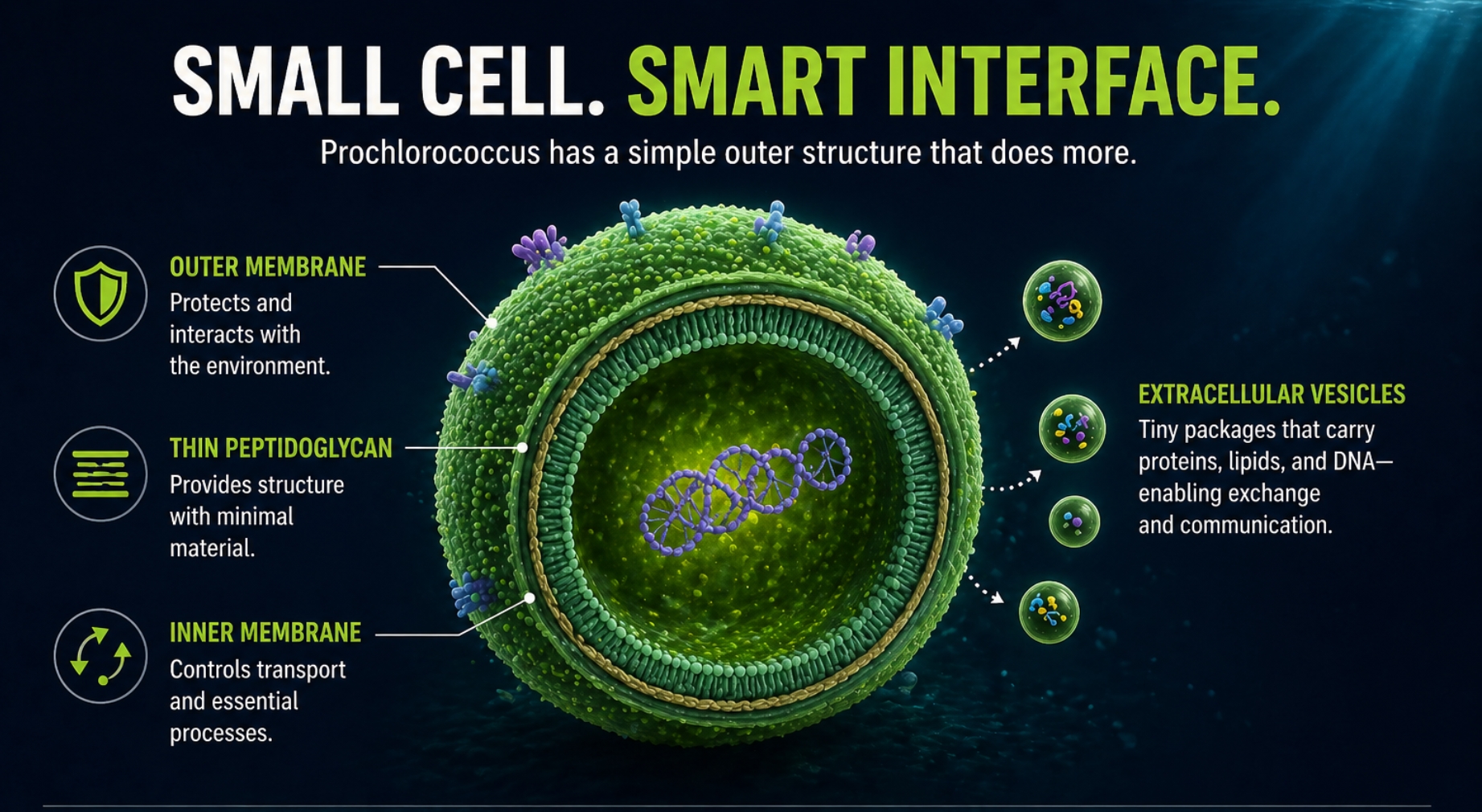
The outer structure of Prochlorococcus acts as the boundary between the cell and the surrounding ocean, controlling how it absorbs nutrients, responds to environmental stress, and interacts with other organisms.
Like most cyanobacteria, Prochlorococcus has a Gram-negative cell envelope composed of an inner membrane, a thin peptidoglycan layer, and an outer membrane exposed directly to seawater. However, this structure is more reduced and compact than in many other bacteria, reflecting the organism’s overall strategy of minimizing cellular complexity.
Its outer membrane contains specialized transport proteins that allow the cell to efficiently absorb extremely dilute nutrients from oligotrophic waters. This is essential because Prochlorococcus survives in regions where nitrogen and phosphorus are often present only in trace amounts.
The cell surface is also involved in interactions with viruses. Cyanophages attach to specific molecules on the outer membrane before infecting the cell, meaning the structure of the envelope partly determines how vulnerable different Prochlorococcus strains are to viral attack.
Another distinctive feature is the release of extracellular vesicles, tiny membrane-bound particles that bud off from the cell surface. These vesicles contain lipids, proteins, metabolites, and fragments of genetic material, allowing Prochlorococcus to influence its surroundings beyond the physical boundary of the cell itself.
Researchers believe these vesicles may contribute to nutrient exchange, microbial communication, redistribution of organic matter, and possibly even gene transfer between microorganisms. Some studies also suggest they can act as partial viral decoys, interacting with cyanophages before they reach living cells.
The outer structure of Prochlorococcus is therefore not simply protective. It functions as an active interface that connects the cell to surrounding microbial networks and ocean chemistry.
Because Prochlorococcus populations are so vast, these microscopic interactions collectively influence nutrient cycling, microbial dynamics, and carbon flow across large regions of the ocean.
Prochlorococcus demonstrates that even a highly reduced structure can remain functionally sophisticated, serving as both a boundary and a point of connection with the environment.