
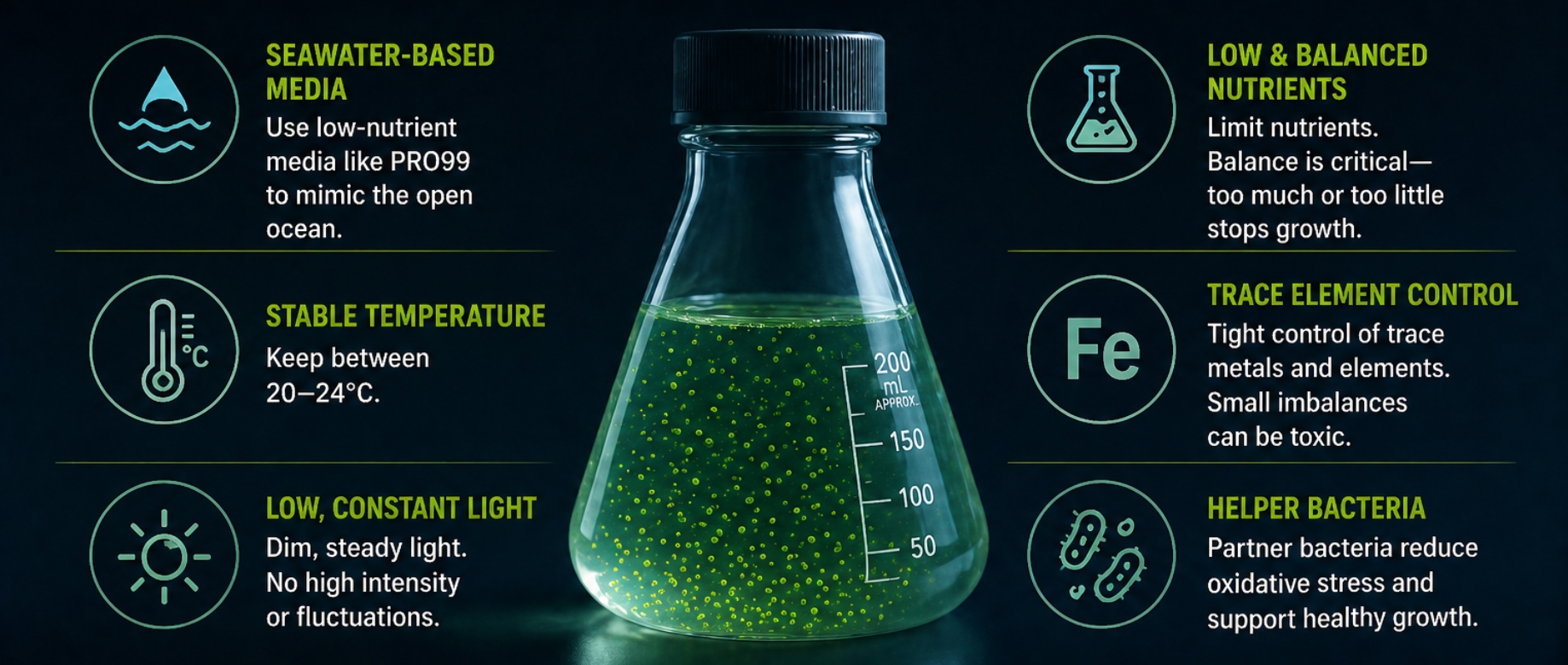
Growing Prochlorococcus in the laboratory is far more difficult than culturing many other microbes. Its survival depends on environmental conditions that closely resemble the stable, nutrient-poor waters of the open ocean.
Researchers typically grow Prochlorococcus in specialized seawater-based media such as PRO99, which is formulated to mimic oligotrophic marine conditions. Unlike many laboratory microorganisms that thrive in nutrient-rich media, Prochlorococcus performs best when nutrients remain dilute and carefully balanced.
Temperature control is especially important.
Most commonly studied strains grow optimally at relatively stable temperatures of around 20-24°C, depending on the ecotype. Sudden fluctuations or excessive warming can rapidly reduce growth and damage cells.
Light conditions must also be tightly regulated. Prochlorococcus is highly sensitive to excessive irradiance, so cultures are usually maintained under:
- low light intensity
- stable light cycles
- and wavelengths similar to those encountered in the open ocean
Strong or fluctuating light can produce oxidative stress and impair photosynthesis.
Chemical balance presents another challenge. Trace nutrients and metals must be maintained within narrow ranges because concentrations that are harmless to many microbes may become toxic to Prochlorococcus.
One of the most important difficulties involves reactive oxygen species, particularly hydrogen peroxide.
Many Prochlorococcus strains possess limited detoxification capacity and grow poorly when cultured completely alone. In laboratory studies, growth often improves substantially when helper bacteria are present to remove harmful oxidative compounds from the surrounding medium.
This dependence reflects the organism’s natural ecology. In the ocean, Prochlorococcus exists within microbial communities where neighboring organisms contribute to environmental stabilization and nutrient recycling.
As a result, culturing Prochlorococcus successfully often requires recreating not only its physical environment, but also aspects of its ecological environment.
These constraints help explain why Prochlorococcus remained undiscovered for so long and why it continues to be technically demanding to study. Its biology is optimized for stable, low-resource ocean conditions rather than the highly artificial and nutrient-rich environments commonly used in laboratory microbiology.
Culturing Prochlorococcus depends on maintaining tightly controlled, resource-limited conditions that mirror its natural environment as it grows in the lab only when conditions are carefully limited, not enriched.