
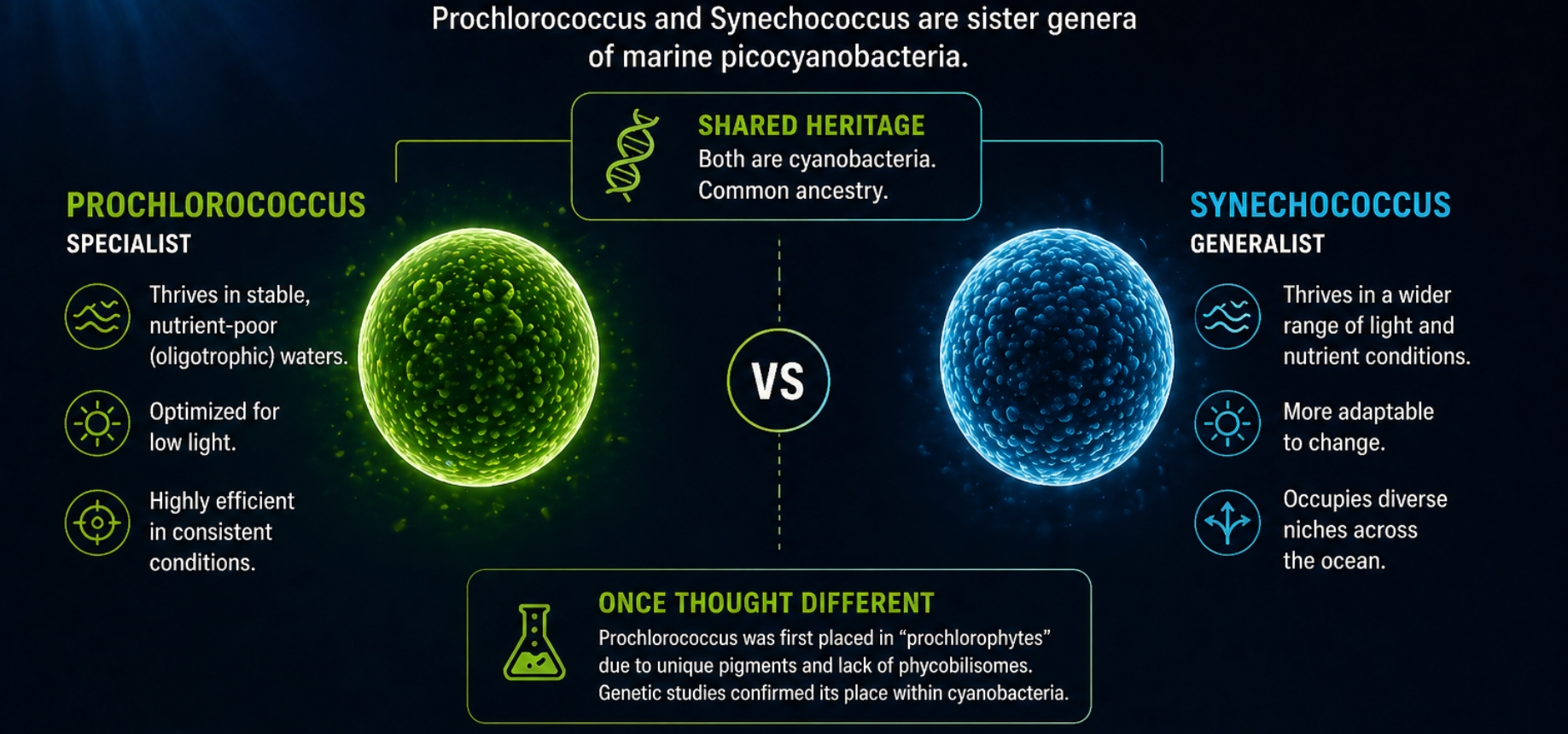
The closest known evolutionary relatives of Prochlorococcus belong to the genus Synechococcus. Both are part of the cyanobacterial lineage and are classified as marine picocyanobacteria, a group of extremely small photosynthetic organisms that contribute substantially to oceanic primary production.
At first glance, the two appear similar. Both drift through the sunlit ocean, perform oxygenic photosynthesis, and occupy overlapping marine environments. Yet their evolutionary paths reveal how closely related organisms can become adapted to very different ecological strategies.
Synechococcus is generally more flexible. It tolerates a broader range of nutrient conditions, temperatures, and light environments, which helps it thrive in coastal waters and other variable regions of the ocean.
Prochlorococcus evolved in a different direction. Its biology became increasingly specialized for stable, nutrient-poor open-ocean environments, where efficiency matters more than versatility.
This distinction initially confused researchers.
When Prochlorococcus was discovered in the 1980s, its pigment composition appeared unusual compared to other cyanobacteria. It contains divinyl chlorophyll a and b and lacks large light-harvesting structures called phycobilisomes, which are commonly found in most cyanobacteria, including Synechococcus.
Because chlorophyll b is more commonly associated with plants and green algae, Prochlorococcus was initially grouped with organisms called “prochlorophytes,” which were thought to represent a separate evolutionary lineage.
Genetic sequencing later overturned that idea. Molecular analyses showed that Prochlorococcus was firmly embedded within cyanobacteria and had diverged from ancestors closely related to modern Synechococcus.
That relationship is ecologically important.
Across much of the ocean, these organisms partition the environment according to their adaptations. Synechococcus tends to dominate in nutrient-rich or fluctuating conditions, while Prochlorococcus becomes more abundant in stable oligotrophic waters where resources are extremely limited.
Together, they illustrate how evolution can produce very different survival strategies from closely related biological foundations. Small changes in metabolism, pigments, and nutrient use can eventually reshape how organisms occupy entire regions of the planet.
Prochlorococcus is most closely related to Synechococcus, with both sharing a common lineage but diverging in how they occupy different ecological niches.