
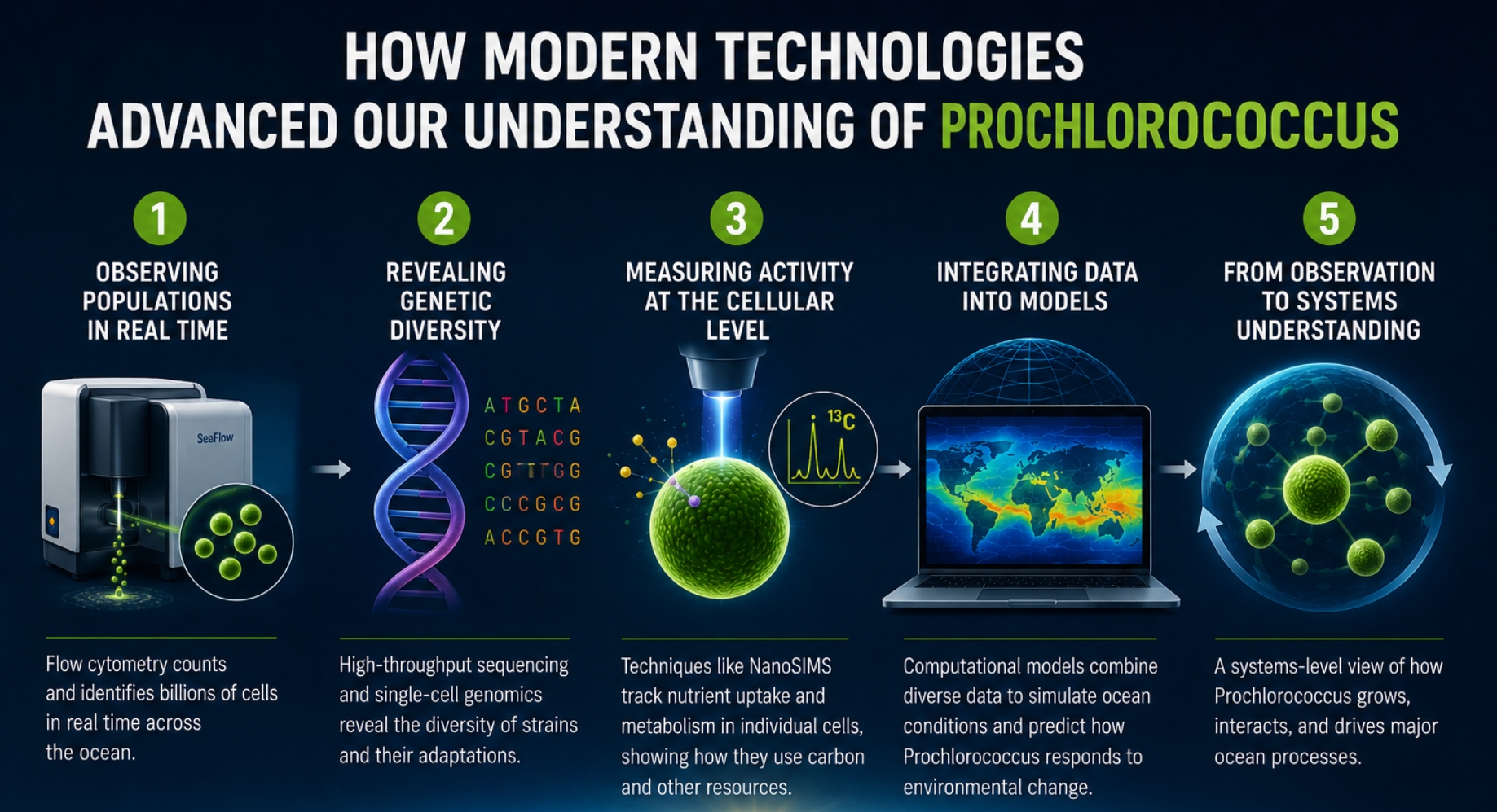
Advances in modern technology have transformed the study of Prochlorococcus from simple observation to a detailed, systems-level understanding of how it functions in the ocean.
Observing populations in real time
A major shift has come from the ability to measure populations directly in their natural environment. Tools such as flow cytometry, used in instruments like SeaFlow, pass individual cells through a laser beam and measure how they scatter light and fluoresce. This allows scientists to count and identify billions of cells in real time and track how populations change across regions and over daily cycles.
Revealing genetic diversity
At the genetic level, high-throughput sequencing reads the DNA of organisms at large scale, while single-cell genomics focuses on the genetic material of individual cells. Together, these approaches reveal how many different versions of Prochlorococcus exist and how each is adapted to specific conditions such as light and nutrient availability.
Measuring activity at the cellular level
Beyond identifying cells, newer techniques focus on what they are doing. Methods such as NanoSIMS allow scientists to track how individual cells take up nutrients by detecting tiny amounts of labeled elements inside them. This provides a direct view of how carbon and other nutrients are processed at the single-cell level.
Integrating data into models
These detailed datasets are combined using computational models, which simulate ocean conditions and biological processes. In simple terms, these models act like virtual oceans, allowing researchers to test how Prochlorococcus populations respond to changes in temperature, nutrients, and light.
From observation to systems understanding
Together, these advances have shifted the focus of research. The question is no longer just what Prochlorococcus is, but how it operates as part of a dynamic, global system, how it grows, interacts, and influences processes such as carbon cycling and oxygen production.
As a result, Prochlorococcus has become not only a subject of study, but also a model for understanding how microscopic organisms shape planetary systems.
Modern tools have turned Prochlorococcus from an invisible organism into one of the best understood drivers of life in the ocean.