
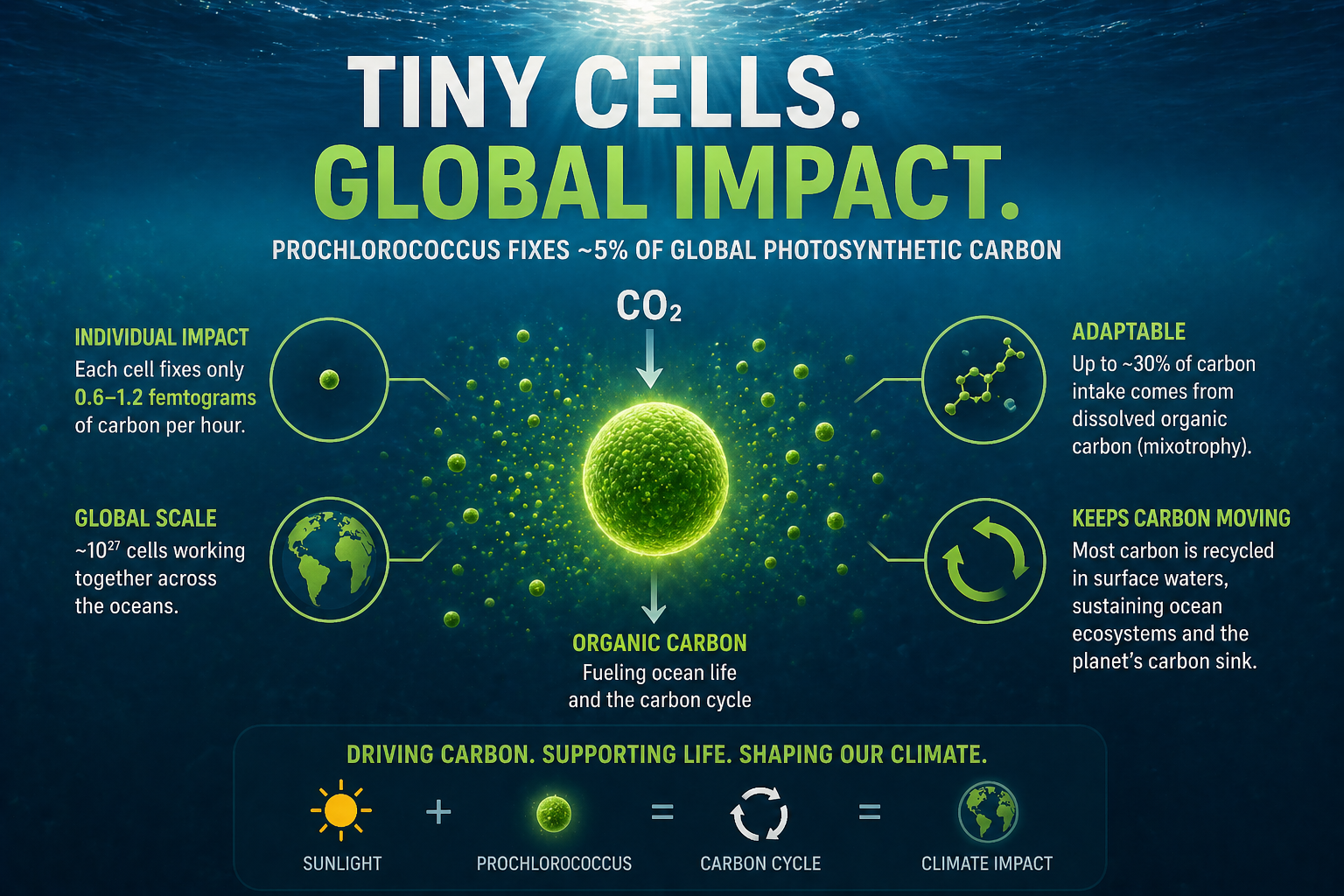
Prochlorococcus is estimated to contribute roughly ~5% of global photosynthetic carbon fixation, an extraordinary figure for a single group of microscopic organisms.
Through photosynthesis, it removes dissolved CO₂ from seawater and converts it into organic carbon, supplying energy and biomass to marine ecosystems. This process forms one of the first steps in the movement of carbon through the ocean.
A single Prochlorococcus cell fixes only about ~0.6-1.2 femtograms of carbon per hour. A femtogram is one quadrillionth of a gram, far too small to matter at the scale of an individual organism.
With an estimated worldwide population of around ~10²⁷ cells, Prochlorococcus collectively processes enormous quantities of carbon across tropical and subtropical oceans. Distributed through vast regions of the sunlit surface ocean, these cells function less like isolated microbes and more like a continuous planetary-scale photosynthetic system.
Much of the open ocean is oligotrophic, meaning nutrient concentrations are extremely low. Many larger phytoplankton struggle under these conditions, but Prochlorococcus is highly specialized for survival in resource-limited environments. This allows it to dominate carbon fixation across enormous marine regions that were once thought to be relatively unproductive.
Although photosynthesis remains its primary carbon source, some strains can absorb dissolved organic compounds from seawater, a strategy known as mixotrophy. Under certain conditions, these organic sources may contribute a meaningful fraction of total carbon intake, helping cells remain metabolically active when photosynthetic conditions become limiting.
However, carbon fixation is not the same as long-term carbon storage.
Much of the carbon processed by Prochlorococcus is rapidly recycled in surface waters through grazing, microbial decomposition, and viral lysis. Only a relatively small fraction becomes exported to the deep ocean for long-term sequestration. Its primary role is therefore regulating how carbon moves through marine ecosystems.
Because this activity occurs continuously and at enormous scale, even modest changes in Prochlorococcus abundance or productivity could influence broader ocean carbon cycling under changing climate conditions.
Prochlorococcus does not control the carbon cycle by storing carbon alone, but by driving the processes that determine where carbon goes and how long it stays there.