
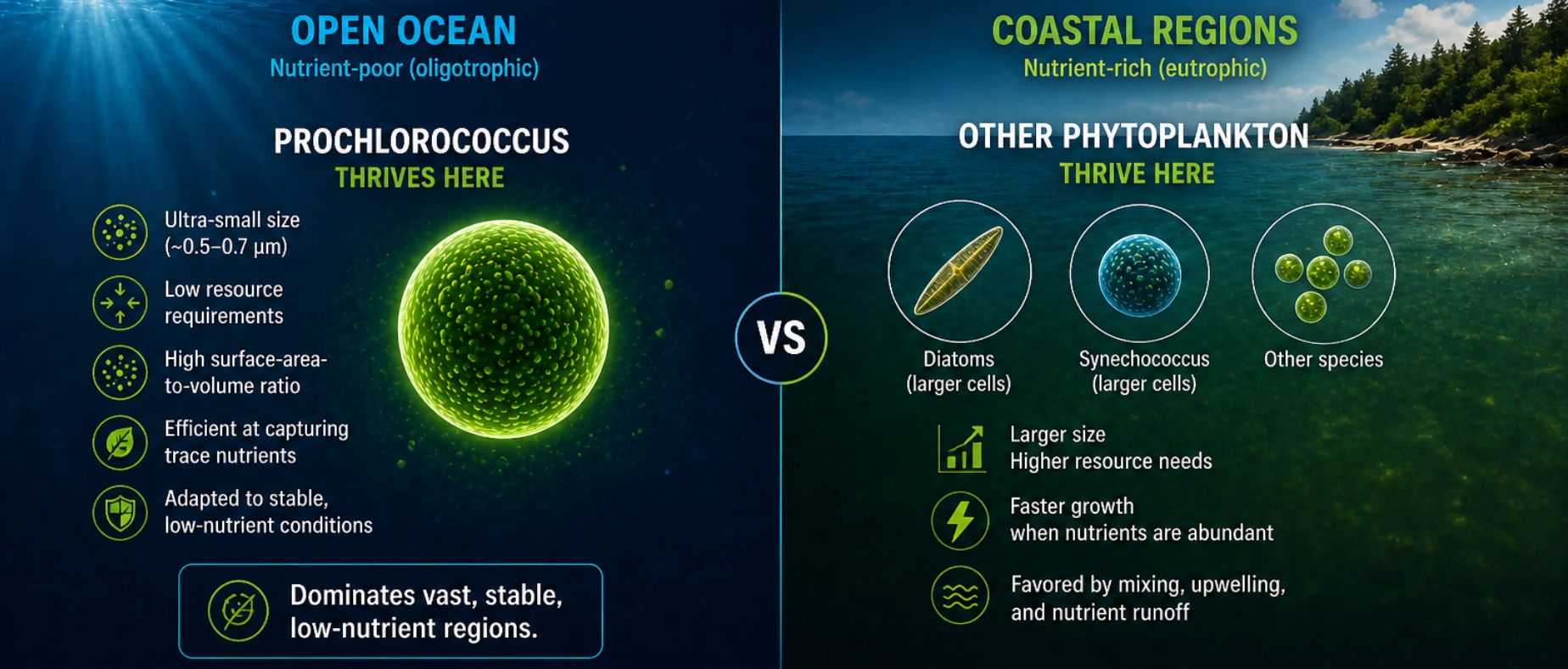
The open ocean appears deceptively empty. Compared to coastal waters, it contains very low concentrations of nutrients such as nitrogen and phosphorus, conditions that severely limit biological growth across much of the planet.
Yet these nutrient-poor regions are where Prochlorococcus becomes most successful.
Its dominance is closely linked to extreme resource efficiency.
Prochlorococcus has an ultra-small cell size and very low nutrient demand relative to many other phytoplankton. This allows it to survive and reproduce using nutrient concentrations that are often too low to sustain larger organisms. Its high surface-area-to-volume ratio also improves nutrient uptake efficiency, helping it absorb scarce dissolved nutrients from surrounding seawater.
These traits are especially advantageous in oligotrophic oceans, where stability and scarcity persist over long periods.
Coastal environments operate differently.
Near coastlines, nutrients are continuously replenished through:
- river runoff
- upwelling
- sediment interactions
- and physical mixing
Under these conditions, larger and faster-growing phytoplankton such as diatoms and Synechococcus gain a competitive advantage. These organisms can rapidly exploit nutrient-rich conditions and accumulate biomass more quickly than Prochlorococcus.
Coastal waters are also more variable. Turbulence, fluctuating salinity, changing temperatures, and high particle loads create environments that favour organisms with broader physiological flexibility.
Prochlorococcus performs best under relatively stable conditions and is less competitive during rapid environmental change.
Its distribution therefore reflects a broader ecological trade-off. Some organisms are adapted to maximize growth when resources are abundant, while others are optimized to persist under chronic limitation.
Prochlorococcus belongs strongly to the second category.
This specialization allows it to dominate enormous regions of the tropical and subtropical ocean, where few other photosynthetic organisms can maintain comparable abundance.
Because oligotrophic waters cover such a large fraction of Earth’s surface, the success of Prochlorococcus has major implications for marine productivity, carbon cycling, and oxygen generation across the global ocean.
Prochlorococcus dominates open oceans because low-nutrient conditions favor its efficiency, while nutrient-rich coastal waters favor faster-growing competitors.