
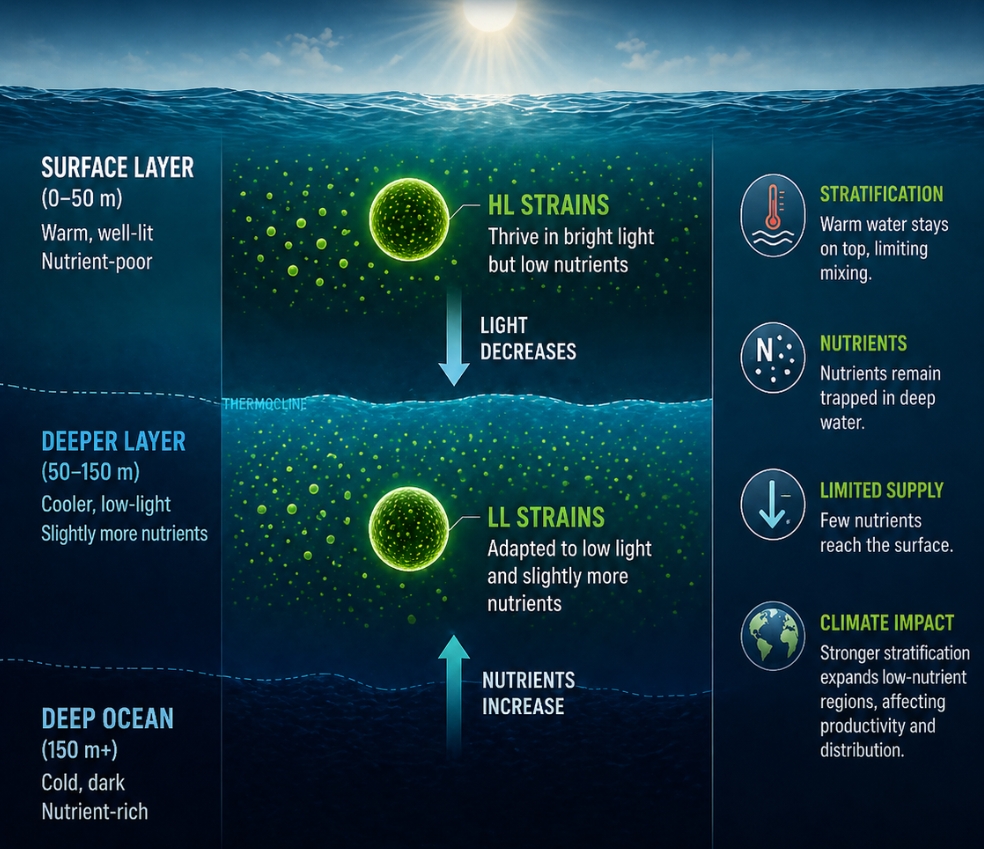
The distribution of Prochlorococcus is closely tied to the layered structure of the ocean.
In stratified oceans, warm and less dense surface waters remain separated from cooler, nutrient-rich deeper layers. This separation limits vertical mixing, creating two strong environmental gradients: abundant light near the surface and increasing nutrient availability with depth.
These gradients define where different Prochlorococcus ecotypes can survive most efficiently.
Light intensity changes especially rapidly through the upper ocean. Near the surface, sunlight is abundant, but it decreases sharply with depth, often falling to roughly ~1% of surface intensity by ~100-150 meters, depending on water clarity. Blue wavelengths penetrate the deepest, while red light is absorbed much closer to the surface.
Prochlorococcus populations are structured around this vertical light environment.
High-light (HL) ecotypes dominate surface waters, where irradiance is intense but nutrients are extremely limited. Deeper in the water column, low-light (LL) ecotypes become more abundant, functioning under dimmer conditions where nutrient concentrations are slightly higher.
Many LL populations occur near the deep chlorophyll maximum (DCM), a zone where the balance between available light and nutrient supply becomes favourable for photosynthetic growth.
This vertical partitioning reduces direct competition between ecotypes and allows Prochlorococcus collectively to occupy a broad portion of the sunlit ocean.
Stratification also imposes constraints.
As surface waters become increasingly isolated from deeper layers, nutrient delivery weakens. Although Prochlorococcus is highly adapted to nutrient-poor conditions, extreme nutrient limitation can still suppress growth and reduce productivity even when light remains abundant.
These dynamics are becoming increasingly important under climate change. Ocean warming strengthens stratification by increasing the temperature difference between surface and deeper waters. Stronger stratification is expected to expand oligotrophic surface regions and alter the vertical distribution of nutrients and light availability.
This may favour some Prochlorococcus ecotypes while disadvantaging others, reshaping patterns of productivity across large ocean regions.
Stratification therefore does more than determine where Prochlorococcus is found. It defines the physical and chemical structure of its habitat, controlling how light, nutrients, and microbial activity are distributed throughout the upper ocean.
Stratification shapes Prochlorococcus by controlling its two limiting factors, light and nutrients which ultimately determines where it can survive and how well it can grow.