
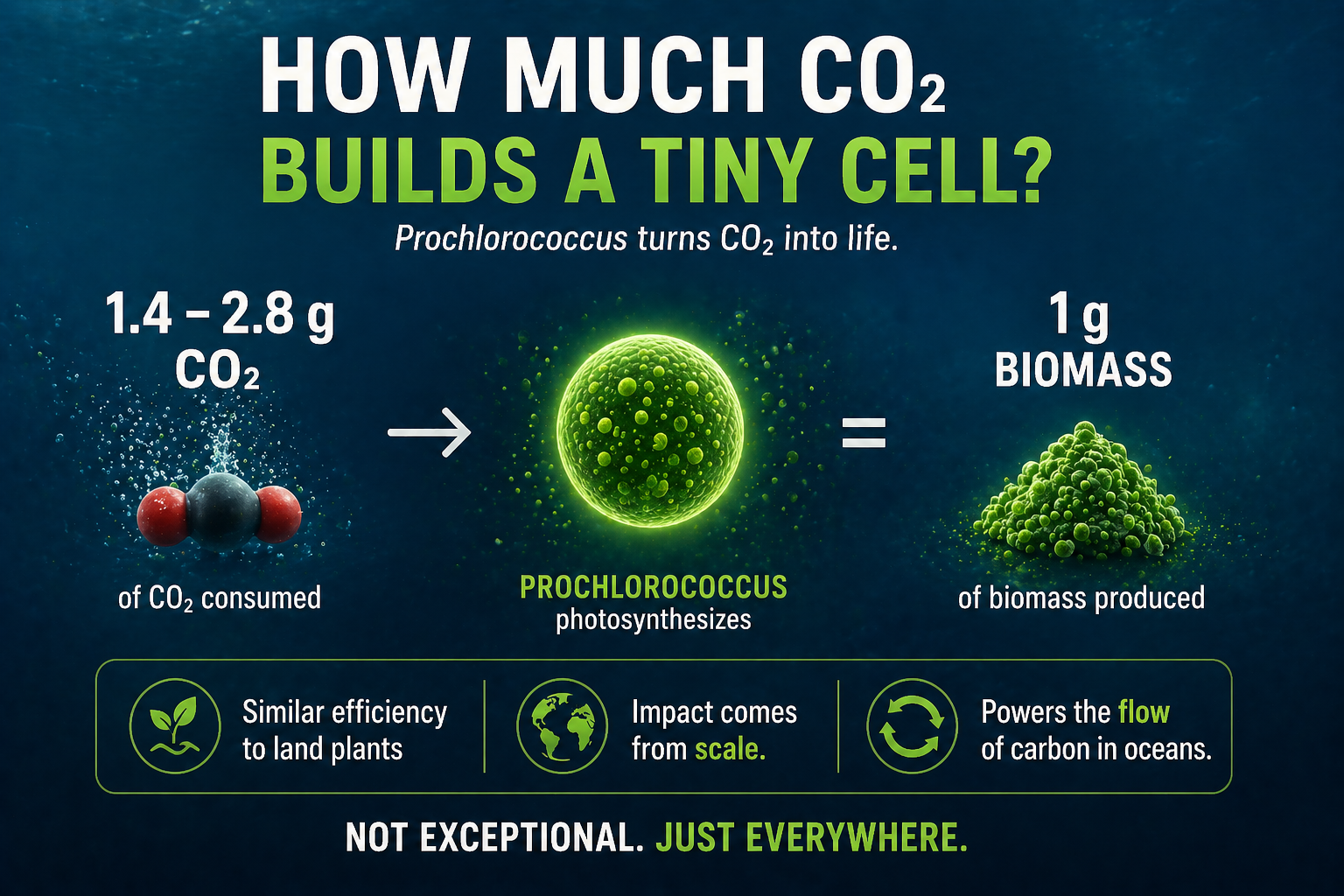
Producing biomass requires converting inorganic carbon into cellular material, and in Prochlorococcus this process occurs through photosynthesis in the surface ocean.
On average, generating 1 gram of Prochlorococcus biomass requires roughly ~1.4-2.8 grams of CO₂. Part of this carbon becomes incorporated into cellular components such as proteins, lipids, carbohydrates, and nucleic acids, while some is used in the metabolic processes needed to sustain growth and maintenance.
In terms of basic carbon conversion, this efficiency is not dramatically different from that of many plants or other photosynthetic microorganisms. What makes Prochlorococcus important is not an unusually high per-cell efficiency, but the scale and persistence of the process.
Unlike forests or algal blooms that are concentrated in specific locations or seasons, Prochlorococcus remains active across vast areas of the tropical and subtropical ocean throughout much of the year. Its populations collectively process enormous amounts of dissolved CO₂ continuously rather than episodically.
This continuous activity contributes substantially to marine carbon cycling in oligotrophic regions where few larger phytoplankton can maintain comparable abundance.
However, carbon fixation does not automatically mean long-term carbon storage.
Much of the carbon incorporated into Prochlorococcus biomass is rapidly recycled within surface waters through grazing, microbial decomposition, and viral lysis. Only a relatively small fraction eventually reaches deeper ocean layers where it can remain stored over long timescales.
Its role is therefore better understood as regulating the movement and transformation of carbon within marine ecosystems rather than acting primarily as a long-term carbon sink.
Even small shifts in the growth efficiency or abundance of Prochlorococcus can influence how carbon flows through the upper ocean because its populations are so extensive globally.
Its significance comes from consistency at scale: billions upon billions of tiny cells continuously converting dissolved carbon into living matter across much of the planet’s ocean surface.
Each gram of Prochlorococcus biomass requires roughly 1.4 to 2.8 grams of CO₂, and when this demand is scaled across its global population, it translates into a major component of ocean carbon processing.