
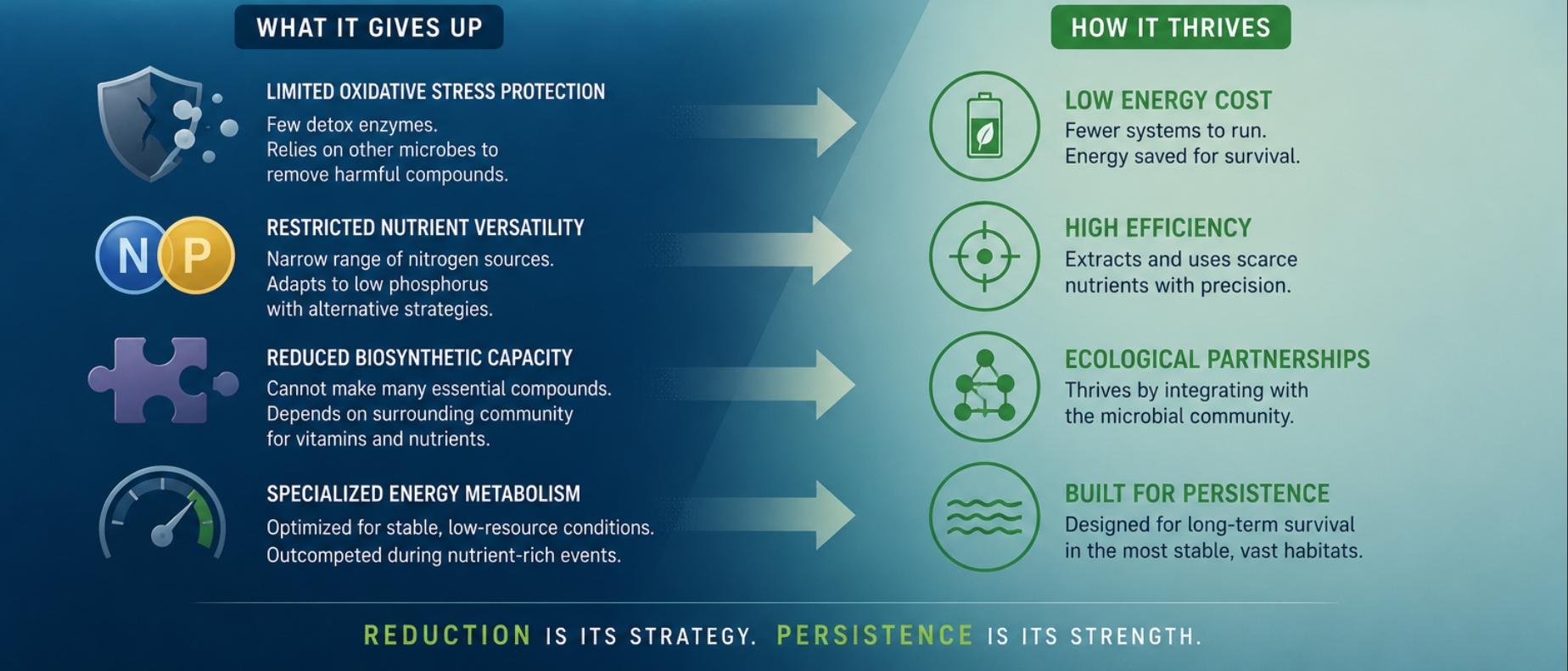
The metabolism of Prochlorococcus is highly specialized, but also highly constrained. Rather than maintaining broad biochemical flexibility, it operates with a reduced set of metabolic functions optimized for stable, nutrient-poor ocean environments.
Limited oxidative stress protection
Many organisms possess extensive systems for detoxifying harmful reactive oxygen species such as hydrogen peroxide. Prochlorococcus, however, has only limited protection against oxidative stress.
In several strains, key detoxification enzymes such as catalase are absent or reduced, leaving the organism vulnerable to oxidative damage. As a result, Prochlorococcus often depends on surrounding microbes to help remove these compounds and maintain a chemically stable environment.
This dependence highlights a major metabolic constraint: some protective functions have effectively been outsourced to the surrounding microbial community.
Restricted nutrient versatility
Prochlorococcus is highly efficient at acquiring nutrients present at extremely low concentrations, particularly nitrogen and phosphorus. However, this efficiency comes with reduced flexibility.
Compared to more metabolically versatile cyanobacteria such as Synechococcus, some Prochlorococcus strains can utilize only a narrower range of nitrogen sources.
Phosphorus availability also strongly shapes its metabolism. Certain ecotypes reduce their phosphorus demand by replacing phosphorus-containing membrane lipids with sulfur-containing alternatives. This adaptation improves survival in oligotrophic waters, but also reflects how tightly its metabolism is constrained by nutrient limitation.
Reduced biosynthetic capacity
Prochlorococcus has limited ability to synthesize certain essential compounds independently.
Instead, it often relies on surrounding microbial communities for access to vitamins, recycled nutrients, and organic molecules. Many metabolic processes therefore function as part of a broader ecological network rather than within the cell alone.
This reduction lowers internal energy costs, but increases dependence on environmental interactions.
Specialized energy metabolism
Its photosynthetic system is optimized for stable, low-resource conditions rather than rapid growth.
Prochlorococcus performs highly efficient, continuous photosynthesis under low nutrient availability and relatively stable light conditions. However, it is less competitive during nutrient-rich events such as upwelling, where larger and faster-growing phytoplankton can rapidly outcompete it.
Its metabolism therefore favors persistence and efficiency over metabolic flexibility or rapid expansion.
A strategy shaped by reduction
Taken together, these constraints reveal a fundamental trade-off. Prochlorococcus has not evolved to maximize metabolic versatility. Instead, it has evolved to minimize energy expenditure and maintain efficiency under persistent environmental limitation.
In many ways, its metabolism is shaped by subtraction. Functions that are energetically costly, redundant, or environmentally replaceable have been reduced or lost, allowing resources to be focused on the processes most critical for survival in the open ocean.
This strategy limits independence, but it also helps explain why Prochlorococcus succeeds across such vast regions of the planet.
Its reduced genome limits stress responses, biosynthetic capacity, and detoxification, defining the boundaries of its metabolism.