
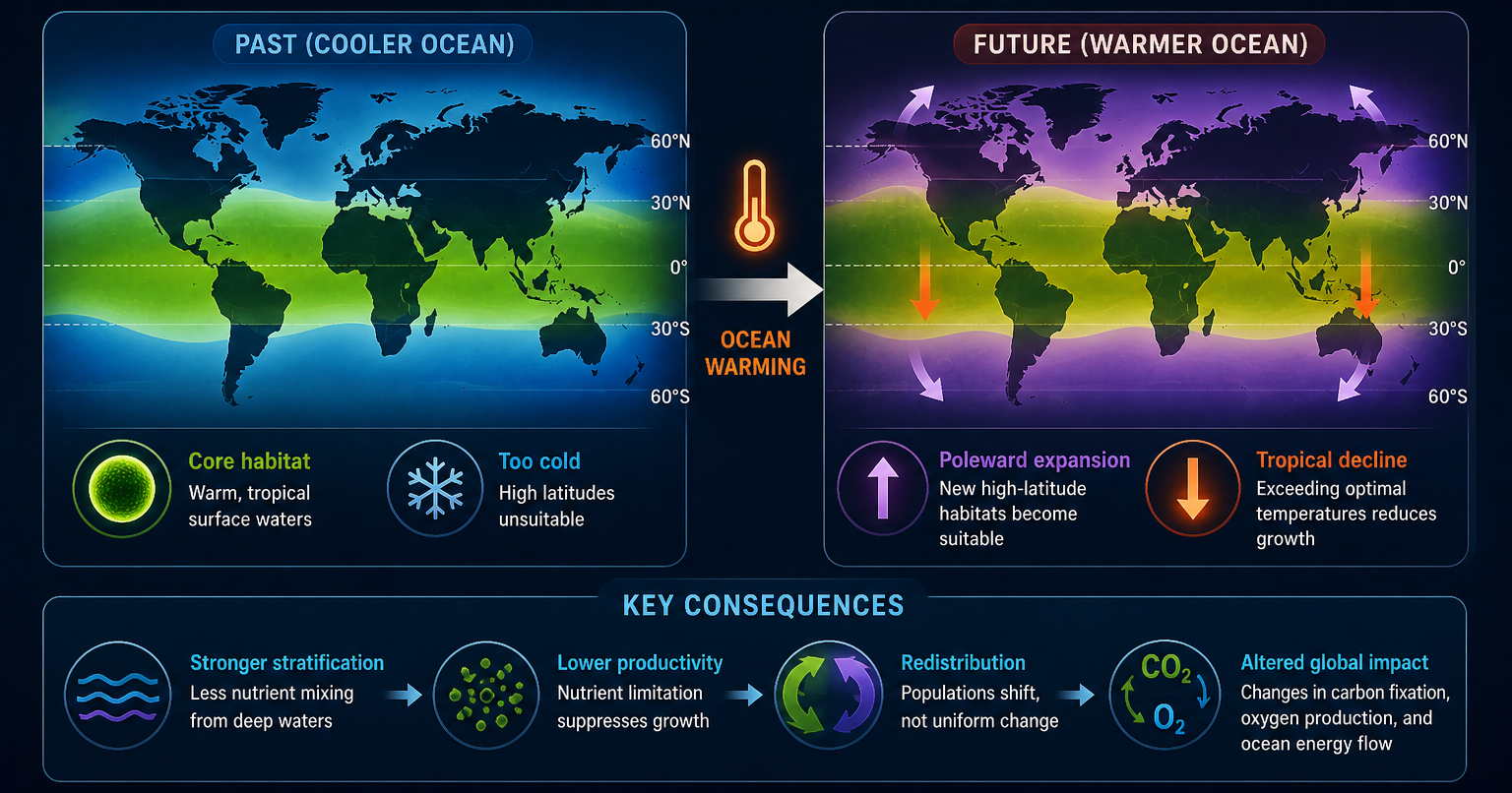
Ocean warming is expected to change both where Prochlorococcus lives and how efficiently it functions across the global ocean.
Although Prochlorococcus is adapted to warm waters, its temperature tolerance has limits. Many strains show reduced growth at temperatures above approximately ~28°C, indicating that warming does not indefinitely favour its expansion.
One of the clearest projected changes is poleward expansion.
As surface oceans warm, regions at higher latitudes that were previously too cold for sustained Prochlorococcus growth may become increasingly suitable. Over time, populations are expected to extend farther north and south from their current tropical and subtropical strongholds.
At the same time, parts of the tropics, which currently support some of the largest Prochlorococcus populations, may begin to exceed optimal thermal conditions. In these regions, growth rates could decline, particularly when warming is combined with nutrient stress.
Warming strengthens ocean stratification, where warmer surface waters mix less effectively with cooler, nutrient-rich deeper waters. Reduced mixing decreases the upward supply of nutrients such as nitrogen and phosphorus into surface layers.
Prochlorococcus is highly efficient under nutrient-poor conditions, but extreme nutrient limitation can still reduce productivity. This means warming may create environments that are thermally suitable but increasingly nutrient-constrained.
Different ecotypes are also expected to respond differently. Some may expand into newly favourable regions, while others decline where environmental thresholds are exceeded. As a result, ocean warming is likely to alter not only the geographic range of Prochlorococcus, but also the internal balance between ecotypes across the ocean.
These shifts carry broader ecological consequences. Because Prochlorococcus contributes significantly to carbon fixation and oxygen production in oligotrophic oceans, changes in its distribution can influence marine productivity and biogeochemical cycling over large spatial scales.
The future of Prochlorococcus under climate change is therefore unlikely to be defined by simple expansion or collapse. More likely, the ocean will see a gradual reorganization of populations as environmental conditions shift across regions and depths.
Ocean warming will not simply increase or decrease Prochlorococcus populations, but it will redistribute them. As their range shifts toward cooler regions and productivity changes across the tropics, the global patterns of carbon fixation, oxygen production, and ocean energy flow will be fundamentally reshaped.