At first glance, comparing Prochlorococcus to forests seems almost absurd. One is an invisible marine microbe drifting through seawater; the other consists of massive terrestrial ecosystems visible from space.
Yet both are fundamental components of Earth’s life-support system.
Their importance, however, comes from very different roles.
Forests as long-term carbon reservoirs
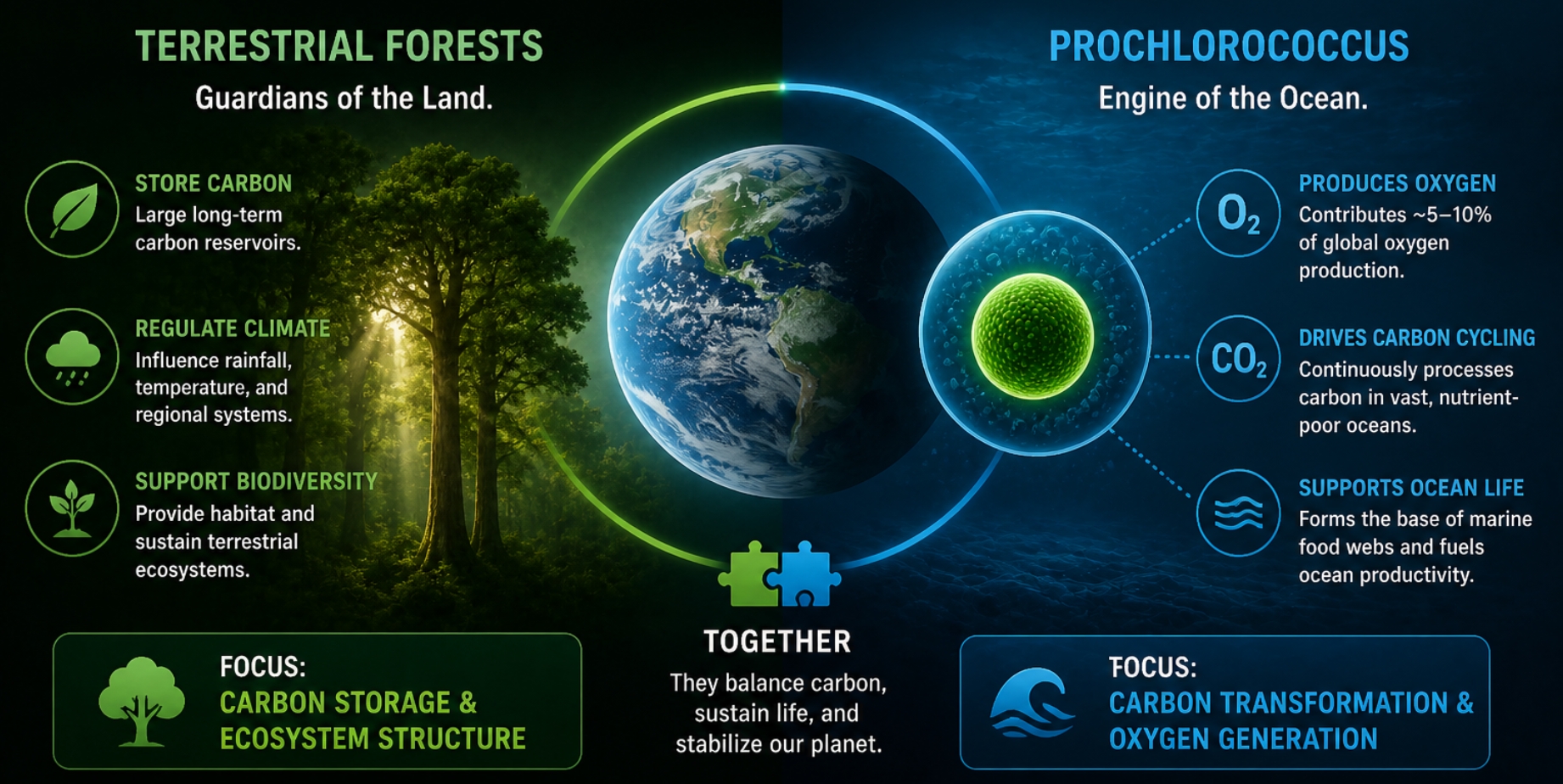
Terrestrial forests store enormous amounts of carbon in wood, roots, soils, and vegetation. Through photosynthesis, they remove CO₂ from the atmosphere and lock a significant fraction of that carbon into biomass over long timescales.
Forests also influence:
- regional climate
- rainfall patterns
- soil stability
- water cycling
- and habitat structure for terrestrial biodiversity
Their ecological impact is strongly tied to physical structure and long-term carbon storage.
Prochlorococcus as a driver of ocean productivity
Prochlorococcus functions differently. It does not build large structures or store carbon in forests of biomass. Instead, it continuously processes carbon within the surface ocean.
Distributed across vast oligotrophic regions, it contributes substantially to marine primary production and is estimated to generate roughly ~5-10% of Earth’s oxygen on its own. Marine phytoplankton collectively account for an estimated 50-80% of global oxygen production.
Its activity supports marine food webs, microbial recycling systems, and large-scale carbon cycling throughout the open ocean.
Rather than storing carbon for centuries, Prochlorococcus participates in rapid and continuous biochemical turnover.
Different systems, connected outcomes
The contrast between these systems reflects two complementary ecological strategies.
Forests emphasize:
- structural complexity
- carbon storage
- and long-term ecosystem stability
Prochlorococcus emphasizes:
- metabolic efficiency
- continuous carbon transformation
- and distributed productivity across the ocean
Both systems influence atmospheric chemistry, climate regulation, and global biogeochemical cycles, but through very different mechanisms.
This comparison also highlights a broader misconception in how ecological importance is perceived. Large, visible ecosystems often receive more attention because their impact is easier to observe directly. Much of the ocean’s regulatory function, however, operates through microscopic organisms functioning at enormous scale.
The stability of Earth’s environment depends on both systems simultaneously. Forests regulate major terrestrial processes, while marine microbes such as Prochlorococcus help maintain the chemical and biological balance of the ocean and atmosphere.
Together, they illustrate how planetary habitability emerges from interactions between visible ecosystems and microscopic biological networks operating across the Earth system.
Forests store carbon and shape terrestrial climates, while Prochlorococcus continuously processes carbon and supports atmospheric balance across the oceans.