
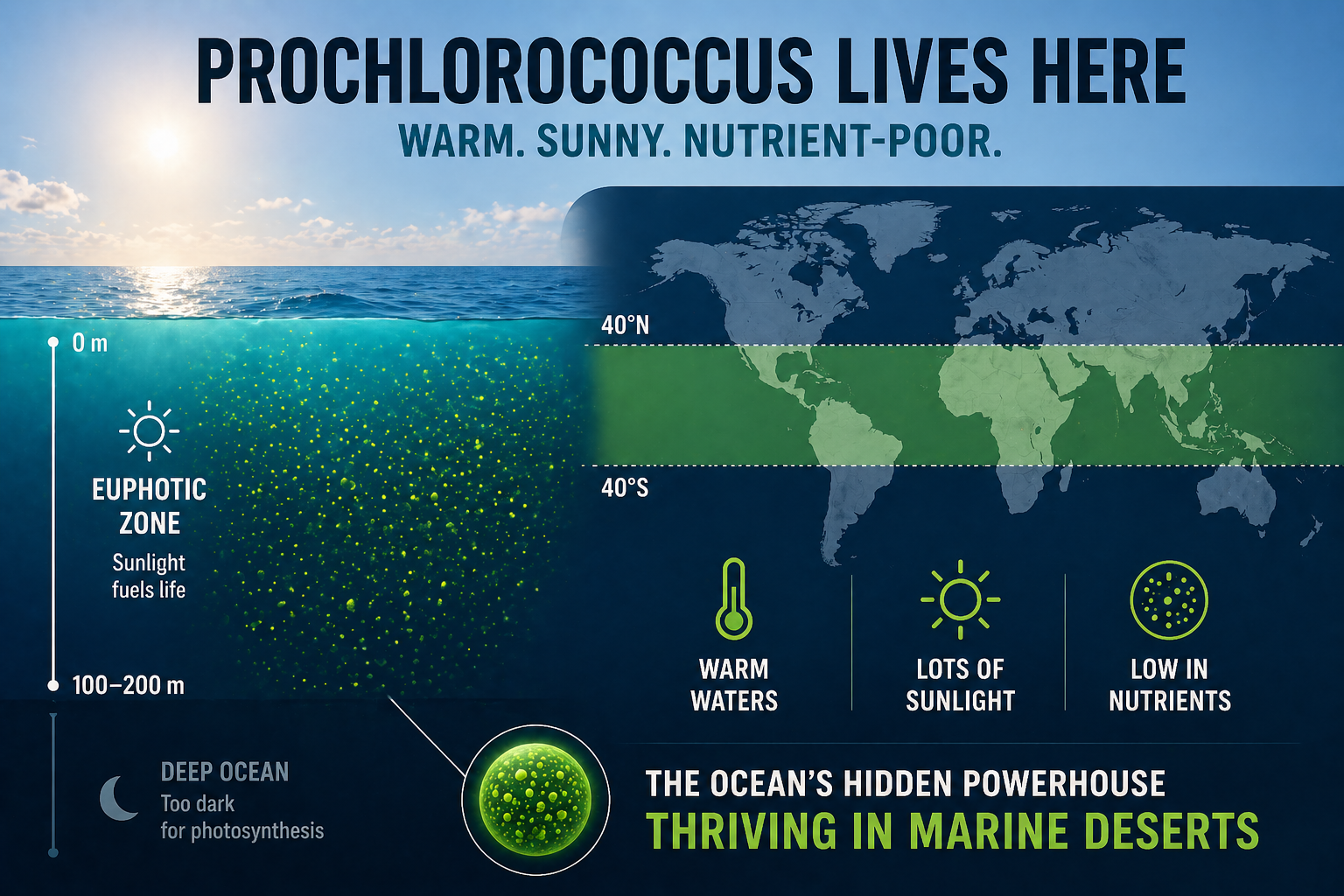
Prochlorococcus thrives in the vast open regions of the tropical and subtropical ocean, primarily between approximately 40°N and 40°S latitude. These waters receive relatively stable sunlight throughout the year, creating environmental conditions that allow continuous photosynthetic activity.
It inhabits the ocean’s euphotic zone, the upper sunlit layer where enough light penetrates to support photosynthesis. Depending on water clarity, Prochlorococcus can occur from near the surface down to depths of roughly ~100-200 meters.
The regions dominated by Prochlorococcus are typically oligotrophic, meaning they contain extremely low concentrations of nutrients such as nitrogen and phosphorus. To larger organisms, these waters can appear almost biologically empty. Compared to productive coastal regions, they often lack visible blooms, dense plankton populations, or high concentrations of organic matter.
Prochlorococcus succeeds because it is exceptionally well adapted to stable, nutrient-poor conditions. Its tiny size, streamlined biology, and low resource demand allow it to maintain enormous populations in environments where many larger phytoplankton struggle to compete.
This specialization gives it dominance across huge portions of the open ocean, especially in regions where nutrient input from deep water mixing or coastal runoff is limited. Its habitat is also shaped by physical ocean conditions.
Clear water allows sunlight, especially blue wavelengths, to penetrate deeply, extending the range over which Prochlorococcus can remain photosynthetically active. Stable stratification in tropical oceans further reinforces the low-nutrient conditions that favour its growth.
Because oligotrophic regions cover such a large fraction of Earth’s surface, the distribution of Prochlorococcus has global significance. Its continuous activity across these seemingly sparse waters contributes substantially to marine productivity, carbon processing, and oxygen generation throughout the planet’s oceans.
Prochlorococcus turns the most nutrient-poor regions of the ocean into some of its most active, operating at a scale that reshapes how these environments function.