
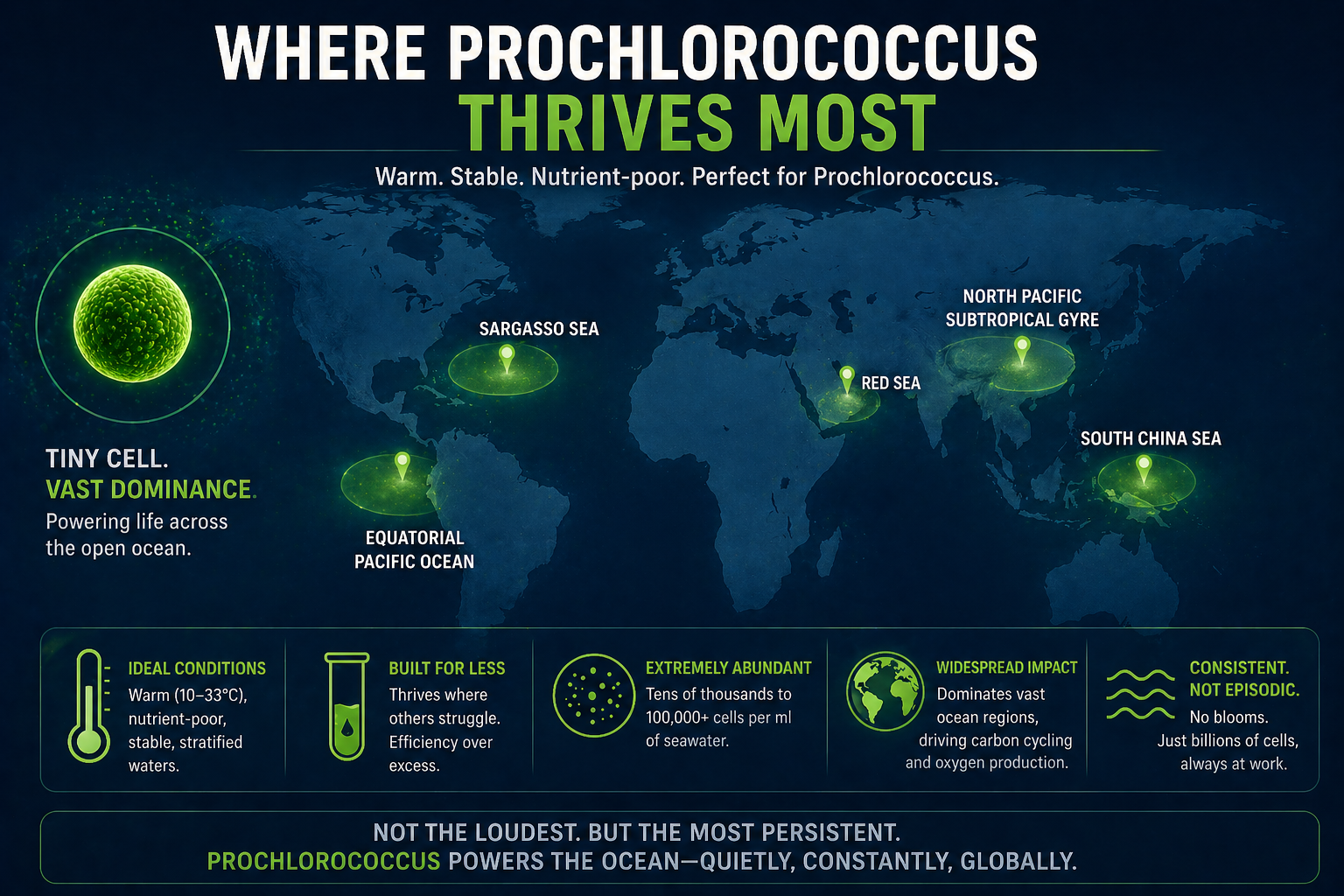
Prochlorococcus is most abundant in the warm, clear waters of the tropical and subtropical open ocean, particularly between roughly 40°N and 40°S latitude.
Major regions of high abundance include:
- the Sargasso Sea
- the Red Sea
- the Equatorial Pacific Ocean
- the North Pacific Subtropical Gyre
- and the South China Sea
These regions share several important environmental characteristics. They are generally warm, strongly stratified, and extremely low in nutrients such as nitrogen and phosphorus.
Such conditions limit the growth of many larger phytoplankton species, particularly those that depend on frequent nutrient input from deep-water mixing or coastal runoff.
Prochlorococcus, however, is highly adapted to exactly these constraints.
Its tiny size and streamlined cellular organization allow it to survive with very low nutrient demand. Instead of relying on rapid bloom formation like many coastal phytoplankton, it maintains stable populations over long periods under chronically nutrient-poor conditions.
In these environments, concentrations commonly reach tens of thousands to more than 100,000 cells per millilitre of seawater.
What makes this especially remarkable is that Prochlorococcus rarely forms visible blooms. Unlike large algal blooms that temporarily discolor seawater, its dominance is mostly invisible to the naked eye. Its influence comes from persistence and enormous cumulative abundance rather than dramatic short-term population explosions.
Water clarity also plays a major role. Clear oligotrophic waters allow sunlight, particularly blue wavelengths, to penetrate deeply into the water column, extending the region where photosynthesis remains possible. Stable stratification further reinforces the low-nutrient conditions that favour Prochlorococcus over faster-growing competitors.
Because these oceanic regions cover such a large fraction of Earth’s surface, the distribution of Prochlorococcus has global implications. Its continuous activity across these waters contributes substantially to marine primary production, carbon cycling, and oxygen generation across the planet.
Its abundance comes from persistence, sustaining dense populations across stable, nutrient-poor oceans rather than appearing in short-lived bursts.