
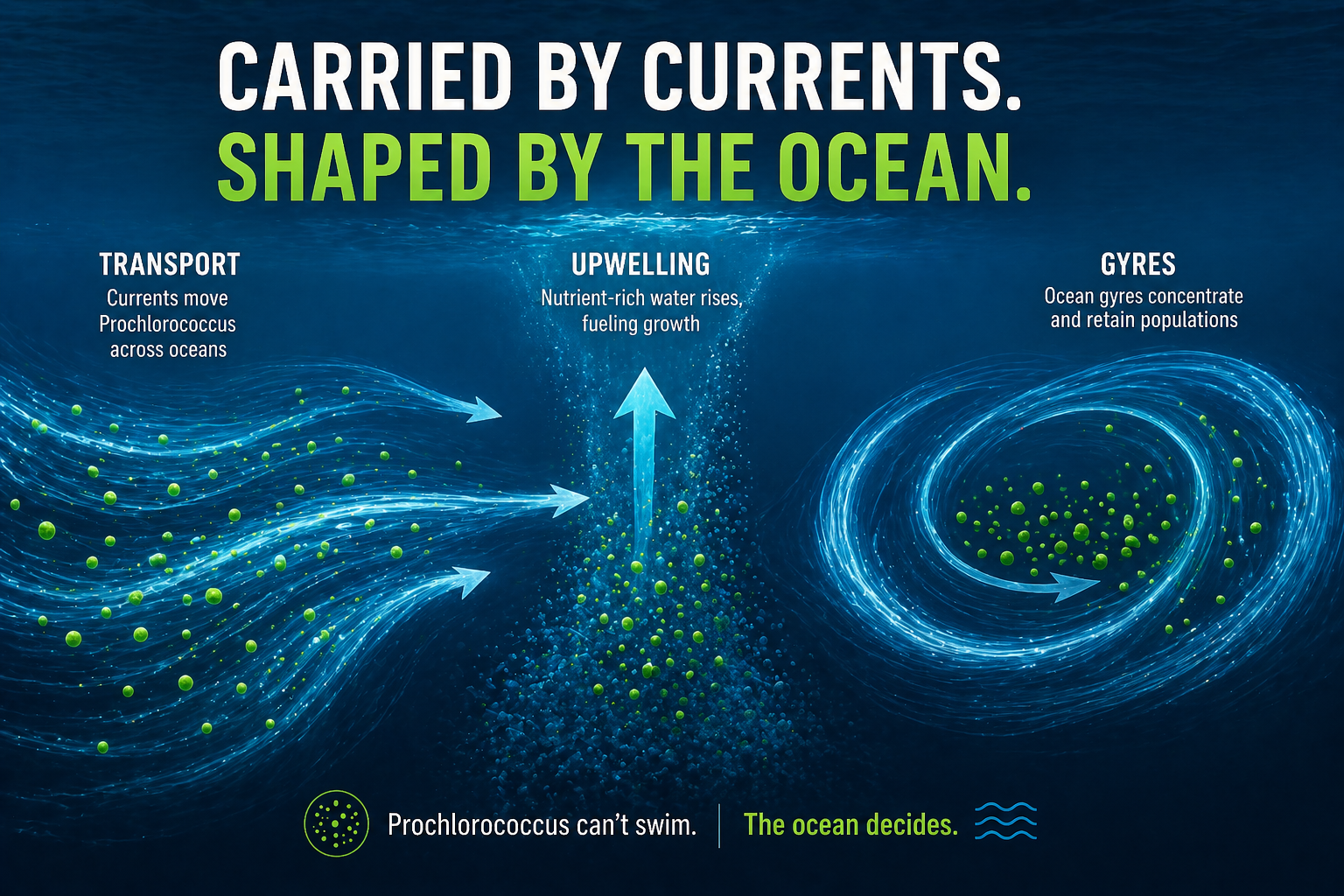
Prochlorococcus drifts with the ocean.
Unlike larger organisms that can actively swim or migrate, it has almost no ability to control its movement. Its distribution is therefore tightly linked to ocean circulation patterns, which continuously transport cells across enormous distances.
Currents influence Prochlorococcus mainly by controlling the environmental conditions surrounding it. One of the most important factors is nutrient transport. In many open-ocean regions, surface waters are extremely poor in nutrients because warm, stratified layers prevent mixing with deeper water.
Processes such as upwelling temporarily disrupt this pattern. When deep, nutrient-rich water rises toward the surface, concentrations of nitrogen and phosphorus increase, altering local productivity. In some cases this can support Prochlorococcus growth, although strong nutrient enrichment often favours faster-growing competitors such as diatoms and larger phytoplankton.
Ocean circulation also regulates temperature distribution. Because Prochlorococcus is adapted primarily to warm waters, major current systems help define the boundaries of its habitat. Warm currents can expand suitable regions, while cold currents restrict its abundance or shift populations toward lower latitudes.
Light conditions are influenced indirectly as well. Circulation patterns affect water clarity, stratification, and vertical mixing, all of which determine how deeply sunlight penetrates into the ocean.
At the same time, horizontal currents physically redistribute populations across entire ocean basins. Large gyres and circulation systems help maintain widespread but uneven distributions, connecting distant marine regions through continuous transport of microbial communities.
This creates an important ecological dynamic:
Prochlorococcus is carried by the ocean through constantly changing environments shaped by ocean physics.
Currents act both as:
- a transport network moving cells across the planet
- and an environmental filter determining where conditions remain suitable for growth
Because Prochlorococcus contributes significantly to marine primary production and carbon processing, changes in ocean circulation can have large-scale consequences. Shifts in stratification, warming, or circulation strength driven by climate change may alter where Prochlorococcus populations thrive and how efficiently they contribute to ocean productivity.
Prochlorococcus does not navigate the ocean, it is carried by it. And through this constant movement, ocean currents quietly shape one of the most important biological systems on the planet.