
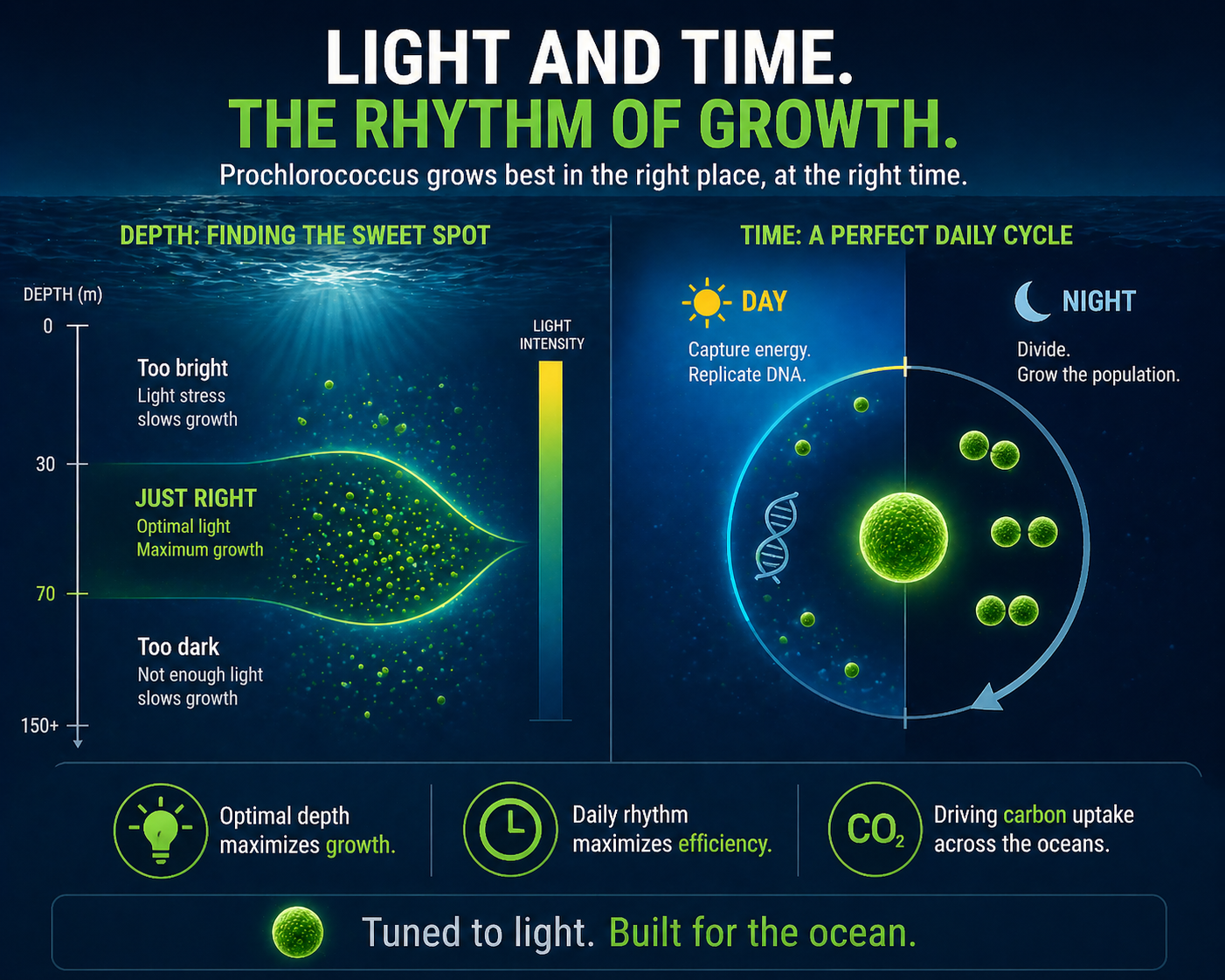
For Prochlorococcus, light acts as both an energy source and a biological clock.
Its growth changes predictably with depth because light intensity decreases rapidly as sunlight moves through seawater. Near the surface, light is abundant, but excessive irradiance and ultraviolet exposure can place cells under stress. Much deeper in the water column, light becomes too weak to sustain efficient photosynthesis.
As a result, growth is often most favorable at intermediate depths, commonly around ~30-70 meters in clear open-ocean waters, where enough light is available for photosynthesis without the damaging effects of extreme surface exposure.
Depth also influences the quality of light. Blue wavelengths penetrate deeper than red light, shaping where photosynthetic activity can continue efficiently within the water column.
Alongside this vertical pattern, Prochlorococcus follows a highly synchronized diel cycle, meaning its cellular activities are coordinated with the daily transition between light and darkness.
During daylight hours, cells primarily focus on:
- harvesting light energy
- fixing carbon
- and replicating DNA
Cell division usually occurs later, often during the evening or nighttime.
This separation is biologically advantageous. Photosynthesis during the day provides the energy required for growth, while dividing at night reduces exposure of newly replicated DNA to intense solar radiation that could cause damage.
Rather than growing continuously at a constant rate, Prochlorococcus operates according to predictable environmental rhythms.
At the scale of individual cells, these timing patterns improve efficiency. At the scale of the ocean, synchronized activity across enormous populations produces measurable daily fluctuations in:
- carbon uptake
- oxygen production
- and microbial productivity
This makes Prochlorococcus tightly linked to the physical light environment of the ocean. Changes in water clarity, vertical mixing, or stratification can alter both the depth distribution of populations and the timing of their metabolic activity.
Its growth is regulated by light in two dimensions, varying with depth and cycling with time, creating a tightly controlled pattern of activity.