Beer is one of humanity's oldest fermented beverages, and its existence depends entirely on microbes. For thousands of years, people have relied on microscopic organisms to transform simple grains into a drink that has influenced cultures, trade, agriculture, and economies around the world.
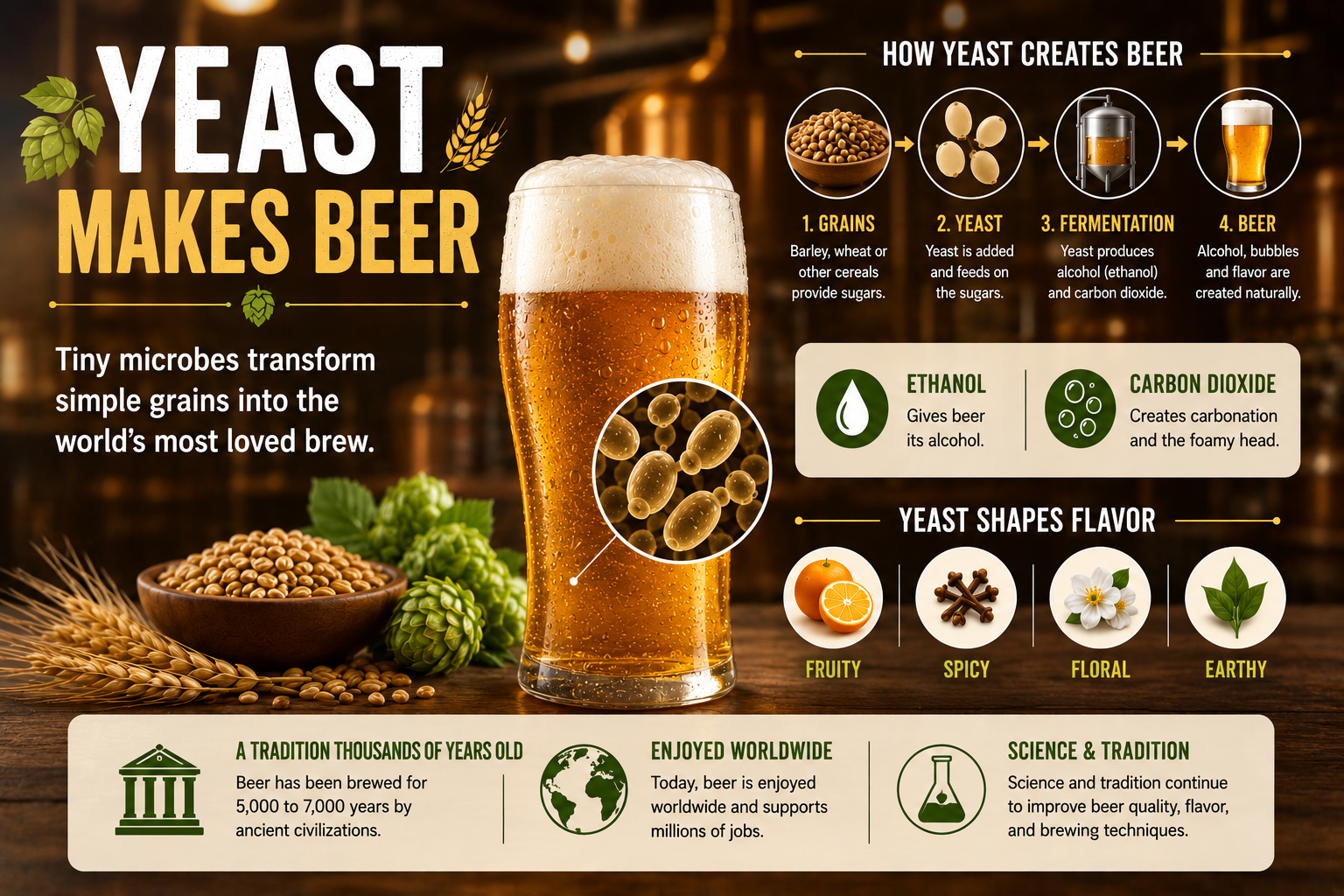
The main microbe responsible is yeast, particularly Saccharomyces cerevisiae, although some beer styles use Saccharomyces pastorianus. These yeasts feed on sugars extracted from grains such as barley, wheat, or other cereals and carry out the fermentation that gives beer its alcohol and natural carbonation.
In many ways, yeast functions like a tiny brewery inside every fermentation tank. As it consumes the grain sugars, it produces ethanol and carbon dioxide as natural by-products. Ethanol gives beer its alcoholic content, while carbon dioxide creates the bubbles and foamy head that characterise freshly brewed beer.
The microbes also shape much of beer's flavour. Ethanol gives beer its alcoholic content, while carbon dioxide creates the bubbles and foamy head that characterize it's aroma. Different yeast strains produce different compounds during fermentation, creating fruity, spicy, floral, or earthy notes. This is one reason why two beers made from similar grains and hops can taste completely different.
The choice of yeast is just as important as the choice of grains or hops. Brewers carefully select different yeast strains because each one contributes its own unique character to the finished beer.
Beer has been brewed for at least 5,000 to 7,000 years and was produced by some of the world's earliest civilizations, including those in Mesopotamia and ancient Egypt. Over time, brewing spread across Europe, Asia, Africa, and the Americas, becoming an important part of food, culture, and commerce.
Today, beer is one of the world's most widely consumed alcoholic beverages. The global brewing industry is worth hundreds of billions of dollars and supports farmers, malt producers, breweries, packaging companies, distributors, restaurants, retailers, and millions of jobs worldwide.
Scientists continue studying brewing yeasts to improve fermentation efficiency, develop new flavours, and better understand how different strains influence beer quality. At the same time, traditional brewing methods remain an important part of many cultures and craft breweries around the world.
Every glass of beer is the result of microbial fermentation. For thousands of years, yeast has transformed simple grains into one of the world's most enduring and widely enjoyed beverages, making it one of humanity's oldest and most successful partnerships with microbes.
A single-celled fungus helped create a global industry worth hundreds of billions of dollars.