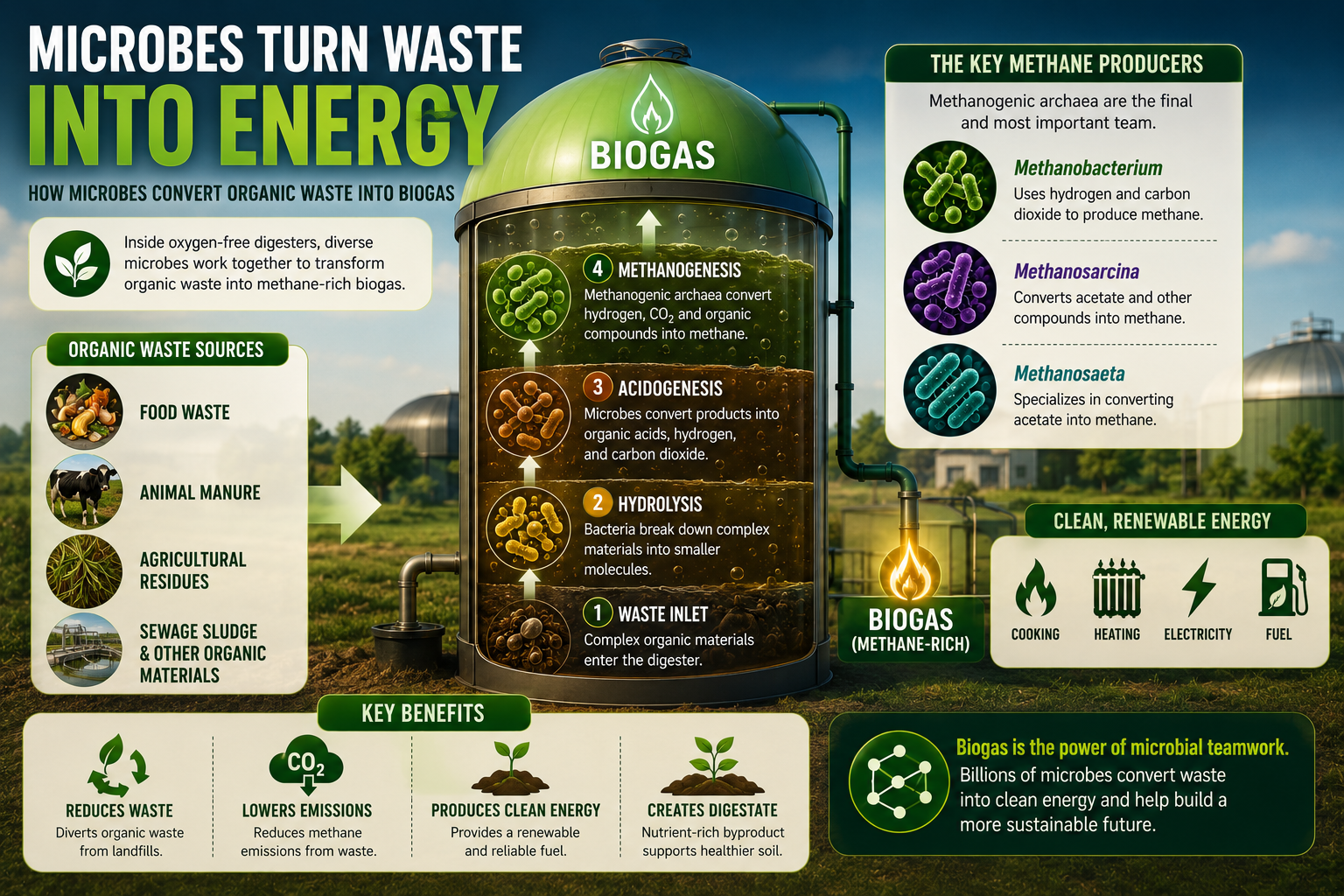
Biogas is one of the world's most important examples of microbes converting waste into useful energy. Every day, billions of microorganisms break down food waste, animal manure, sewage sludge, agricultural residues, and other organic materials, producing a renewable fuel that can be used for cooking, heating, electricity generation, and even transportation.
The process occurs inside oxygen-free environments known as anaerobic digesters. Rather than a single microbe doing all the work, biogas production depends on a diverse microbial community that works together to gradually convert complex waste into simpler compounds and eventually into methane-rich biogas.
The process begins with bacteria that break down large materials such as carbohydrates, proteins, and fats into smaller molecules. Other microbes then convert these products into organic acids, hydrogen, and carbon dioxide. Each group performs a specific step, passing its products to the next group of microorganisms.
The final and most important step is carried out by methanogenic archaea, including microbes such as Methanobacterium, Methanosarcina, and Methanosaeta. These microorganisms consume hydrogen, carbon dioxide, and organic compounds and convert them into methane, the main energy-rich component of biogas.
Biogas production is a remarkable example of microbial teamwork. No single microbe can efficiently convert complex organic waste into methane on its own. Instead, entire microbial communities cooperate to transform waste into usable energy.
Today, anaerobic digestion is used around the world to process agricultural waste, livestock manure, food waste, and sewage. Thousands of biogas plants operate across Europe, Asia, North America, and many other regions, helping reduce waste while generating renewable energy. In some countries, upgraded biogas—often called renewable natural gas or biomethane—is injected directly into natural gas networks.
The benefits extend beyond energy production. Anaerobic digestion helps reduce landfill waste, lowers odors, decreases methane emissions from unmanaged organic waste, and produces nutrient-rich digestate that can be used as a fertilizer.
Scientists continue working to improve biogas systems by optimizing microbial communities, increasing methane yields, and expanding the range of wastes that can be processed efficiently. However, the fundamental technology is already well established and widely used.
Every cubic meter of biogas represents billions of microbes transforming waste into energy. By converting discarded organic materials into a valuable fuel, microbial communities are helping create more sustainable systems for waste management, agriculture, and renewable energy production.
A biogas digester is a living factory where entire microbial ecosystems convert waste into usable energy.