
Agriculture depends heavily on nutrients such as nitrogen and phosphorus, but supplying these nutrients through chemical fertilizers can be expensive and may create environmental challenges. For decades, scientists and farmers have used beneficial microbes as biofertilizers to help plants obtain nutrients more naturally.
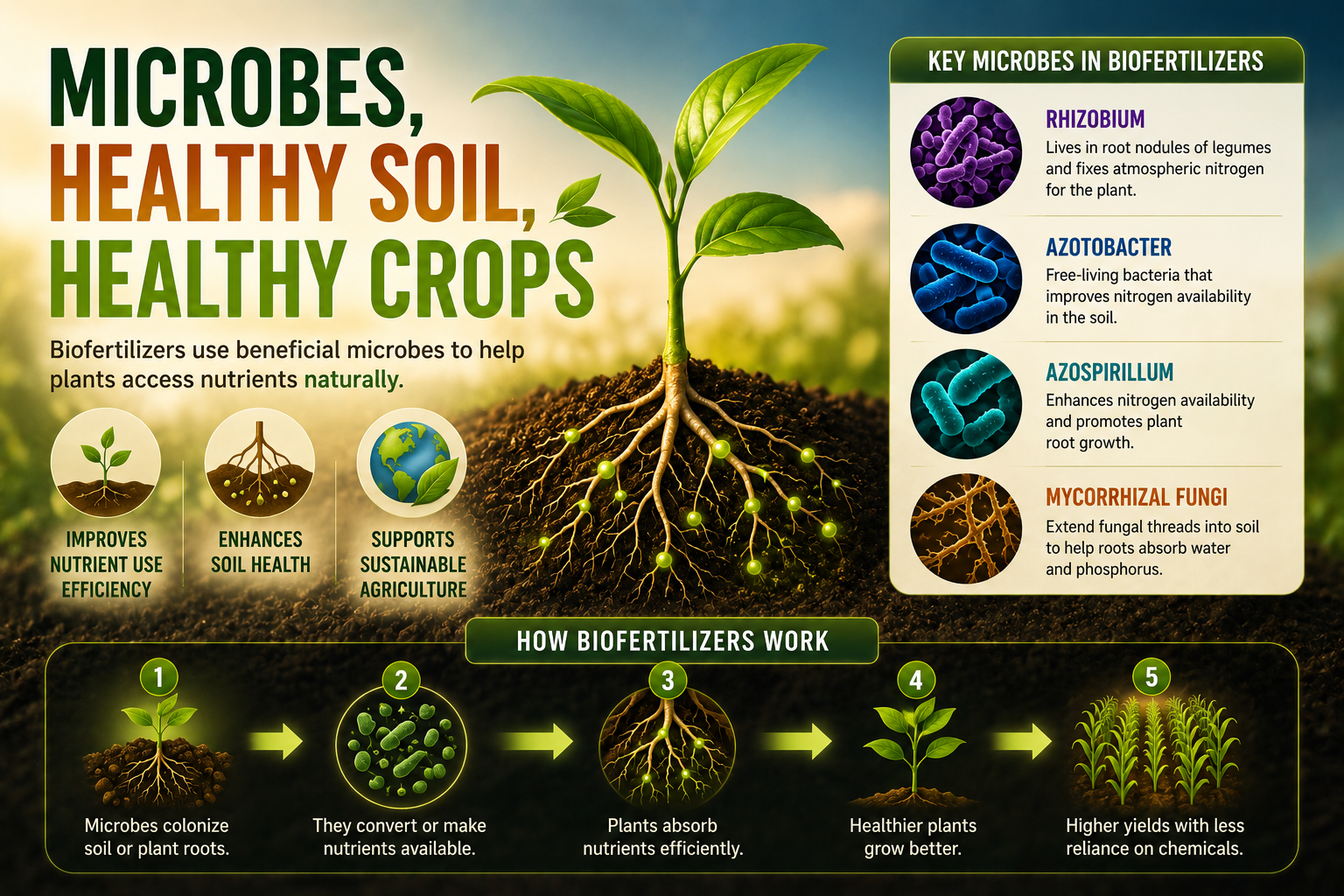
Biofertilizers contain living microorganisms such as Rhizobium, Azotobacter, Azospirillum, and mycorrhizal fungi. These microbes colonize the soil or plant roots and form beneficial partnerships with crops.
Some of the most important biofertilizer microbes are nitrogen fixers. Rhizobium bacteria live inside the root nodules of legumes such as peas, beans, and soybeans, where they convert atmospheric nitrogen into forms that plants can use. Other bacteria such as Azotobacter and Azospirillum can also improve nitrogen availability in the soil.
Mycorrhizal fungi help plants in a different way. Their thread-like structures extend far into the soil, allowing roots to access water and nutrients, particularly phosphorus, that might otherwise remain unavailable. In return, the plant provides the fungi with sugars produced through photosynthesis.
Rather than supplying nutrients directly, many biofertilizer microbes help plants access nutrients that already exist in the environment. This makes them fundamentally different from conventional fertilizers.
Today, biofertilizers are used in many agricultural systems around the world, particularly in legumes, cereals, horticultural crops, and sustainable farming programs. They are often used alongside conventional fertilizers rather than replacing them entirely.
Interest in biofertilizers has grown because they can improve nutrient-use efficiency, support soil health, and reduce some of the environmental impacts associated with excessive fertilizer use. However, their performance can vary depending on soil conditions, climate, crop type, and farming practices.
Every successful biofertilizer relies on a partnership between plants and microbes. By helping crops access essential nutrients more efficiently, these microorganisms have become important tools in efforts to make agriculture more productive and sustainable.
Biofertilizers work by activating one of nature's oldest partnerships: the alliance between microbes and plants.