
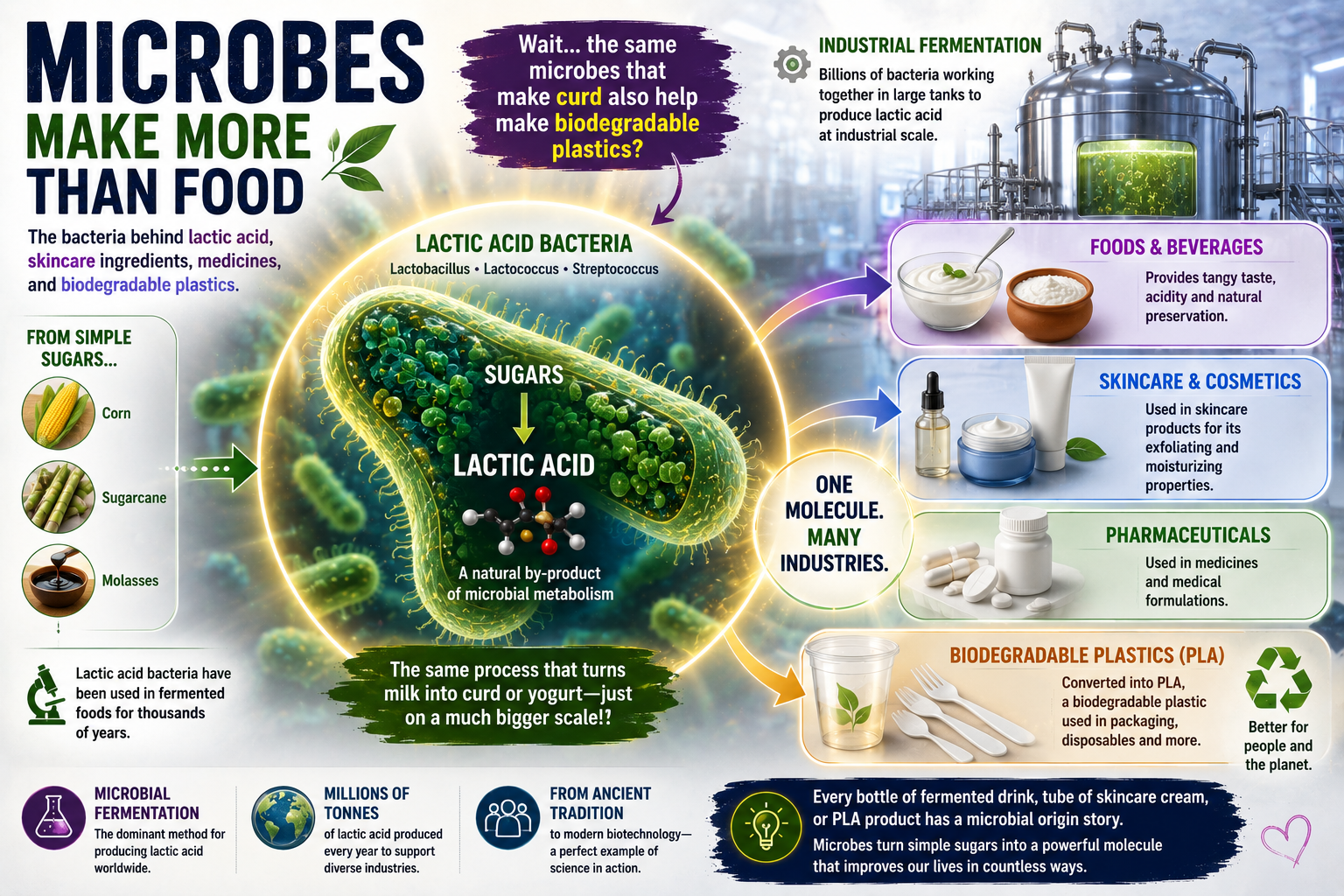
Lactic acid is all around us, although most people never notice it. It gives yoghurt and curd their familiar tangy taste, helps preserve many fermented foods, appears in skincare products, is used in pharmaceuticals, and even serves as a starting material for some biodegradable plastics. Surprisingly, much of this versatile compound is produced by microbes.
The main producers are lactic acid bacteria, including Lactobacillus, Lactococcus, and Streptococcus. These microbes have been helping humans make fermented foods for thousands of years, long before anyone understood what bacteria were.
When these bacteria are supplied with sugars from sources such as corn, sugarcane, or molasses, they begin feeding and growing. As they consume the sugars, they release lactic acid as a natural by-product of their metabolism. The acid gradually accumulates and can later be collected and purified for industrial use.
This is essentially the same process that turns milk into curd or yoghurt. The difference is scale. Instead of a kitchen container, industrial producers use large fermentation tanks containing billions of bacterial cells working continuously to manufacture lactic acid.
The microbes are performing a process that humans have relied on for centuries, but modern industry now carries it out on a massive scale. Today, microbial fermentation is the dominant method used to produce commercial lactic acid worldwide.
The applications are remarkably diverse. In foods, lactic acid provides acidity, flavour, and preservation. In cosmetics, it is used in skincare products because of its exfoliating properties. Pharmaceutical companies use it in medicines and medical formulations.
Lactic acid has also gained attention as the starting material for polylactic acid (PLA), a biodegradable plastic used in some packaging and disposable products. While PLA currently represents only a small fraction of global plastic production, it demonstrates how a compound made by bacteria can be transformed into entirely new classes of materials.
Today, millions of tonnes of lactic acid are produced annually, supporting industries that range from food and beverages to healthcare and materials manufacturing.
Every bottle of fermented drink, tube of skincare cream, or PLA product containing lactic acid can trace part of its origin back to microbial fermentation. By converting simple sugars into a highly useful chemical, microbes have become the foundation of one of the world's largest and most versatile fermentation industries.
Lactic acid may be one of the best examples of microbes turning biology into industry.