
Most plastics are made from petroleum and can persist in the environment for decades or even centuries. Scientists have therefore explored whether microbes can help produce alternative materials that are capable of breaking down more readily under suitable conditions.
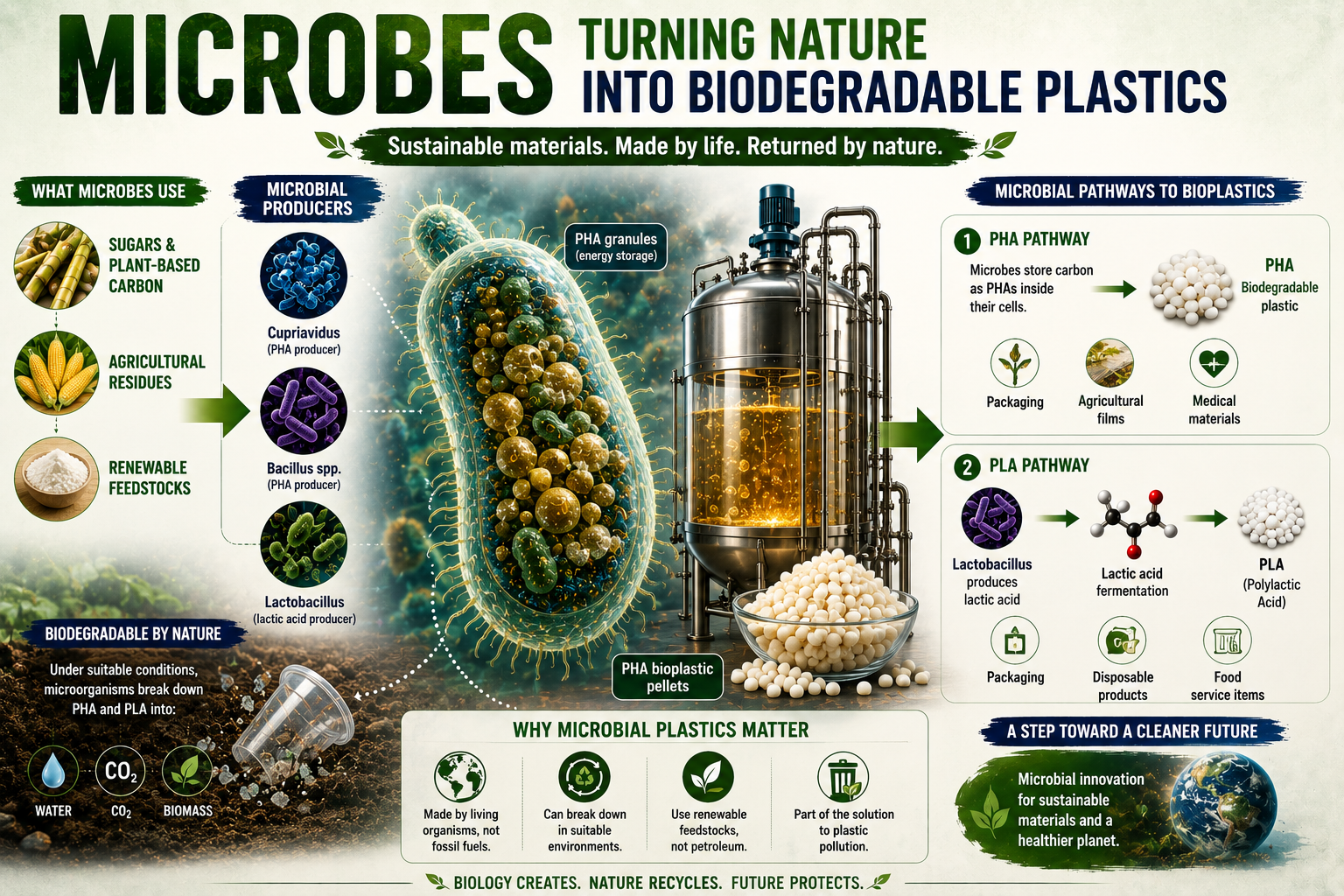
Some bacteria naturally produce substances called polyhydroxyalkanoates (PHAs). Microbes such as Cupriavidus and certain Bacillus species manufacture these compounds inside their cells when they have access to abundant carbon but limited supplies of other nutrients. In nature, PHAs act as energy reserves that the microbes can use later when conditions become less favorable.
In industrial production, these microbes are grown in fermentation tanks and encouraged to accumulate large amounts of PHAs. The material is then extracted and processed into biodegradable plastics that can be used in selected products such as packaging, agricultural films, and some medical materials.
Unlike conventional plastics, PHAs are produced by living organisms rather than from fossil fuels. Under suitable conditions, many microorganisms can break these materials down into simpler compounds, although the speed and extent of degradation depend on the environment.
Another microbial contribution involves lactic acid, which is produced by bacteria such as Lactobacillus. Lactic acid can be converted into polylactic acid (PLA), a biodegradable plastic used in some packaging and disposable products. While the plastic itself is manufactured through industrial processes, microbial fermentation plays an important role in producing the starting material.
Today, biodegradable plastics derived from microbial processes represent only a small share of global plastic production. Although several products are commercially available, higher production costs and competition from conventional plastics have limited wider adoption.
Microbial plastics demonstrate that microorganisms can be used to manufacture useful materials as well as food, medicines, and fuels. While they are unlikely to eliminate plastic pollution on their own, they provide a practical example of how biology can contribute to the development of alternative materials.
Tiny bacteria can act as living plastic factories, producing materials from renewable resources.