
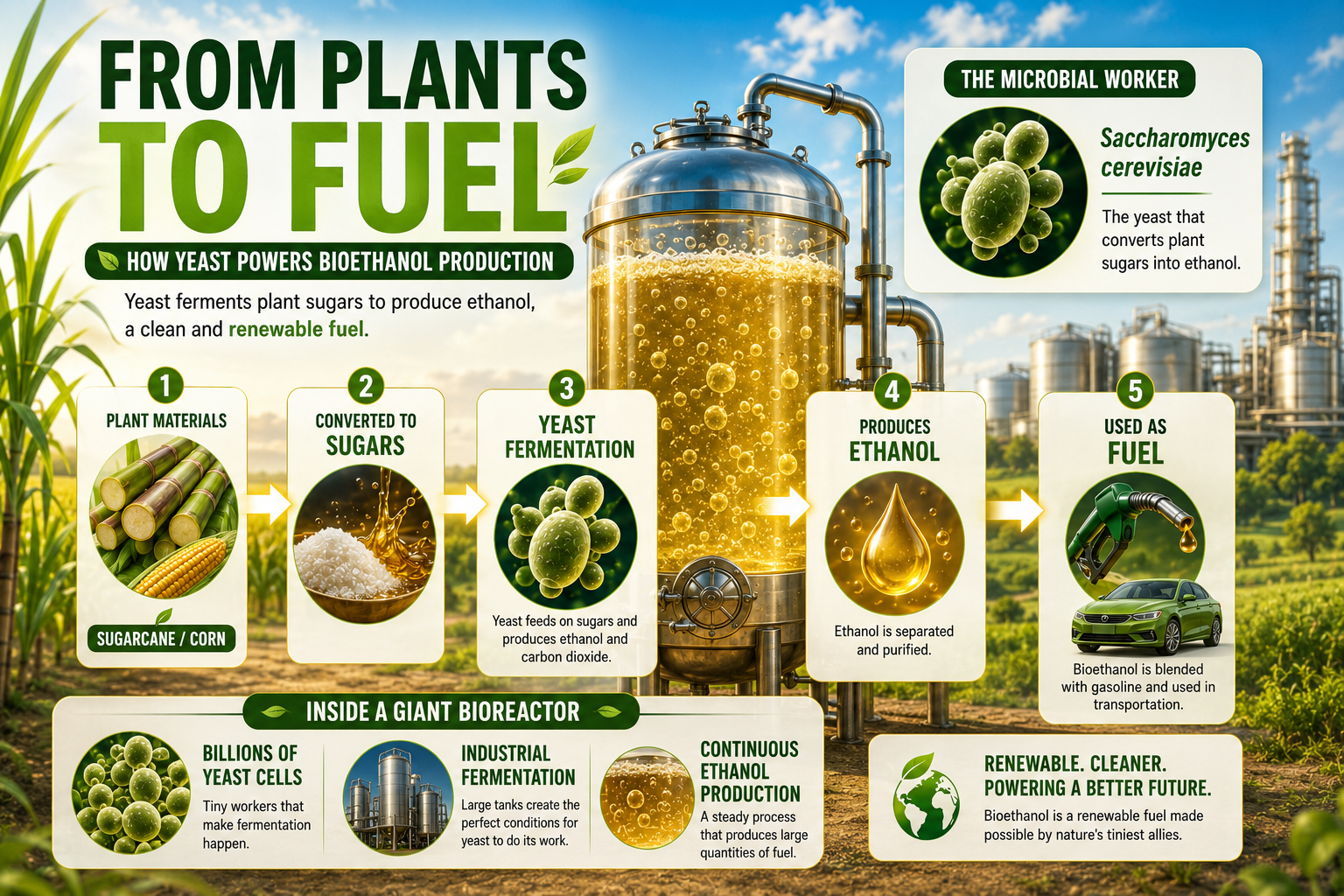
Every year, billions of litres of bioethanol are produced by microbes. Although bioethanol is often discussed as a renewable fuel, the process behind it is surprisingly simple: tiny microorganisms convert plant sugars into alcohol through fermentation.
The main microbe responsible is yeast, particularly Saccharomyces cerevisiae. The same organism that helps make bread rise and produces beer and wine is also used in large industrial facilities to manufacture fuel.
The process begins with crops such as sugarcane and corn. These plants contain large amounts of sugars or starches, which are converted into sugars that yeast can consume. As the yeast feeds, it produces ethanol and carbon dioxide.
In many ways, a bioethanol plant operates like a giant brewery. Instead of producing beverages, however, the fermentation process is optimised to produce fuel that can be blended with gasoline and used in transportation.
Without microbial fermentation, modern bioethanol production would not exist. Yeast performs the key biological step that transforms plant-derived sugars into a usable liquid fuel.
Today, Brazil and the United States are the world's largest producers of bioethanol. Brazilian production relies mainly on sugarcane, while most American bioethanol is produced from corn. Together, these industries process enormous quantities of agricultural products every year.
Researchers have also explored producing bioethanol from crop residues such as straw and corn stalks. While technically possible, these materials are more difficult and expensive to process than conventional feedstocks, which has limited their widespread adoption.
Bioethanol remains one of the most commercially successful renewable fuels currently available. However, its environmental benefits depend on factors such as the crops used, farming practices, land use, and production efficiency.
Every litre of bioethanol begins with a microbe feeding on plant sugars. By carrying out a natural fermentation process, yeast helps convert agricultural products into one of the world's most widely used renewable fuels.
Long before humans invented engines, microbes had already mastered the chemistry needed to create liquid fuels.