Cheese is one of the world's most diverse foods, with more than 2,000 varieties enjoyed across different cultures and cuisines. From soft mozzarella and creamy Brie to sharp Cheddar and blue-veined Roquefort, the remarkable differences between cheeses are created largely by microbes. Without them, cheese would simply remain milk.
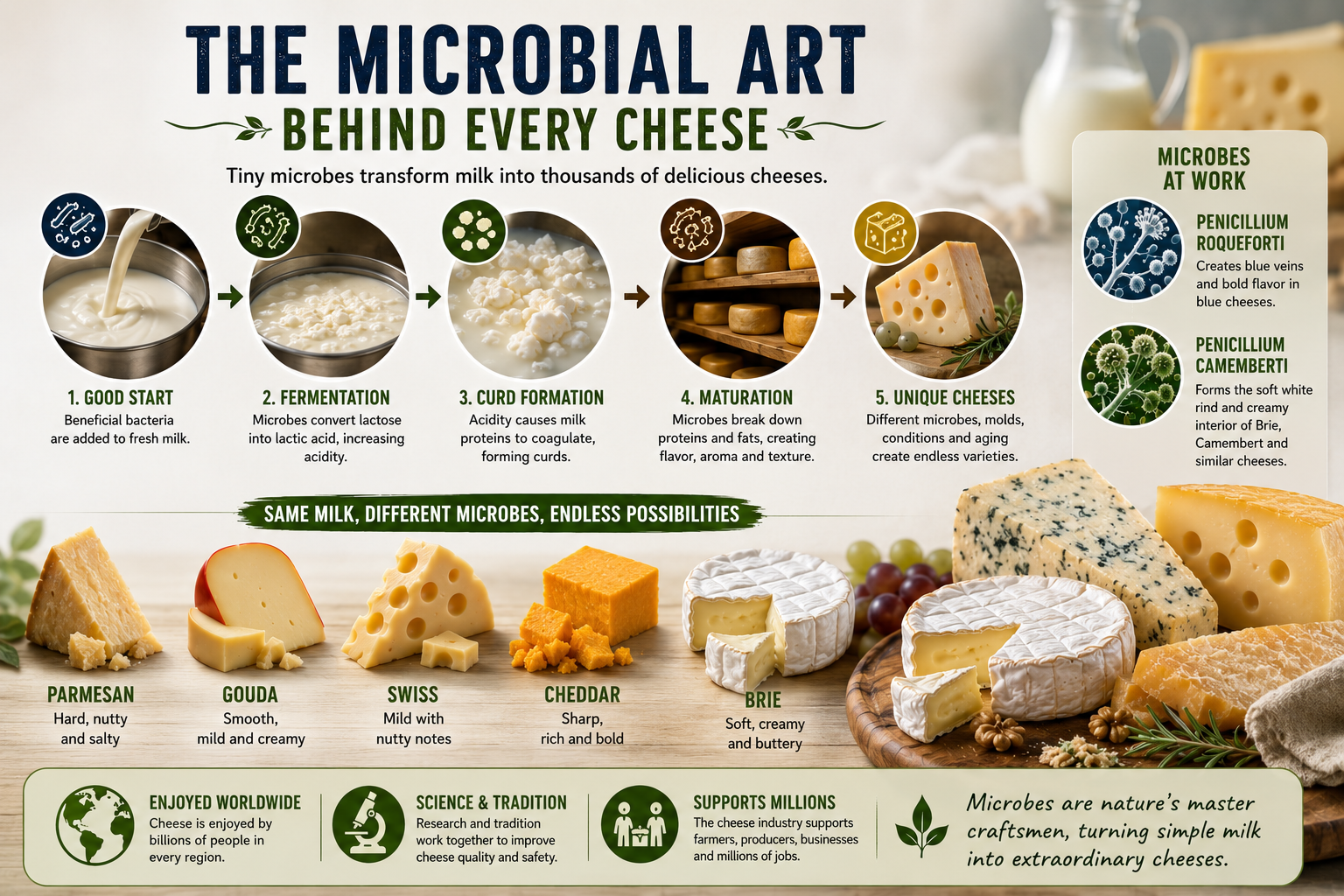
The process begins when beneficial bacteria such as Lactococcus, Lactobacillus, and Streptococcus are added to fresh milk. These microbes feed on lactose, the natural sugar in milk, and convert it into lactic acid. As the acidity increases, the milk proteins begin to coagulate, forming the curds that become cheese.
The microbes do far more than turn milk into curds. As the cheese matures, they continue breaking down proteins and fats into hundreds of smaller compounds that create the characteristic flavours, aromas, and textures of different cheeses. The longer many cheeses age, the more time these microbes have to shape their final character.
Some of the world's most famous cheeses depend on molds rather than bacteria alone. Penicillium roqueforti creates the blue veins and bold flavour of blue cheeses, while Penicillium camemberti forms the soft white rind and creamy interior of cheeses such as Brie and Camembert. Different combinations of bacteria, molds, temperature, humidity, and ageing time produce the enormous variety of cheeses found today.
The same milk can become completely different cheeses simply by changing the microbes involved. This is why identical milk can be transformed into Parmesan, Gouda, Swiss, Cheddar, or Brie, each with its own unique taste, texture, and appearance.
Today, cheese is produced in almost every region of the world and is consumed by billions of people. The global cheese industry is worth hundreds of billions of dollars and supports dairy farmers, cheesemakers, food manufacturers, distributors, retailers, and millions of jobs across the food supply chain.
Scientists continue studying cheese microbes to better understand how they influence flavor development, texture, food safety, and shelf life. This research is helping producers improve traditional cheeses while also developing new varieties with distinctive characteristics.
Every piece of cheese is the result of microbial craftsmanship. For thousands of years, bacteria and fungi have transformed fresh milk into one of humanity's most diverse, flavorful, and economically important foods, demonstrating how tiny microorganisms can create extraordinary culinary diversity.
The next time you eat cheese, remember: its flavor was designed by microbes.