A relatively small group of microbes supports a surprisingly large share of life on Earth. In oceans, lakes, soils, and even extreme environments, these microorganisms act as primary producers, decomposers, and nutrient recyclers that sustain entire ecosystems.
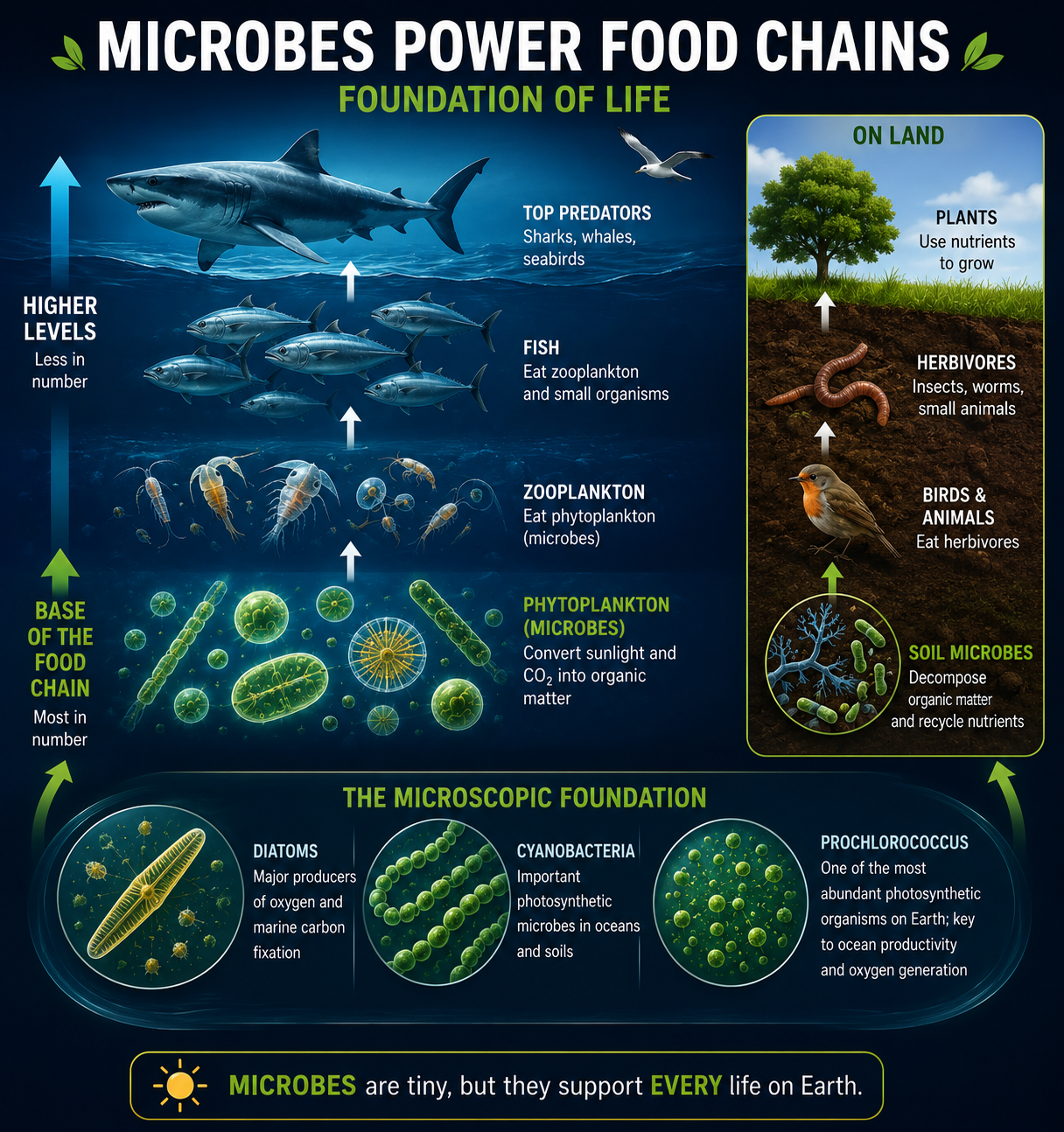
In marine ecosystems, phytoplankton form the base of most food chains. This group includes:
-
diatoms
-
cyanobacteria
-
dinoflagellates
-
coccolithophores
These photosynthetic microbes convert sunlight and carbon dioxide into organic matter that feeds zooplankton, fish, and eventually larger marine animals. Diatoms alone contribute significantly to global oxygen production and marine carbon fixation.
Among the most important cyanobacteria is Prochlorococcus, one of the most abundant photosynthetic organisms on Earth. Despite being microscopic, it plays a major role in ocean productivity and atmospheric oxygen generation.
In terrestrial ecosystems, soil microbes such as bacteria and fungi decompose dead organic matter and recycle nutrients back into the environment. Without them, ecosystems would rapidly accumulate undecomposed material and lose nutrient availability.
Nitrogen-fixing microbes are especially important because they convert atmospheric nitrogen into biologically usable forms. Species such as Rhizobium form symbiotic relationships with plants and help sustain agricultural and natural ecosystems.
In deep-sea hydrothermal vent ecosystems, where sunlight does not penetrate, chemosynthetic microbes form the foundation of entire food webs by generating energy from sulfur and other inorganic compounds.
Although often invisible, these microbes support the productivity, nutrient cycling, and energy flow of nearly every major ecosystem on Earth. Many larger organisms ultimately depend on microbial processes either directly or indirectly for survival.
From ocean plankton to soil decomposers, microbes support many of the food chains that maintain life on Earth.