Modern microbiology has been shaped by a small group of researchers whose discoveries transformed how we understand microbes, ecosystems, health, and evolution.
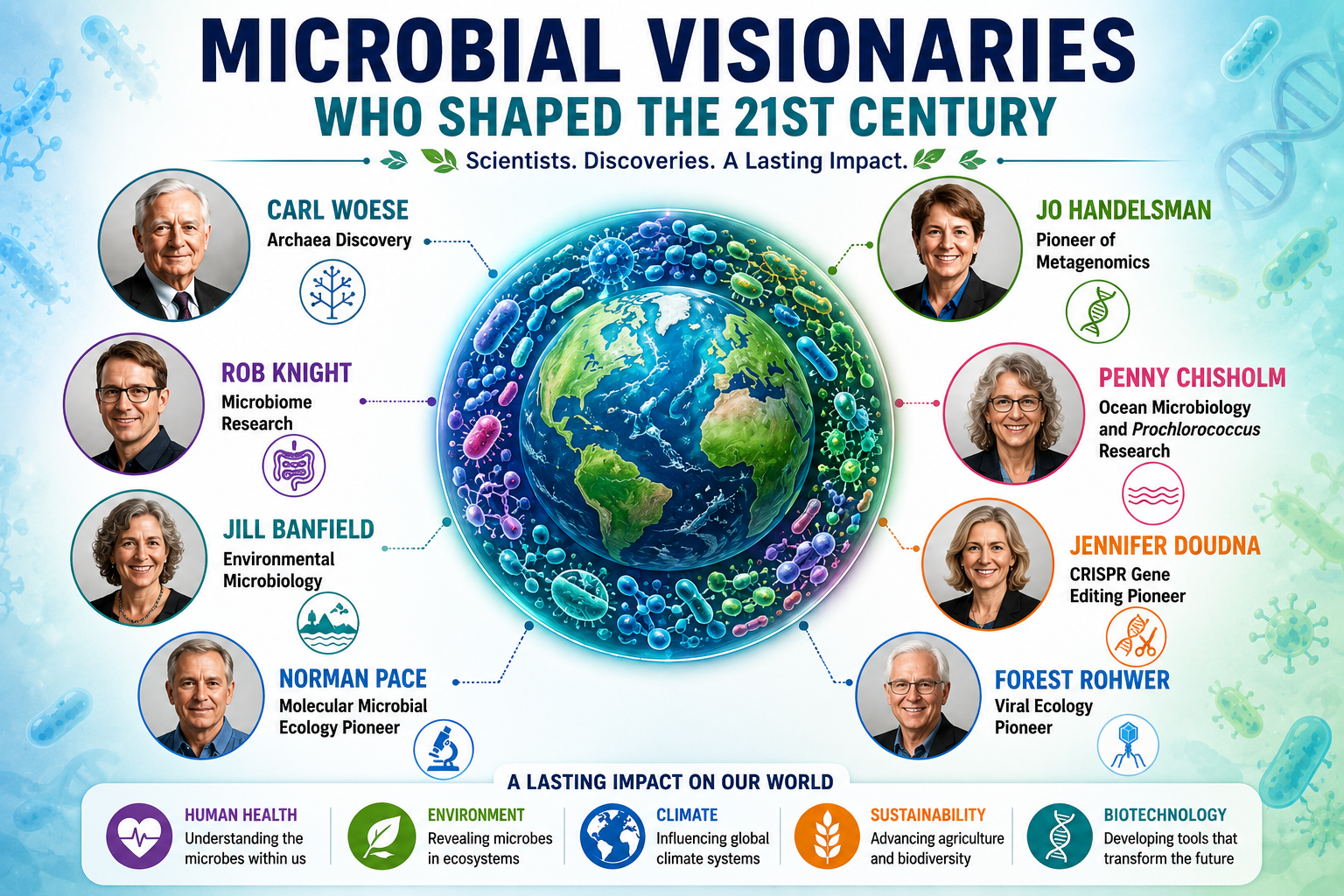
Carl Woese fundamentally changed biology by discovering the domain Archaea. His work revealed that the microbial world was far more diverse than scientists had imagined.
Jo Handelsman helped pioneer metagenomics, allowing researchers to study entire microbial communities directly from environmental samples rather than relying only on laboratory cultures.
Rob Knight became one of the leading figures in microbiome research. His work helped uncover how microbial communities influence human health, nutrition, and disease.
Jill Banfield transformed environmental microbiology through genome-based studies of microbial ecosystems. Her research revealed many previously unknown branches of microbial life.
Penny Chisholm revolutionized ocean microbiology through her work on Prochlorococcus, one of the most abundant photosynthetic organisms on Earth and a major contributor to global oxygen production.
Norman Pace pioneered molecular approaches for studying microbes in natural environments. Many modern microbial ecology techniques trace their origins to his work.
Jennifer Doudna helped develop CRISPR gene editing after studying microbial defense systems. Her work turned a bacterial immune mechanism into a transformative biotechnology.
Forest Rohwer helped establish the field of viral ecology. His research showed how viruses influence microbial communities and shape ecosystems across the oceans.
Together, these scientists helped reveal a hidden world that influences everything from human health to climate systems, making microbiology one of the most transformative sciences of the modern era.
The microbial revolution transformed microbes from unseen curiosities into some of the most important subjects in science.