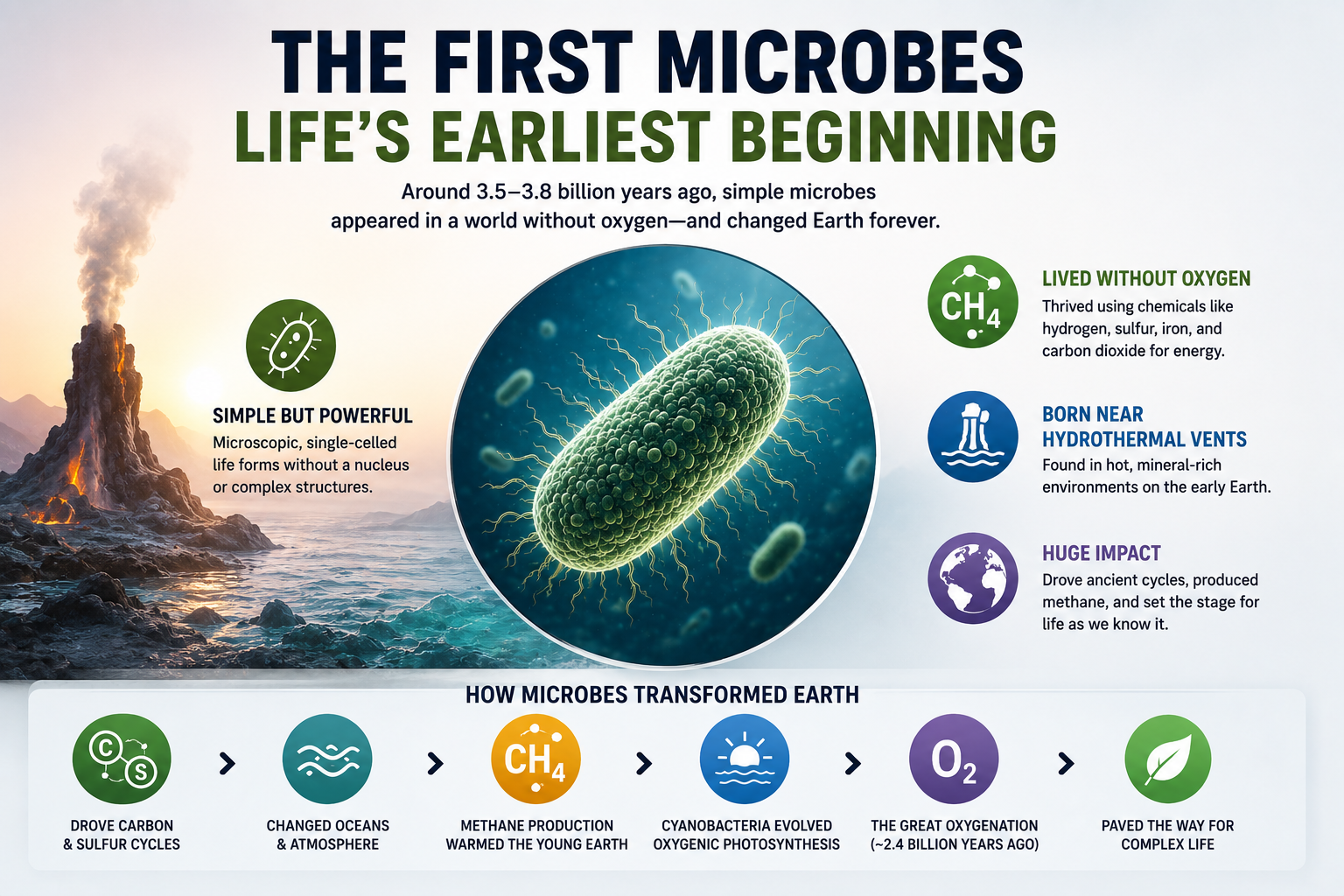
The first microbes on Earth likely appeared around 3.5–3.8 billion years ago, at a time when the planet was still volcanically active and the atmosphere contained almost no oxygen. Scientists cannot identify a single exact “first microbe,” but the earliest organisms were probably simple prokaryotic cells resembling modern archaea and bacteria.
Among the strongest candidates are methanogens, ancient archaea that survive without oxygen and produce methane gas through anaerobic metabolism. These microbes likely lived near hydrothermal vents and chemically active oceans, where they obtained energy from compounds such as hydrogen, sulfur, iron, and carbon dioxide rather than from sunlight.
Structurally, these early microbes were:
- microscopic and single-celled
- lacking a nucleus and complex organelles
- highly tolerant of heat and chemically unstable environments
- dependent on chemical energy instead of oxygen-based respiration
Despite their simplicity, their impact on Earth was enormous. Early microbes helped drive primitive carbon and sulfur cycles, altered ocean and atmospheric chemistry, and may have warmed the young Earth through methane production when the Sun was still weaker than it is today.
Much later, microbes such as cyanobacteria evolved oxygen-producing photosynthesis, eventually triggering the Great Oxygenation Event around 2.4 billion years ago. This permanently transformed Earth’s atmosphere and created conditions that allowed complex multicellular life to evolve.
Evidence for these ancient microbes comes from stromatolites, fossilized microbial structures, and isotopic signatures preserved in Archean rocks. Although the exact first microbe may never be identified, scientists widely agree that microbial life shaped Earth’s oceans, atmosphere, and biochemical systems billions of years before plants or animals appeared.
The earliest microbial life laid the biochemical foundations on which all later life evolved.