
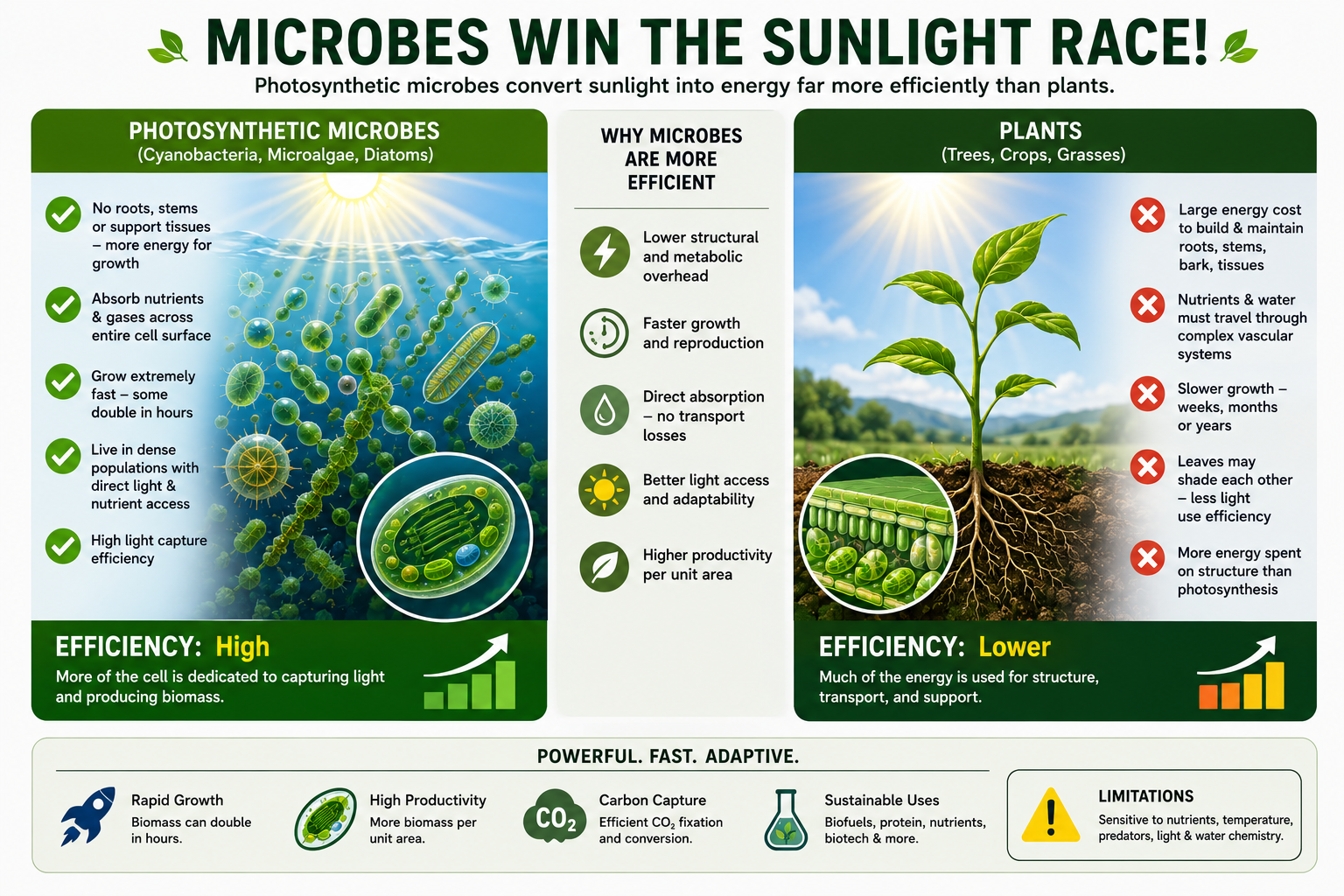
Photosynthetic microbes are generally far more efficient than plants at converting sunlight into biological energy because they operate with much lower structural and metabolic overhead.
A large portion of a plant’s energy is spent maintaining roots, stems, bark, vascular tissues, and supportive structures that are not directly involved in photosynthesis. Photosynthetic microbes such as cyanobacteria, diatoms, and microalgae do not invest energy into these large non-photosynthetic organs. Much more of their biomass is devoted directly to capturing light and producing cellular material.
This gives microbes several important advantages.
First, many photosynthetic microbes grow extremely rapidly. Certain microalgae can double their biomass within hours, whereas plants may require weeks, months, or years to generate comparable growth.
Second, microbes absorb nutrients and gases directly across their entire cell surface. Plants must transport water, minerals, and sugars through complex vascular systems, which consumes additional energy.
Third, aquatic photosynthetic microbes often exist as dense suspended populations exposed directly to light and dissolved nutrients. In oceans and lakes, phytoplankton continuously adjust their position, pigment composition, and metabolism in response to changing environmental conditions much faster than most plants can.
Diatoms are especially efficient because their microscopic silica structures optimize light capture and nutrient exchange. Cyanobacteria, meanwhile, evolved some of Earth’s earliest oxygen-producing photosynthetic systems and still contribute significantly to global oxygen production.
Under ideal laboratory conditions, some microalgae can convert solar energy into biomass several times more efficiently than major agricultural crops. Their productivity per unit area can greatly exceed that of terrestrial plants.
However, microbial photosynthesis also has limitations. Many photosynthetic microbes are highly sensitive to:
-
nutrient availability
-
temperature changes
-
grazing by predators
-
light fluctuations
-
water chemistry
Even so, their efficiency, rapid growth, and adaptability make photosynthetic microbes some of the most powerful solar-driven biological systems on Earth. This is why they are increasingly studied for biofuels, carbon capture, sustainable protein production, and advanced biotechnology systems.
Photosynthetic microbes are among the most efficient solar-powered biological systems on Earth.