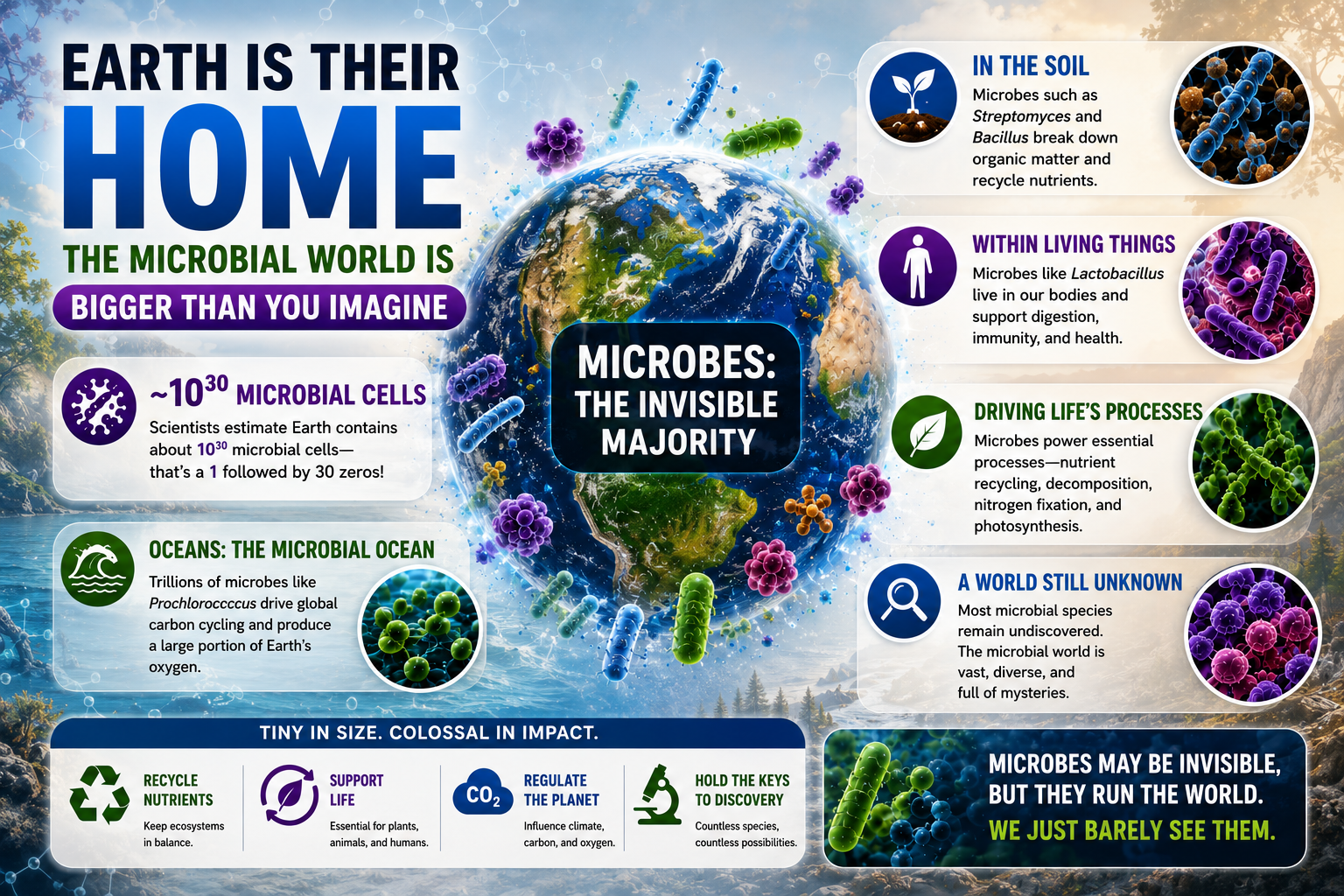
The number of microbes on Earth is almost beyond comprehension. Scientists estimate that our planet contains roughly 10³⁰ microbial cells, a figure so large that it is difficult to visualize. Written out, it is a 1 followed by 30 zeros.
These microbes inhabit nearly every environment imaginable. Vast populations of bacteria such as Prochlorococcus fill the oceans, while soil microbes including Streptomyces and Bacillus thrive beneath our feet. Other microorganisms, such as Lactobacillus, live within animals and humans, forming complex microbial communities.
The oceans alone contain enormous numbers of microbes. Prochlorococcus, one of the most abundant photosynthetic organisms on Earth, is thought to number in the octillions and plays a major role in global carbon cycling and oxygen production.
Despite their microscopic size, the combined biomass of Earth's microbes is immense. Collectively, they outweigh many groups of larger organisms and drive essential processes such as nutrient recycling, decomposition, nitrogen fixation, and photosynthesis.
What makes this estimate even more remarkable is that most microbial species remain undiscovered. Although scientists have identified many important microbes, the majority of Earth's microbial diversity is still unknown, suggesting that much of the microbial world remains unexplored.
If every microbe on Earth were the size of a grain of sand, they could bury the planet many times over.