
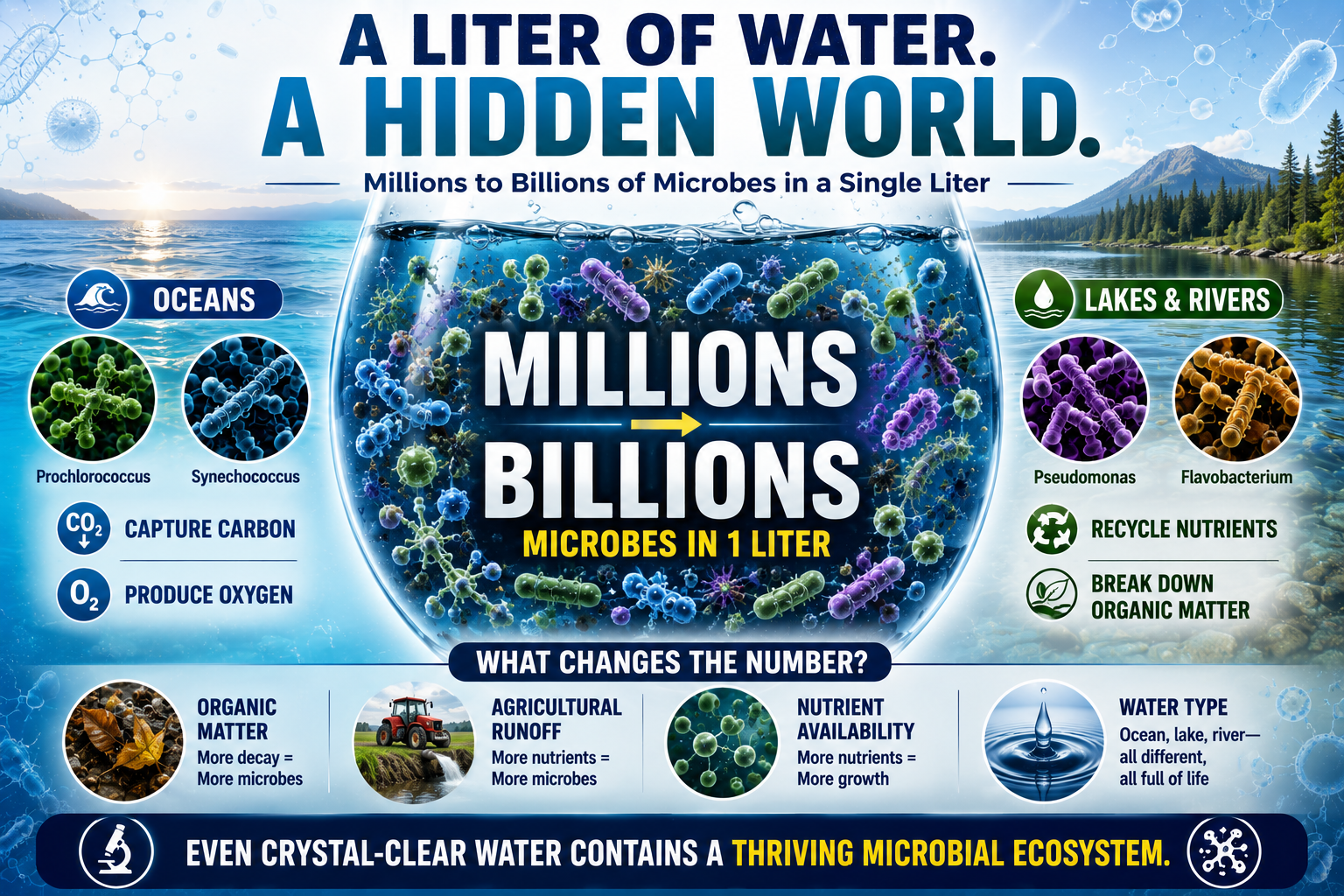
One liter of natural water can contain millions to billions of microbes, depending on where the water comes from and how nutrient-rich it is. A clear mountain lake, a muddy river, and a coastal ocean sample will not contain the same microbial load.
In ocean water, bacteria such as Prochlorococcus and Synechococcus can be extremely abundant, especially in sunlit surface waters. These tiny photosynthetic microbes help capture carbon dioxide and contribute to oxygen production.
Freshwater lakes and rivers contain different microbial communities. Bacteria such as Pseudomonas, Flavobacterium, and Actinobacteria help break down organic matter and recycle nutrients within aquatic ecosystems.
Water with more decaying plant material, sewage input, or agricultural runoff usually contains higher microbial numbers. In such conditions, microbes multiply rapidly because more nutrients are available.
So, while the exact number varies widely, a single liter of lake, river, or ocean water may hold an entire microscopic ecosystem. Even water that looks clean can contain vast microbial communities carrying out essential chemical work.
Even the clearest water can contain a hidden world of millions to billions of living organisms.