
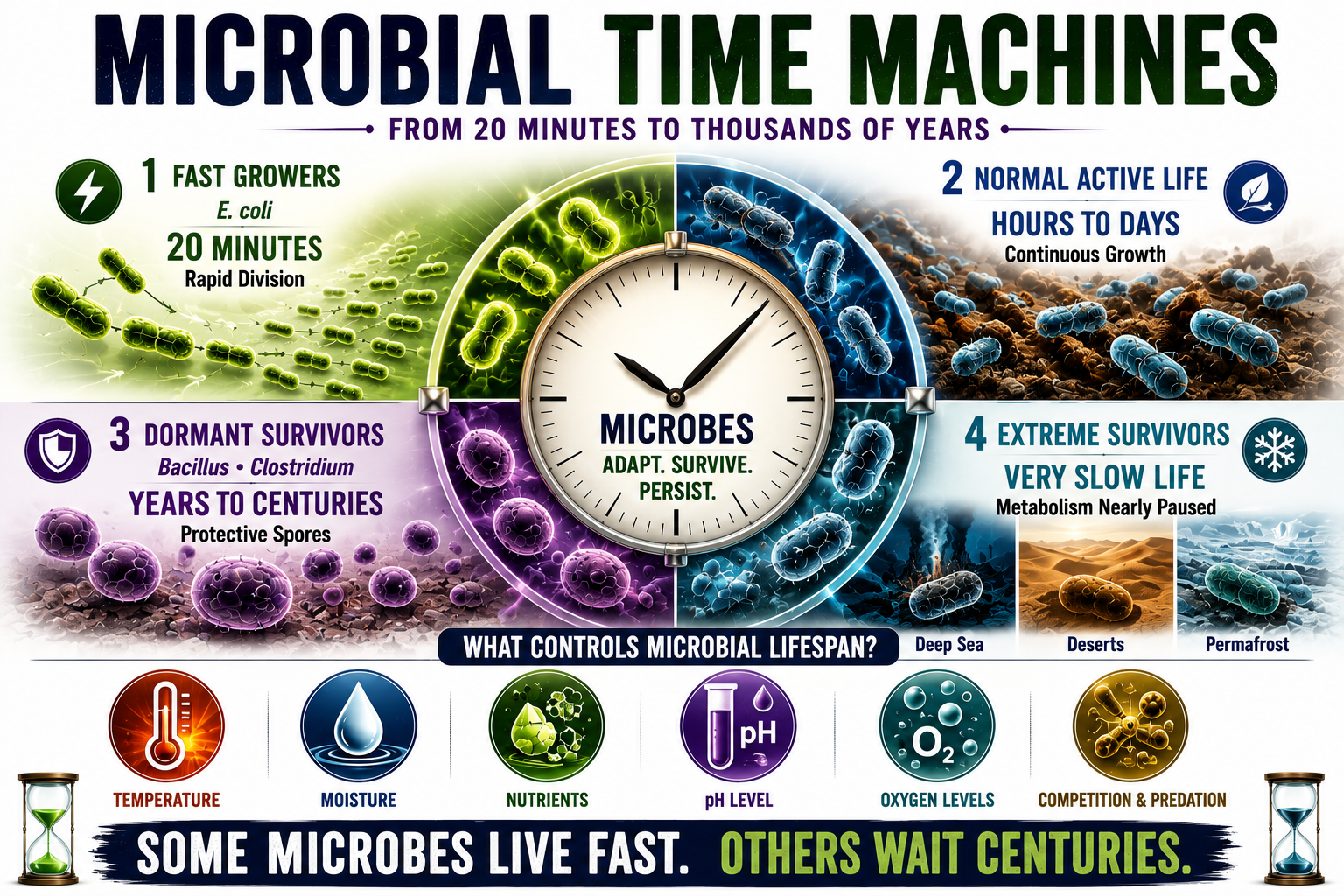
Microbial lifespans vary enormously. Some microbes live for only a few hours or days, while others can survive for years, centuries, or even longer under the right conditions. The lifespan of a microbe depends on its species, environment, access to nutrients, and ability to withstand stress.
Many bacteria reproduce rapidly and have relatively short lives. Under favorable conditions, organisms such as Escherichia coli can divide every 20 minutes, producing new generations continuously as long as nutrients remain available.
Other microbes are adapted for long-term survival. Species of Bacillus and Clostridium can form highly resistant spores that remain dormant for years when exposed to heat, dryness, radiation, or nutrient scarcity. Once conditions improve, the spores can become active again.
Some microorganisms survive in extreme environments where growth is very slow. Certain deep-sea microbes, desert bacteria, and permafrost microorganisms may persist for remarkably long periods because low temperatures and limited resources reduce metabolic activity.
Viruses occupy a special category. Outside a host cell, viruses such as influenza viruses or bacteriophages are inactive particles rather than living cells. Their survival depends on environmental conditions and the availability of suitable hosts.
Factors such as temperature, moisture, oxygen levels, pH, nutrient availability, competition, and predation all influence microbial lifespan. A microbe living in a nutrient-rich environment may reproduce rapidly but die quickly, while another may survive for long periods in a dormant state.
Rather than having a single typical lifespan, microbes have evolved a wide range of survival strategies. Their ability to switch between rapid growth and long-term persistence is one reason they have successfully colonized nearly every environment on Earth.
Microbial survival is measured not just in years, but in an extraordinary ability to adapt and endure.