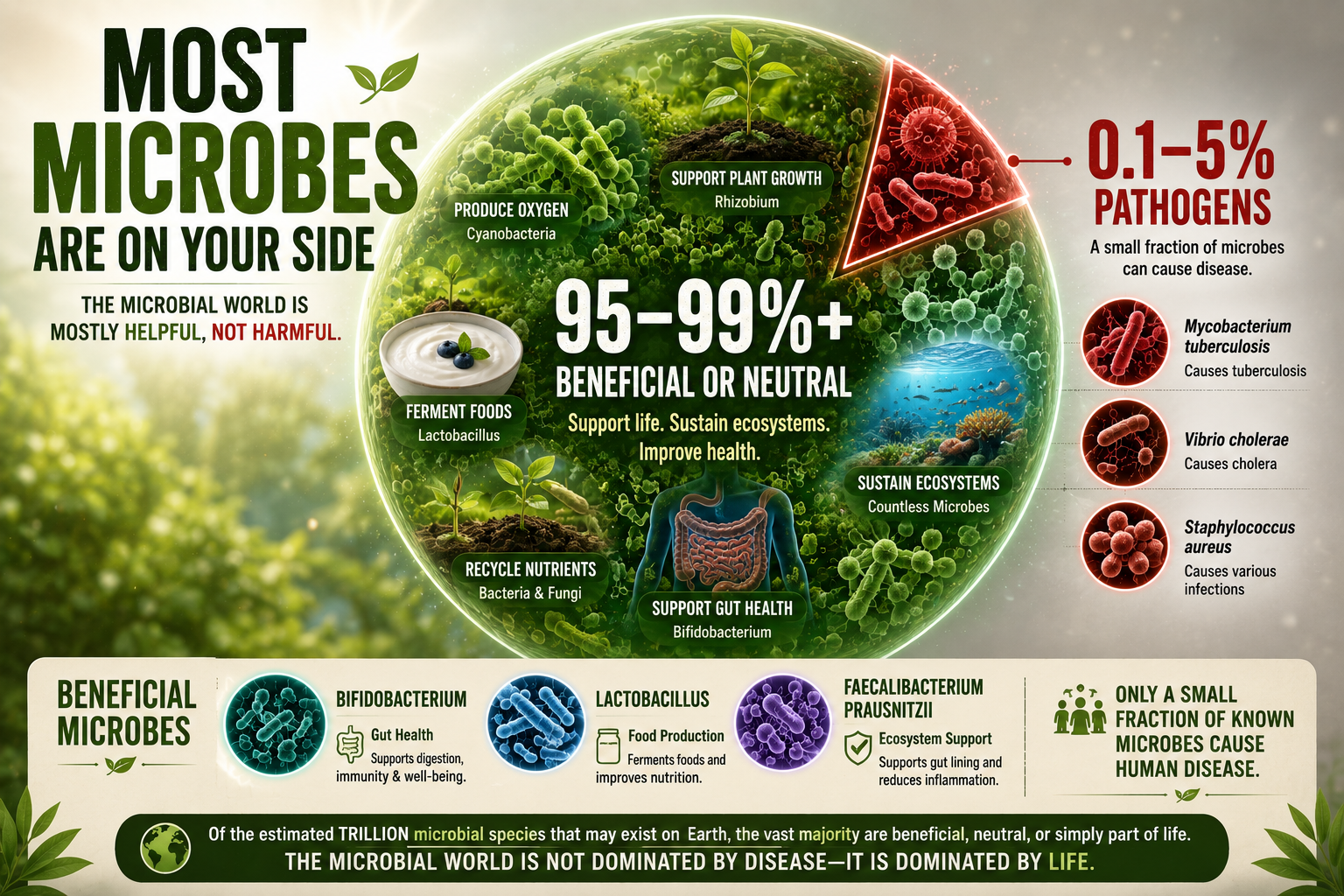
Despite their reputation, only a small fraction of microbes are harmful to humans. Scientists estimate that among the vast diversity of microbial life, only a tiny percentage are known to cause disease, while the overwhelming majority are either beneficial, neutral, or have no direct effect on human health.
Many microbes actively support life. In the human gut, organisms such as Bifidobacterium, Lactobacillus, and Faecalibacterium prausnitzii help digest food, produce useful compounds, and interact with the immune system. Similar microbial communities are found on the skin, in the mouth, and throughout the environment.
Beyond the human body, microbes perform functions that make modern ecosystems possible. Rhizobium supplies plants with usable nitrogen, cyanobacteria contribute to global oxygen production, and countless bacteria and fungi recycle nutrients by decomposing dead organic matter.
A relatively small number of microbes are responsible for most infectious diseases. Organisms such as Mycobacterium tuberculosis, Vibrio cholerae, and Staphylococcus aureus can cause serious illness, but they represent a tiny fraction of Earth's microbial diversity.
The same pattern appears across the microbial world. Of the estimated trillion microbial species that may exist on Earth, only a very small proportion are known pathogens. Most are either harmless, poorly understood, or perform ecological functions that indirectly support human life.
For much of history, microbes were associated primarily with disease because harmful species attract attention. Modern microbiology has revealed a very different picture: the microbial world is dominated not by pathogens, but by organisms that help sustain ecosystems, agriculture, food production, and human health.
The greatest microbial story is not one of disease, but of billions of unseen organisms continuously supporting the living world.