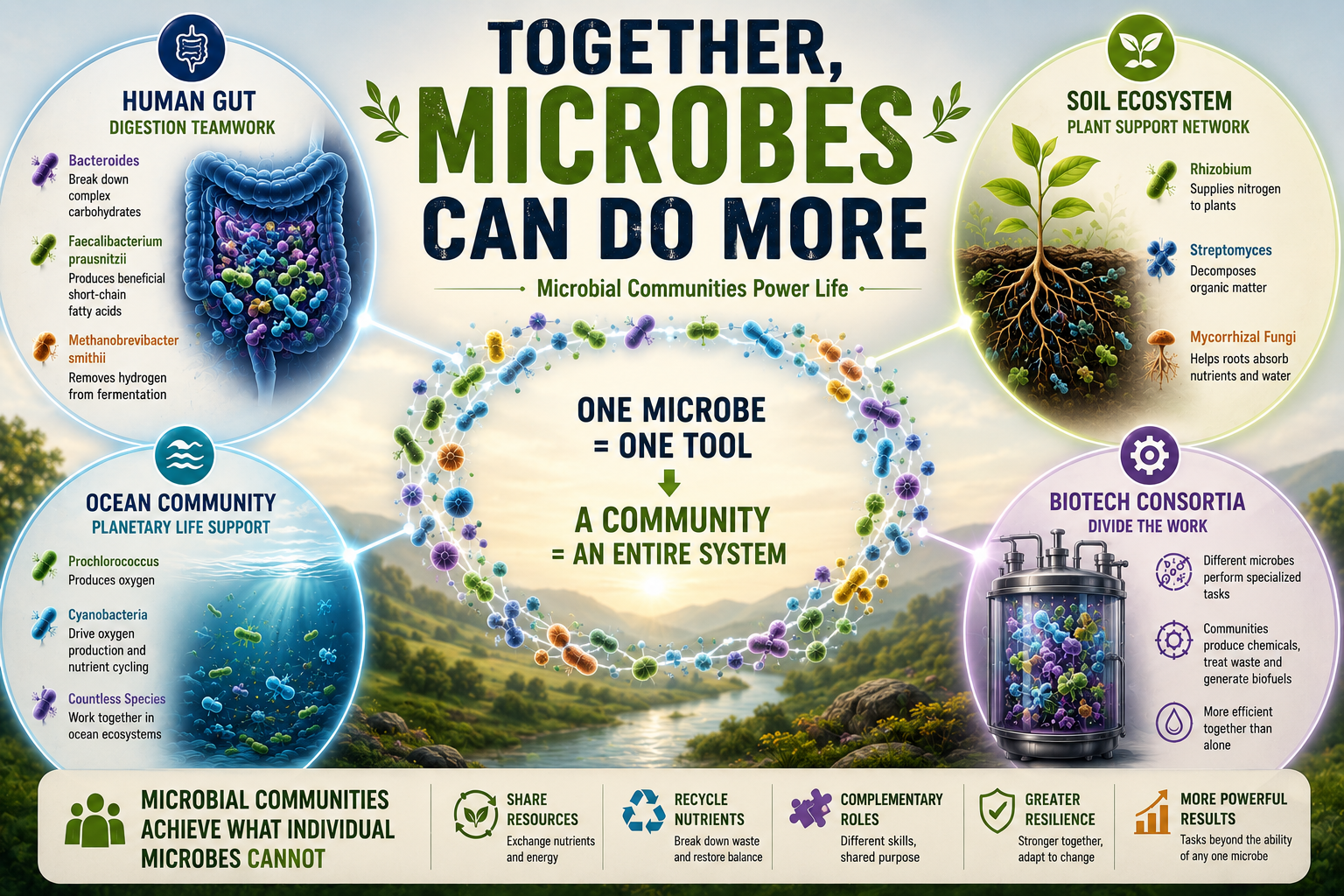
Most microbes do not live alone. In nature, they form complex communities where different species exchange nutrients, remove waste products, and perform complementary functions.
The human gut is a good example. Bacteroides break down complex carbohydrates, Faecalibacterium prausnitzii produces beneficial short-chain fatty acids, and Methanobrevibacter smithii removes hydrogen generated during fermentation. Together, they accomplish far more than any one species could alone.
Similar cooperation occurs in soils. Rhizobium supplies nitrogen to plants, Streptomyces decomposes organic matter, and mycorrhizal fungi help roots absorb nutrients and water.
Large microbial communities also drive planetary processes. Ocean microbes such as Prochlorococcus, cyanobacteria, and countless other species collectively influence oxygen production, carbon cycling, and nutrient recycling.
Scientists increasingly use microbial consortia in biotechnology because different microbes can be assigned different jobs. Communities often produce chemicals, treat waste, or generate biofuels more efficiently than individual species.
A single microbe performs a limited set of functions. A microbial community combines many capabilities into a coordinated system, allowing it to carry out biological tasks that no individual microbe could achieve alone.
The true power of microbes is not found in individual cells, but in the vast cooperative networks that allow them to function as living systems within living systems.