
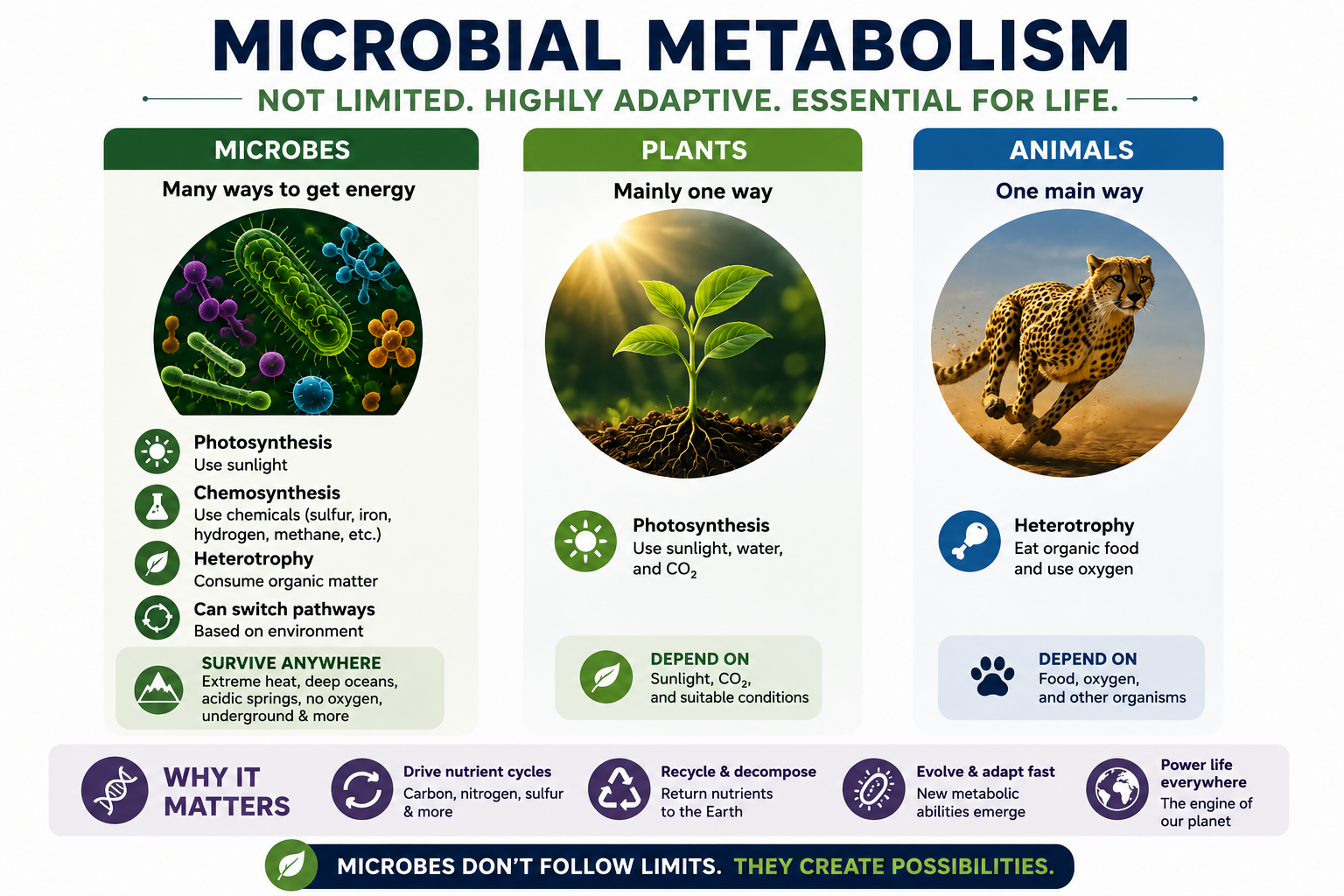
Microbial metabolism is vastly more diverse than the metabolism of plants and animals. While most plants depend primarily on sunlight and most animals rely on consuming organic food and oxygen-based respiration, microbes can obtain energy through an extraordinary range of chemical pathways.
Some microbes behave like plants and perform photosynthesis. Others behave more like animals by consuming organic matter. But many microbes use strategies that larger organisms simply cannot. Certain bacteria and archaea generate energy from sulfur, iron, hydrogen, ammonia, or methane through chemical processes known as chemosynthesis.
This metabolic flexibility allows microbes to survive in environments where plants and animals would quickly die, including:
-
deep-sea hydrothermal vents
-
acidic hot springs
-
oxygen-free sediments
-
underground rock systems
-
hypersaline lakes
Another major difference is adaptability. Many microbes can rapidly switch metabolic pathways depending on oxygen availability, temperature, nutrients, or environmental stress. Some can survive with oxygen, without oxygen, or alternate between both conditions.
Microbial metabolism also drives many of Earth’s major biogeochemical cycles. Processes such as nitrogen fixation, methane production, sulfur cycling, and decomposition are largely microbial functions and are essential for maintaining ecosystems.
Because microbes reproduce and evolve rapidly, entirely new metabolic capabilities can emerge over relatively short evolutionary timescales. This adaptability is one reason microbes remain the most chemically versatile life forms on Earth.
Microbes are the most metabolically versatile organisms on Earth because they can obtain energy through an enormous range of biological and chemical pathways.