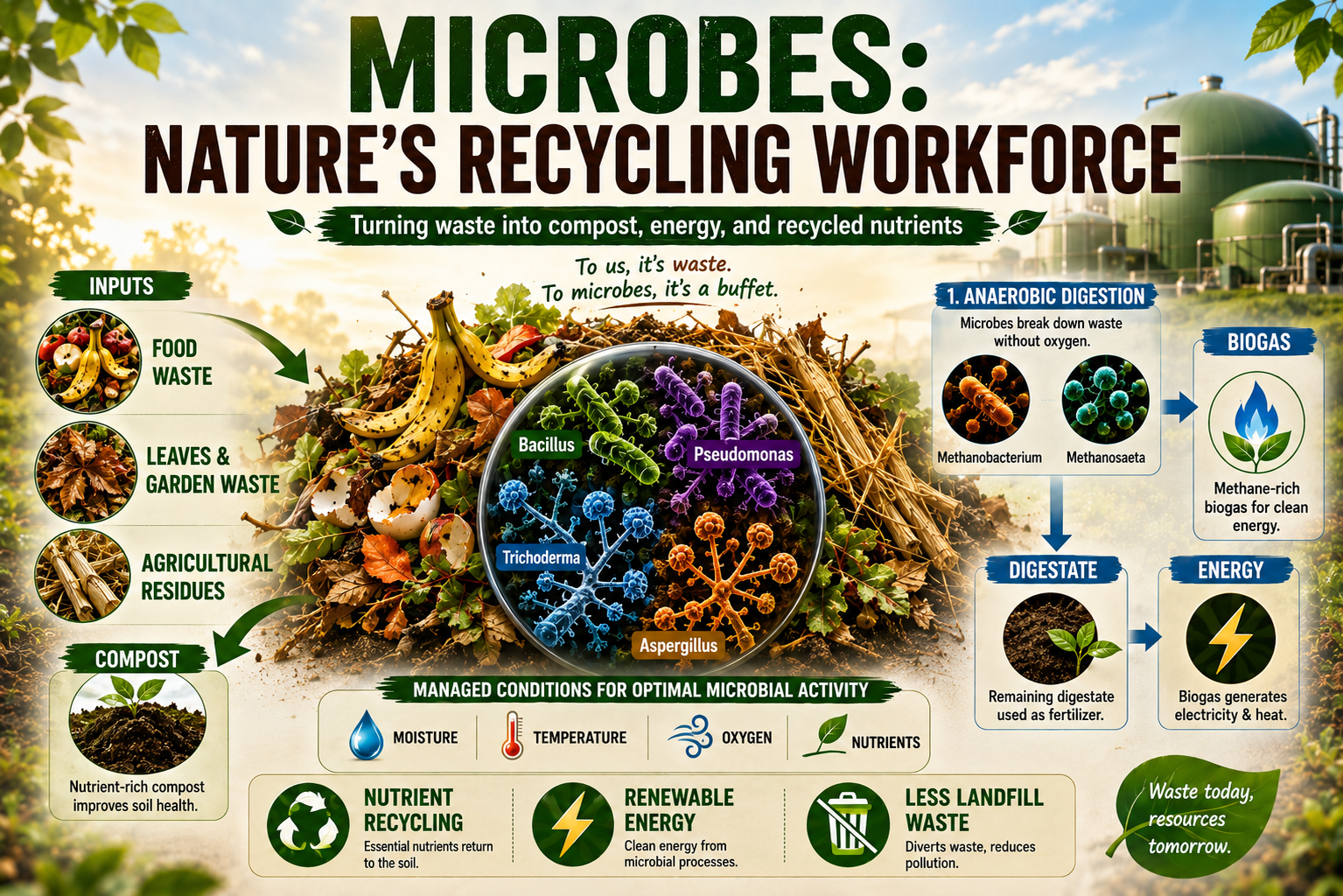
A banana peel, a pile of leaves, leftover food, and agricultural waste may look like garbage to us. To microbes, they are a buffet.
Much of the world's solid waste contains organic material that microbes can consume. Rather than allowing this waste to accumulate in landfills, waste management systems harness microbial communities to break it down in a controlled and environmentally friendly way.
One of the most common approaches is composting. Bacteria such as Bacillus and Pseudomonas, together with fungi such as Trichoderma and Aspergillus, decompose organic waste and convert it into nutrient-rich compost. What begins as discarded material can eventually become a valuable soil amendment.
Some waste is processed in large anaerobic digesters, sealed tanks where microbes work without oxygen. Diverse microbial communities first break down food waste, sewage sludge, and agricultural residues into simpler compounds. Methanogenic archaea such as Methanobacterium and Methanosaeta then convert these products into methane-rich biogas.
The biogas produced during anaerobic digestion can be used to generate electricity and heat. This process not only reduces waste volumes but also creates a renewable source of energy. The remaining digestate can often be used as a fertilizer.
In modern facilities, microbial activity is carefully managed by controlling factors such as moisture, temperature, oxygen, and nutrient availability. The goal is to create ideal conditions for efficient decomposition. Proper treatment can also help reduce odors and some disease-causing organisms.
Solid waste management is therefore not simply about disposing of garbage. It is increasingly about converting waste into useful resources. Through microbial activity, discarded organic matter can become compost, renewable energy, and recycled nutrients.
In many waste treatment facilities, the most important workers are invisible. Trillions of microbes quietly transform what society throws away into products that can be used again. Their activities help support more sustainable and circular waste management systems.
The world's oldest and most successful waste-management system is microbial decomposition.