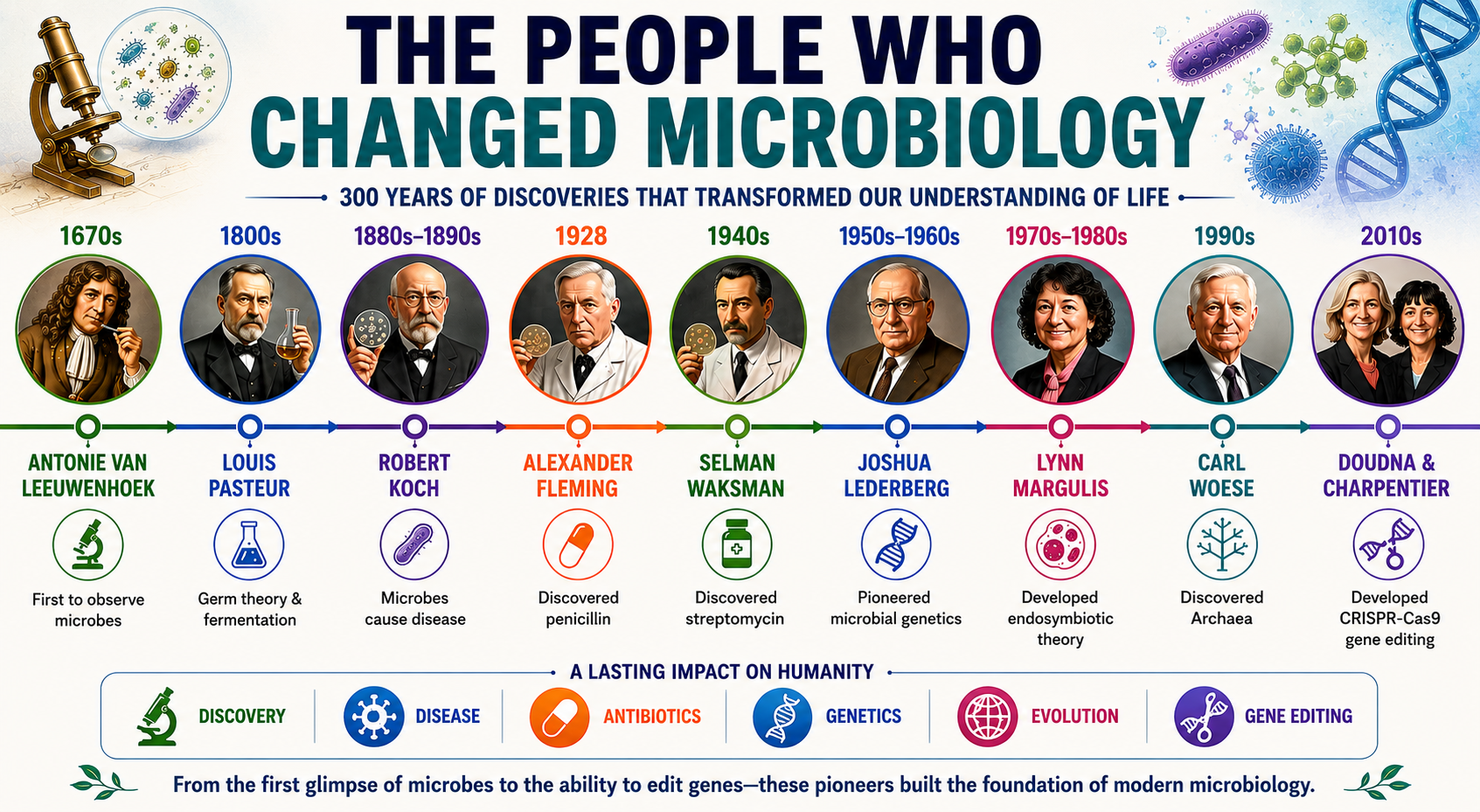
The history of microbiology has been shaped by a handful of individuals whose discoveries transformed how humanity understands life, disease, evolution, and the microbial world. Their contributions laid the foundations for modern medicine, biotechnology, and microbial science.
Antonie van Leeuwenhoek is often considered the father of microbiology. Using handcrafted microscopes in the 1670s, he became the first person to observe and describe bacteria and other microorganisms.
Louis Pasteur demonstrated that microbes cause fermentation and spoilage, disproved spontaneous generation, and helped establish the foundations of modern microbiology and vaccination.
Robert Koch provided definitive evidence that specific microbes cause specific diseases. His work on tuberculosis, anthrax, and cholera helped establish the field of medical microbiology.
Alexander Fleming changed medicine through the discovery of penicillin, ushering in the antibiotic era and transforming the treatment of bacterial infections.
Selman Waksman expanded the antibiotic revolution by discovering streptomycin and several other antimicrobial compounds. His work helped establish antibiotic discovery as a major scientific field.
Joshua Lederberg pioneered microbial genetics by discovering bacterial genetic recombination and horizontal gene transfer, revealing that microbes can exchange genetic information.
Lynn Margulis revolutionized evolutionary biology through the endosymbiotic theory, showing how complex cells evolved through ancient microbial partnerships.
Carl Woese transformed biology by discovering the domain Archaea and fundamentally reshaping the modern tree of life.
Jennifer Doudna and Emmanuelle Charpentier helped develop CRISPR-Cas9 gene editing, turning a bacterial immune system into one of the most powerful technologies in modern biology.
Together, these scientists changed how humanity views the living world. Their discoveries connect a continuous story that stretches from the first observation of microbes under a microscope to the ability to edit genes, explore entire microbial ecosystems, and understand the evolutionary history of life itself.
What began with a simple microscope eventually gave humanity the power to fight infections, understand evolution, and edit the genetic code of life .